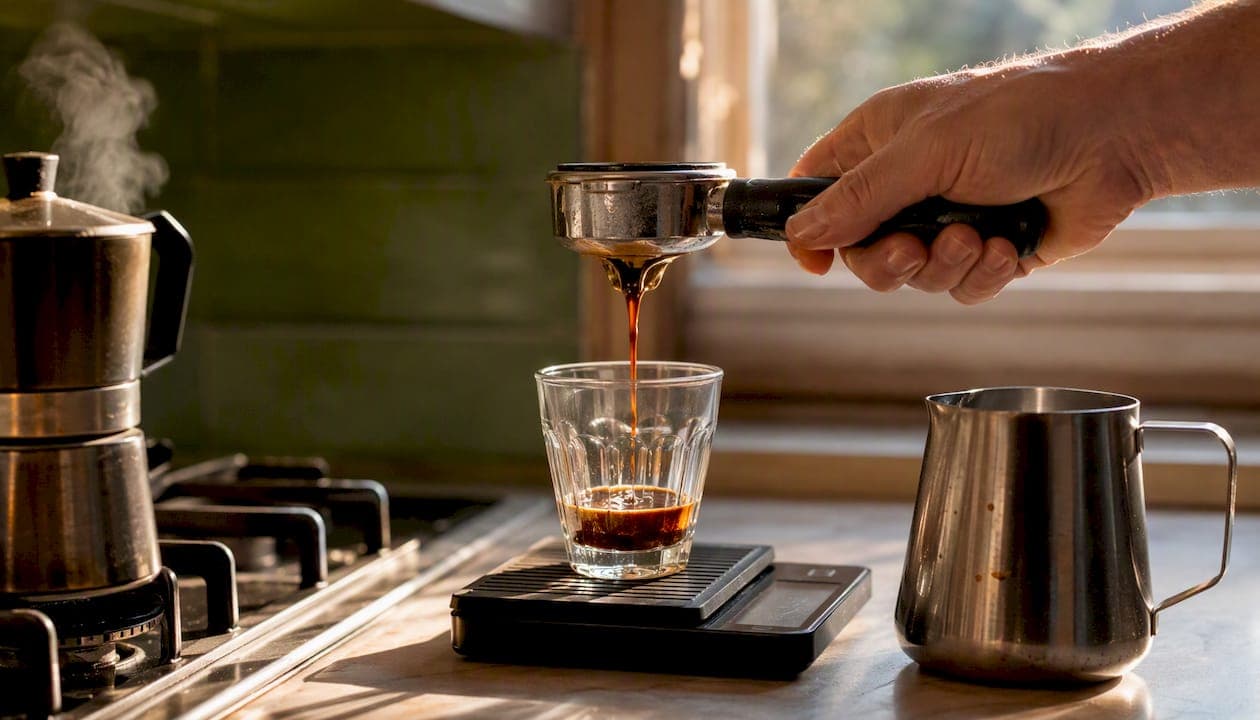
A moka pot makes strong, concentrated coffee, but it is not espresso. The distinction matters more than most home brewers realize. True espresso is extracted at high pressure around 9 bar; a standard moka pot operates at much lower pressure. That pressure gap produces measurably different coffee in terms of dissolved solids, crema, body, and flavor clarity. For most home enthusiasts, the moka pot is the smarter starting point. For those who want café-quality milk drinks or precise shot control, an espresso machine earns its place.
Quick picks:
- Choose a moka pot if you want strong black coffee, have limited counter space, or are working with a modest budget. The Bialetti Moka Pot, introduced by Alfonso Bialetti in 1933, remains the archetype of this category.
- Choose an espresso machine if milk-based drinks (lattes, cappuccinos) are central to your routine or if you want to replicate café-standard shots at home.
- Own both if you want a quick weekday brew and a more deliberate weekend ritual.
Lyons Den Publishers covers the full technical and sensory picture of both methods in The Complete World of Coffee.
Table of Contents
- How moka pot vs espresso extraction actually differs
- What moka coffee and espresso actually taste like
- Which brew works better for milk drinks and daily routines
- How to brew moka pot coffee that gets closer to espresso
- Which should you choose: moka pot or espresso machine?
- Key Takeaways
- When a moka pot is enough, and when it is not
- Deepen your knowledge with Lyons Den Publishers
How moka pot vs espresso extraction actually differs
The core difference is pressure, and pressure shapes everything downstream.
Espresso machines use a pump to force hot water through a tightly tamped puck of finely ground coffee at around 9 bar. That force drives a rapid, high-yield extraction in 25–30 seconds, pulling a dense concentration of dissolved solids, oils, and emulsified compounds. Measured data confirms that espresso typically reaches a total dissolved solids (TDS) level of roughly 9–10%, compared with approximately 3–4% TDS for moka pot coffee.
A moka pot works differently. Steam pressure builds in the sealed lower chamber, pushing water upward through a basket of ground coffee and into the upper chamber. Pressure monitoring studies show that a well-managed moka pot holds between 0.75 and 1.0 bar during extraction, with spikes up to 1.5–2 bar if heat is left unchecked. The flow is upward, slower, and less forceful than espresso's downward pump-driven stream.
Temperature exposure time also diverges sharply. Espresso completes extraction in under 30 seconds. A stovetop moka cycle takes several minutes, during which water contacts the grounds at varying temperatures. That longer contact time extracts different solubles, which is why moka coffee tastes roastier and less sweet than a well-dialed espresso shot.
Concentration comparison: Espresso's TDS of 9–10% is roughly two to three times higher than the 3–4% TDS typical of moka pot coffee, even though both taste "strong" relative to drip coffee.
Grind size reinforces these differences. Espresso demands a fine, uniform grind and a tamped, level puck to create resistance for the pump. Moka brewing calls for a medium-fine to medium grind loaded loosely into the basket. Packing a moka basket tightly mimics the espresso puck but actually restricts upward flow, raises pressure unpredictably, and produces bitter, over-extracted coffee.
| Parameter | Espresso | Moka Pot |
|---|---|---|
| Pressure | ~9 bar | 0.75–2 bar |
| TDS (dissolved solids) | ~9–10% | ~3–4% |
| Brew time | 25–30 seconds | 4–6 minutes |
| Grind size | Fine, tamped | Medium-fine, loose |
| Flow direction | Downward (pump-driven) | Upward (steam-driven) |
Understanding coffee extraction at this level helps explain why small technique changes in moka brewing produce large flavor shifts.
What moka coffee and espresso actually taste like
Espresso produces a syrupy, full-bodied shot topped with crema, the reddish-brown emulsified foam that forms when pressurized water forces oils and CO₂ out of the grounds. Crema is a direct product of high pressure; a standard moka pot cannot replicate it. Some moka pots with modified pressure valves (such as Bialetti's Brikka model) produce a light foam, but it differs in texture and stability from true espresso crema.
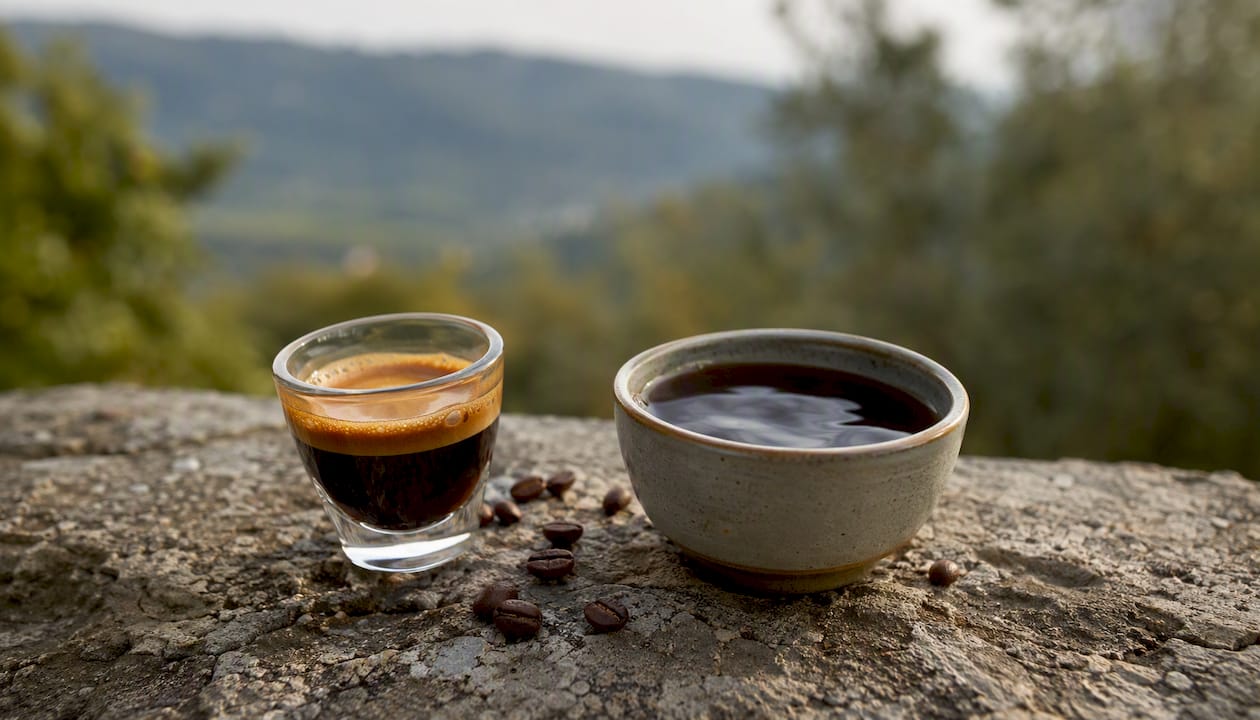
Moka coffee has a robust, full-flavored character that reads as strong, but its body is thinner than espresso. The longer extraction at lower pressure pulls more bitter compounds, which is why moka coffee tends toward dark-roast, chocolatey, and slightly bitter flavor notes. Espresso, when properly extracted, delivers concentrated sweetness alongside bitterness, with more perceptible acidity and flavor clarity.
| Sensory marker | Espresso | Moka pot |
|---|---|---|
| Crema | Present, stable | Absent or minimal |
| Body | Syrupy, dense | Full but thinner |
| Perceived intensity | Very high | High |
| Sweetness balance | Pronounced when dialed in | Lower, roastier |
| Typical flavor notes | Caramel, fruit, chocolate | Chocolate, roast, bitter |
Perceived strength is worth separating from measured concentration. Moka coffee tastes strong relative to drip or pour-over, but its TDS sits well below espresso. A home brewer switching from moka to espresso often finds the espresso simultaneously more intense and more nuanced.
Which brew works better for milk drinks and daily routines
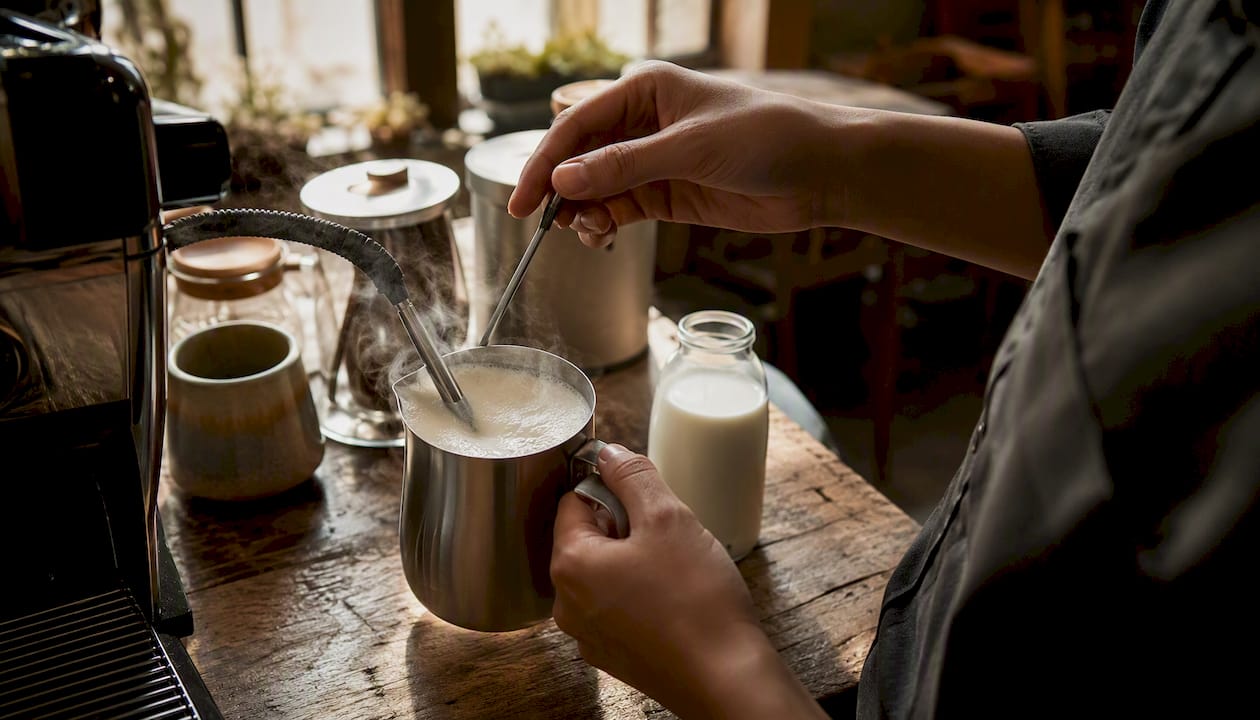
For milk-based drinks, espresso machines hold a clear functional advantage. A steam wand heats and textures milk to produce microfoam, the fine-bubbled, glossy milk that defines a latte or cappuccino. Without microfoam, a milk drink is simply coffee with warm milk. Moka pot coffee lacks the crema and body to integrate well with steamed milk, and no amount of technique compensates for the absence of a steam wand.
For black coffee, Americano-style drinks, or concentrated shots drunk straight, the moka pot performs admirably. It brews quickly once the water is hot, requires no electricity beyond a stovetop burner, and produces a cup that satisfies the same morning ritual as espresso for a fraction of the equipment cost. Travelers and campers favor the moka pot for exactly this portability.
Cleanup also differs in daily practice. A moka pot disassembles into three parts, rinses in seconds, and requires no descaling or group-head maintenance. An espresso machine demands regular portafilter cleaning, group-head backflushing, and periodic descaling.
Pro Tip: If you own a moka pot and want milk drinks, a handheld milk frother (such as the Aerolatte or a simple battery-powered wand) heats and froths milk to a passable texture. Heat the milk to around 140–150°F before frothing for the best result. It will not replicate microfoam, but it produces a pleasant, creamy drink.
How to brew moka pot coffee that gets closer to espresso
Technique separates a bitter, metallic moka cup from a clean, concentrated one. Bialetti's own guidance recommends filling the lower chamber to just below the safety valve, using a medium-fine grind, and keeping heat moderate throughout.
Recipe card (3-cup moka pot):
- Coffee dose: 15–17 g, medium-fine grind
- Water: fill lower chamber to just below the valve (~90 ml)
- Coffee-to-water ratio: approximately 1:6 by mass
- Heat: low to medium-low throughout
Numbered steps:
- Grind coffee to medium-fine. It should feel like coarse sand, not espresso powder.
- Fill the lower chamber with water to just below the safety valve. Using preheated water shortens brew time and reduces heat exposure on the grounds.
- Add ground coffee to the basket. Level it gently with a finger; do not tamp or compress.
- Assemble the pot firmly and place on low to medium-low heat.
- Keep the lid open and watch for the first light, steady stream of coffee rising into the upper chamber.
- At the first sign of sputtering or a change in color from dark to pale, remove the pot from heat immediately.
- Run the base under cold water for a few seconds to stop extraction, then swirl and pour.
Heat management is the single most important variable in moka brewing. Low, steady heat maintains pressure in the 0.75–1.0 bar range where extraction is even and clean. High heat spikes pressure, accelerates the brew, and pushes bitter compounds into the cup.
Tasting adjustments:
- Bitter or harsh: use a coarser grind or lower the heat further.
- Weak or thin: grind slightly finer or increase dose by 1–2 g.
- Metallic: check the rubber gasket for wear and consider filtered water.
Pro Tip: For a more espresso-like serving, brew a 3-cup moka pot into a small pitcher and serve in a 2 oz demitasse. The concentration is closer to a lungo than a true shot, but the ritual and flavor profile satisfy the same craving. Pair it with a guide to espresso-based drinks for creative serving ideas.
A Starbucks home-brewing guide and Serious Eats' moka pot review both reinforce the low-heat, no-tamp approach as the baseline for a clean cup.
Which should you choose: moka pot or espresso machine?
Pick a moka pot if:
- Budget is a priority and you want strong coffee without a large equipment investment.
- Black coffee, Americanos, or concentrated stovetop brews cover your daily needs.
- Counter space is limited or you brew while traveling.
- You want to develop a feel for extraction and coffee variables before committing to espresso equipment.
Pick an espresso machine if:
- Lattes, cappuccinos, or other milk-based drinks are a regular part of your routine.
- You want to replicate café-standard shots with crema, precise shot timing, and pressure control.
- You are prepared to invest in a quality burr grinder alongside the machine.
- Customization and repeatability matter more than simplicity.
Own both if:
- A quick, low-effort moka brew suits weekday mornings while a more deliberate espresso ritual fits weekends.
- You want to understand extraction differences firsthand before deciding where to invest further.
Moka pot vs espresso machine comparisons consistently show that neither option is universally superior; the right choice depends on how you actually drink coffee every day.
Key Takeaways
A moka pot produces espresso-like coffee at 1–2 bar of pressure, roughly one-ninth the force of a true espresso machine, which produces measurably different concentration, body, and crema.
| Point | Details |
|---|---|
| Pressure gap is fundamental | Espresso runs at ~9 bar; moka pots operate at 0.75–2 bar, making them espresso-like but not technically espresso. |
| Concentration differs measurably | Espresso TDS runs 9–10%; moka coffee sits at 3–4% TDS, closer to strong drip than true espresso. |
| Milk drinks favor espresso machines | Steam wands produce microfoam that moka pots cannot replicate; espresso is the better base for lattes and cappuccinos. |
| Heat control defines moka quality | Low, steady heat and removing the pot at the first light stream produces a cleaner, less bitter cup. |
| Lyons Den Publishers | The Complete World of Coffee covers espresso science, grinder selection, and sensory training for home brewers who want to go deeper. |
When a moka pot is enough, and when it is not
The moka pot is one of the most misunderstood brewers in home coffee. It is routinely dismissed as a poor substitute for espresso and just as routinely overpraised as an equivalent. Neither view is accurate.
What the moka pot does well is produce a concentrated, flavorful cup with minimal equipment and almost no learning curve beyond heat management. For a home brewer who drinks black coffee in the morning and wants something stronger than a pour-over, it is genuinely sufficient. The ritual of a stovetop brew, the sound of coffee rising into the upper chamber, and the smell of a well-managed extraction are pleasures in their own right, not consolation prizes for not owning an espresso machine.
Where it falls short is specific and predictable: crema, milk integration, and shot-to-shot precision. A home brewer who wants to make a proper flat white or pull a 9-bar shot with a 25-second extraction window will find the moka pot's limits quickly. That is not a flaw in the device; it is a design boundary.
The more useful question is not which brewer is better in the abstract, but which one fits the way you actually drink coffee. Mastering the moka pot first, understanding its extraction variables, and developing a palate for concentrated coffee is a sound foundation before investing $400 or more in espresso equipment. The moka pot teaches patience, heat sensitivity, and grind awareness, all of which transfer directly to espresso when the time comes.
Deepen your knowledge with Lyons Den Publishers
Lyons Den Publishers offers home brewers a direct path from curiosity to genuine expertise. The Complete World of Coffee by Keith Lyons covers espresso science, grinder selection, sensory evaluation, and the full spectrum of brewing methods in a single authoritative reference. For readers who want to go further, the coffee science topics hub provides in-depth, evidence-based articles on extraction, roasting, and technique. Those interested in the history behind the moka pot and the café culture it shaped will find detailed context in the coffee history collection. To explore virtual brewing sessions or book a personalized education session, visit keithlyons.org and take the next step toward a more informed cup.