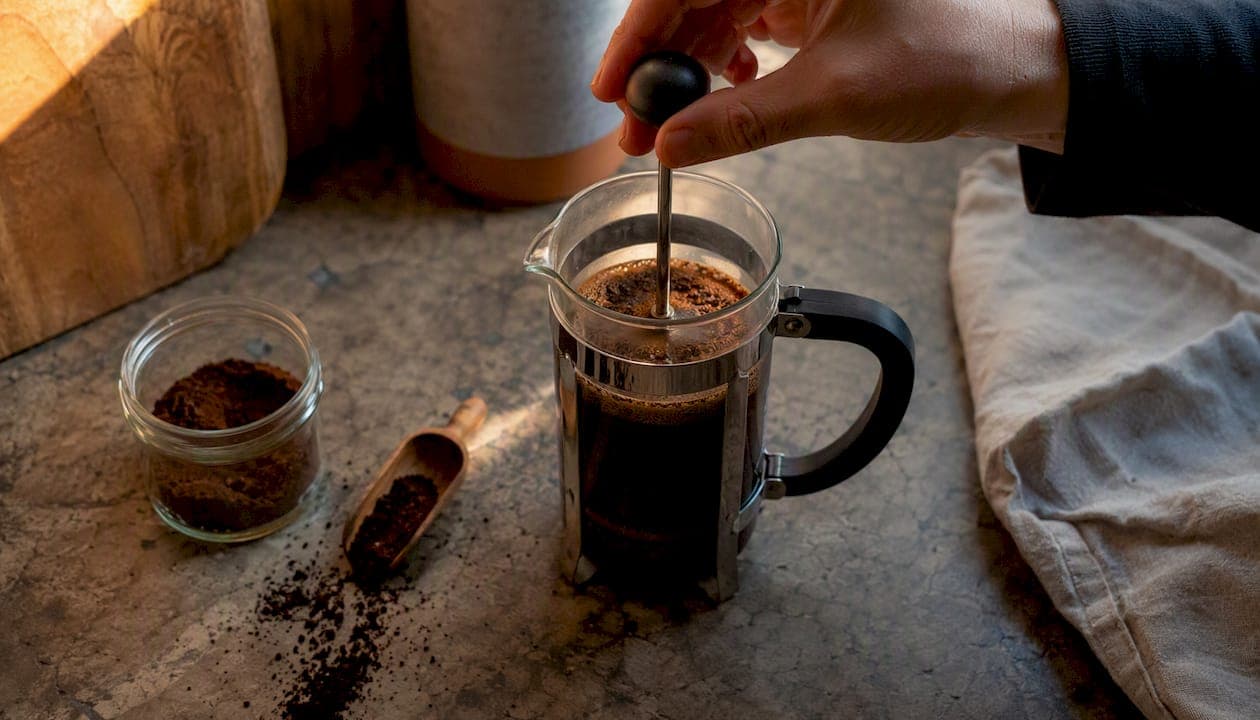
French press sediment is primarily composed of fines — tiny, insoluble coffee particles that slip through the metal mesh filter during brewing. The single highest-impact fix for most home brewers is a coarser, more uniform grind combined with a slow plunge and stopping the pour before the last cloudy ounce. Excessive sediment almost always signals a grind or technique problem, not a flaw in the French press itself.
Before reading further, try these six changes on your next brew:
- Grind coarser. Target particles that look like chunky kosher salt or coarse sea salt — not powder, not sand.
- Switch to a burr grinder. Blade grinders shatter beans unevenly, generating far more fines than a burr mill.
- Plunge slowly. Plunge slowly over a period of several seconds. Fast plunging forces fines past the mesh.
- Let grounds settle. After plunging, wait 30–60 seconds before pouring so particles sink.
- Stop early. Leave the bottom 1–2 cm in the carafe. That layer is concentrated sediment.
- Add a paper filter. For a noticeably cleaner cup, place an ESPRO paper filter inside the carafe before brewing.
Pro Tip: Stopping the pour before the last slurp is the single easiest change you can make today. That bottom layer holds a disproportionate amount of grit, and leaving it behind costs you almost nothing in volume.
Key Takeaways
Reducing French press sediment comes down to three controllable variables: grind uniformity, plunge technique, and pour discipline, with paper filtration as an optional fourth lever for maximum clarity.
| Point | Details |
|---|---|
| Grind coarser and more uniformly | Target chunky kosher-salt-size particles; a burr grinder is the most effective single equipment change. |
| Plunge slowly and let grounds settle | Take 15–30 seconds on the downstroke; wait 30–60 seconds after plunging before pouring. |
| Stop the pour early | Leave the bottom 1–2 cm in the carafe; that layer holds concentrated fines. |
| Use paper filters for maximum clarity | ESPRO-style paper inserts reduce sediment and oils significantly, but also reduce body. |
| Lyons Den Publishers | The French press hub and coffee science resources at keithlyons.org provide deeper technique and science guidance. |
Table of Contents
- What is French press sediment and why does it form?
- How to grind for less sediment: size, grinders, and sifting
- Brew steps that reduce sediment in practice
- Filters and hardware upgrades that make a real difference
- How to inspect and maintain your French press
- Why grind distribution and burr quality change sediment outcomes
- Quick symptom-to-fix cheat sheet for persistent sediment
- A practical philosophy on sediment and when to accept it
- The Complete World of Coffee goes deeper on brewing science
- Sources
What is French press sediment and why does it form?
The word "sediment" covers two distinct things in a French press cup. The first is fines — physically insoluble coffee particles small enough to pass through the metal mesh. The second is dissolved residue, meaning soluble compounds (oils, proteins, melanoidins) that remain suspended in the liquid. Most of what bothers drinkers is the first category: gritty particles that settle at the bottom of the cup.
A standard French press mesh filter operates at roughly 100–200 microns. Coffee fines produced during grinding can be far smaller than that, which is why no metal mesh eliminates sediment entirely. Some residue in the cup is normal and expected with immersion brewing. The question is how much.
Fines are an unavoidable byproduct of grinding. Every grinder produces them. The goal is not zero fines but fewer fines — and keeping the ones that exist out of your cup through technique and, when needed, filtration.
Several upstream factors increase fines beyond the baseline:
- Fine grind settings. The finer the grind, the higher the proportion of sub-100-micron particles produced.
- Blade grinders. These shatter beans at random rather than cutting them, producing a wide, uneven particle distribution with a large fine fraction.
- Worn burrs. Dull burr edges tear rather than slice, generating more fines per gram of coffee ground.
- Aggressive agitation. Stirring vigorously or plunging fast creates turbulence that suspends settled fines and drives them through the mesh.
- Pouring every last drop. The final portion of liquid in the carafe carries the highest concentration of settled particles.
Each of these causes has a direct fix covered in the sections below.
How to grind for less sediment: size, grinders, and sifting
The visual target
The correct grind for French press looks like chunky kosher salt or coarse breadcrumbs — irregular but clearly chunky, with no visible powder coating the particles. If you rub a pinch between your fingers and it feels sandy or silky, it is too fine. A coarser, uniform grind reduces the number of fines that slip through the mesh, and the visual check is the fastest way to calibrate without a sieve.
Why burr grinders outperform blade grinders
A burr grinder cuts coffee between two abrasive surfaces set at a fixed distance apart. The result is a relatively narrow particle-size distribution. A blade grinder spins a blade through the beans, producing everything from powder to large chunks in the same batch. That powder fraction is almost entirely sub-mesh fines. For French press, the difference in cup clarity between a burr grinder and a blade grinder is immediate and significant.
Evaluating your current grind in three steps
- Catch-and-inspect test. Grind a small dose onto a white sheet of paper. Look for visible powder coating the larger particles. Any fine dust indicates the grind is too fine or the grinder is producing excessive fines.
- Settling test. Place a small pinch of ground coffee in a clear glass of cold water. Swirl gently and watch. Coarse particles sink within seconds. Fines cloud the water and take minutes to settle. A lot of cloudiness means a lot of fines.
- Cup comparison. Brew two identical batches back-to-back, shifting the grind one step coarser for the second. Compare the sediment at the bottom of each cup after drinking. The coarser batch will show less.
Grind settings and when to adjust
Most home burr grinders label settings from fine to coarse on a numbered or stepped dial. For French press, start at the coarser end of the medium-coarse range and adjust based on the visual check above. If the cup tastes sour or thin, grind slightly finer and extend the steep by 30 seconds rather than grinding fine enough to increase sediment. The goal is extraction balance, not the finest grind that still fits the brewer.
Optional sifting
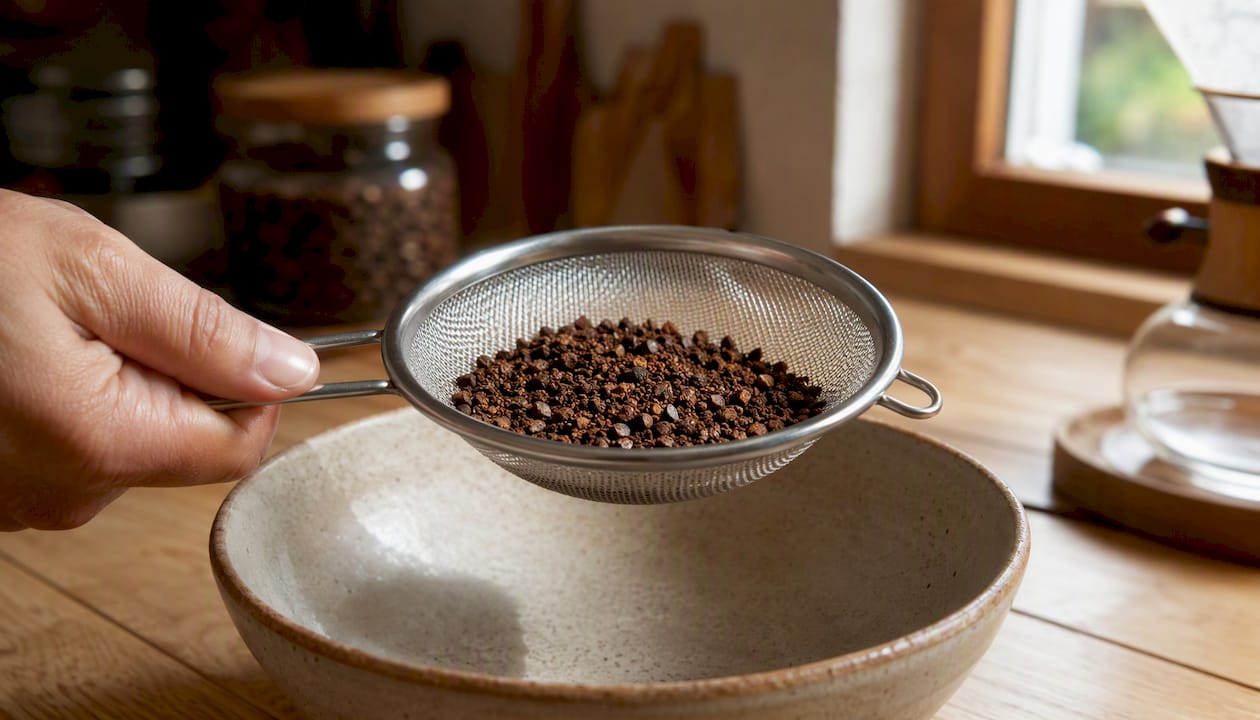
A fine kitchen sieve (around 300–400 microns) placed over the grinder catch cup can remove a meaningful portion of fines before they enter the brew. The trade-off is a slightly lighter body, since some of the flavor compounds bound to fines are removed. Sifting works well for brewers who want maximum clarity without switching to paper filters.
Pro Tip: Clean your burrs every 200–300 grams of coffee ground. Residual oils coat the burr surfaces and cause clumping, which increases fines. A stiff brush takes 60 seconds and noticeably improves grind consistency over time.
Brew steps that reduce sediment in practice
A clean French press cup starts with a sound recipe. The Kitchn's established method uses a coarse grind, a staged pour, and a four-minute steep as a reliable baseline. Here is a repeatable recipe built around minimizing sediment:
Recipe baseline: 1:15 ratio (1 gram coffee per 15 grams water), water at 200°F (just off the boil), 4-minute total steep.
Step-by-step method
- Pre-heat the carafe. Rinse with hot water and discard. A cold carafe drops water temperature quickly, which affects extraction and encourages uneven particle behavior.
- Add coarsely ground coffee. Use the kosher-salt visual standard. Dose by weight if possible.
- Bloom pour. Add twice the coffee weight in water (e.g., 30g water for 15g coffee). Wait 30 seconds. This releases CO₂ and promotes even saturation, which reduces channeling and uneven extraction.
- Top up slowly. Pour the remaining water in a steady, low-turbulence stream. Avoid splashing, which suspends fines.
- Place the lid, plunger up. Do not plunge yet. Steep for 3.5 minutes from the top-up pour.
- Break the crust gently. At 3.5 minutes, use a spoon to skim or stir the floating crust once. This allows grounds to begin settling before the plunge.
- Wait 30 seconds. Let grounds sink toward the bottom of the carafe.
- Plunge slowly. Take a full 15–30 seconds. A slow, steady plunge reduces turbulence and the mechanical forcing of fines past the mesh. If you feel strong resistance, stop — do not force it.
- Decant immediately. Pour into a separate vessel or cups right away. Coffee left sitting on grounds continues to extract and accumulates more sediment as particles resettle.
- Stop before the last pour. Leave the bottom 1–2 cm in the carafe. That layer is concentrated fines.
Common mistakes and quick fixes
- Stirring aggressively after adding water. This suspends fines throughout the liquid. Stir once, gently, or skip it entirely.
- Plunging in under five seconds. Forces fines through the mesh. Slow down.
- Leaving coffee in the press after plunging. Grounds continue to release particles into the liquid. Decant promptly.
- Serving every last drop. The final ounce is almost entirely sediment. Stop early.
Pro Tip: Letting grounds settle after breaking the crust, plunging slowly, and stopping the pour early can produce a substantially cleaner cup without changing any equipment. Test this combination before buying anything new.
Filters and hardware upgrades that make a real difference
When grind and technique improvements are not enough, or when you want filter-level clarity while keeping immersion extraction, purpose-made filtration accessories offer a practical next step.
ESPRO paper filters
ESPRO paper filters are designed specifically for French press carafes. Placed inside the carafe before brewing, they intercept fines and oils that pass through the metal mesh, producing what ESPRO describes as an ultra-clean, oil-free cup. The trade-off is real: paper absorbs coffee oils, which reduces body and mouthfeel compared to unfiltered French press. For drinkers who prioritize clarity over richness, this is a worthwhile exchange.
Double-mesh and finer mesh upgrades
Some French press models include a double-layer mesh plunger, and aftermarket finer-mesh replacements are available for common carafe sizes. These reduce sediment compared to a single standard mesh but do not approach paper-filter clarity. They preserve more body and oils than paper, making them a middle-ground option for brewers who want less grit without sacrificing the characteristic French press mouthfeel.
Pour-through strainers and sifting accessories
A fine-mesh pour-through strainer placed over the cup or decanting vessel catches micro-grounds that survive the plunger. Sifting grounds and using a second fine strainer when pouring are effective supplemental methods when grind or hardware changes are impractical. This approach adds a step but requires no new equipment beyond a small kitchen strainer.
Choosing the right filtration approach
- Paper filters (ESPRO-style): Best for drinkers who want the cleanest possible cup and do not mind losing some body. Ideal for occasional use or when serving guests who prefer a lighter brew.
- Double or finer mesh: Best for daily use when some sediment reduction is wanted without changing cup character significantly.
- Pour-through strainer: Best as a supplemental fix when other changes have not fully solved the problem, or when traveling with a basic press.
- Caffi-style filter bags: Similar to ESPRO paper inserts in effect; they markedly reduce sediment but also strip oils, changing body and mouthfeel. Worth considering for brewers who want a disposable, single-use option.
Pro Tip: When using a paper filter insert, wet it with hot water before adding coffee. This removes any papery taste and seats the filter against the carafe walls, preventing grounds from bypassing the edges.
How to inspect and maintain your French press
Equipment condition directly affects how much sediment reaches the cup. A worn or poorly assembled press can undermine even a perfect grind and technique.
Physical inspection checklist
- Mesh screen: Look for tears, holes, or warping. Hold the mesh up to light — any visible gaps larger than the weave pattern indicate damage.
- Spring or gasket: The rubber or silicone gasket around the mesh should sit flush and show no cracking or compression deformation. A loose gasket allows grounds to bypass the filter entirely.
- Plunger column screw: Check that the screw securing the mesh assembly to the rod is tight. A loose assembly wobbles during plunging and creates gaps at the carafe wall.
- Glass or carafe walls: Chips or cracks near the base can trap grounds and are difficult to clean thoroughly.
- Mesh-to-wall seal: When the plunger is fully depressed, the mesh should press evenly against the carafe walls with no visible gap around the perimeter.
Cleaning best practices
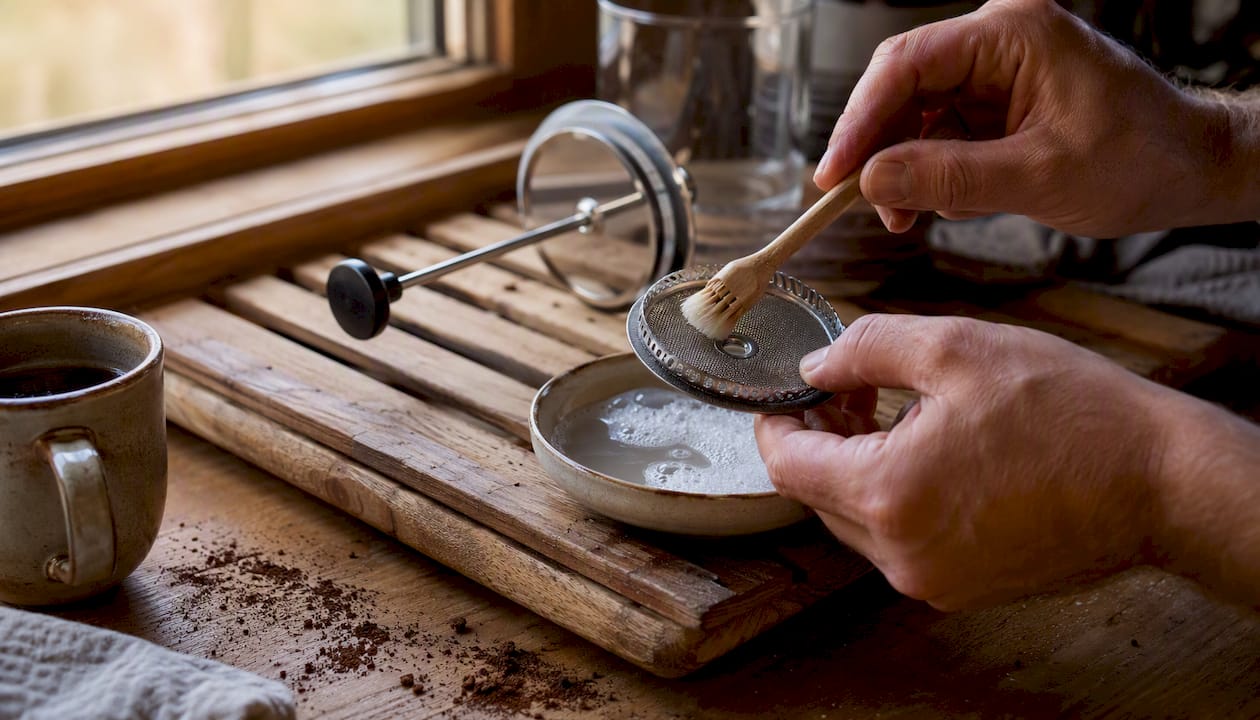
Disassemble the plunger completely after every use. Rinse each component under hot water, then use a soft brush to remove grounds from the mesh weave. Oil buildup on the mesh reduces filtration efficiency over time. A weekly soak in a solution of warm water and a small amount of unscented dish soap, followed by a thorough rinse, keeps the mesh performing as intended.
For scale and mineral buildup, a monthly soak in a diluted white vinegar solution (one part vinegar to three parts water) dissolves deposits without damaging metal or glass. Water chemistry plays a meaningful role here: hard water accelerates scale formation on mesh and glass surfaces.
White sediment: scale vs. coffee fines
White or off-white particles at the bottom of the cup are almost never coffee fines. They are mineral deposits from hard water, either dislodged from the carafe or mesh during brewing, or precipitated from the water itself during heating. Descaling the carafe and mesh with a vinegar soak resolves this. If white deposits persist after descaling, consider filtering your brew water.
| Symptom | Likely cause | Immediate action |
|---|---|---|
| Gritty texture throughout cup | Grind too fine or blade grinder | Grind coarser; switch to burr grinder |
| Muddy last sips only | Settled fines in final pour | Stop pouring 1–2 cm before empty |
| Cloudy cup overall | Agitation or fast plunge | Slow plunge; let settle before pouring |
| White particles | Mineral scale | Descale carafe and mesh with vinegar |
| Sediment despite coarse grind | Worn or torn mesh | Inspect and replace mesh assembly |
Why grind distribution and burr quality change sediment outcomes
To understand why grind quality matters so much, try a simple home test. Grind the same dose of coffee twice: once with a blade grinder and once with a burr grinder set to coarse. Place each sample in a separate clear glass of cold water, swirl gently, and observe. The blade-ground sample will cloud the water within seconds and remain murky for several minutes. The burr-ground sample will show far less cloudiness, with most particles sinking quickly. That visual difference translates directly into what ends up in your cup.
The reason lies in particle-size distribution. A burr grinder cuts coffee between two precisely spaced abrasive surfaces. The gap between the burrs determines the target particle size, and most particles land close to that target. A blade grinder has no fixed gap — it spins a blade through the beans until the user stops it, producing everything from whole fragments to dust in the same batch. That dust fraction is almost entirely sub-mesh fines.
Burr geometry matters beyond the grinder's price point. As burrs dull with use, their edges tear rather than slice, producing a wider particle distribution and more fines per gram. A well-maintained mid-range burr grinder will often outperform a neglected premium one.
Burr condition degrades gradually, which is why sediment can increase in a press even when nothing else has changed. Home brewers who notice their cup getting progressively grittier over months, without changing grind settings, are often experiencing burr wear. Cleaning the burrs removes oil and residue buildup; replacing them restores the original cutting geometry.
For home brewers, the practical implication is straightforward. A quality burr grinder, kept clean and set to a coarse enough setting, addresses the largest single preventable source of sediment. Technique changes (plunge speed, settle time, pour discipline) address the rest. Buying new filtration hardware before fixing the grind is working in the wrong order. The extraction science behind grind and steep interactions confirms that grind uniformity affects not just sediment but overall flavor balance.
Pro Tip: Run a small amount of coffee through your burr grinder and discard it before grinding your actual dose. This "purge" clears stale grounds and oils from the previous session and gives you a cleaner, more consistent grind from the first gram.
Quick symptom-to-fix cheat sheet for persistent sediment
If sediment persists after applying the grind and technique changes above, use this reference to identify the specific cause:
- Very gritty cup, throughout: Grind is too fine, or a blade grinder is in use. Shift to a coarser setting or switch to a burr grinder. Check mesh for tears.
- Muddy only at the end of the cup: Settled fines are being poured out with the last portion. Stop 1–2 cm before empty.
- Cloudy cup from the first sip: Agitation during brewing or a fast plunge is suspending fines. Reduce stirring, slow the plunge, and let the press sit for 30–60 seconds after plunging before pouring.
- White or chalky particles: Mineral scale, not coffee fines. Descale the carafe and mesh.
- Sediment despite correct grind and slow plunge: Mesh is worn, torn, or not seating properly against the carafe wall. Inspect and replace.
- Sediment even with a paper filter: The filter is not seated correctly, or grounds are bypassing the edges. Wet the filter before use and press it firmly against the carafe walls.
| Symptom | Likely cause | Immediate fix | Follow-up test |
|---|---|---|---|
| Gritty throughout | Grind too fine or blade grinder | Grind coarser; use burr grinder | Visual grind check (kosher-salt size) |
| Muddy last sips | Settled fines in final pour | Stop pouring 1–2 cm early | Leave bottom layer; compare cups |
| Cloudy overall | Fast plunge or excess agitation | Slow plunge to 15–30 seconds | Settling test in clear glass |
| White particles | Mineral scale | Descale with diluted vinegar | Check water hardness |
| Sediment with paper filter | Filter not seated | Wet filter; press to carafe wall | Inspect filter placement before brewing |
If zero sediment is a firm requirement, a French press is the wrong tool for the job. Pour-over methods using paper filters (V60, Chemex, Kalita Wave) produce a sediment-free cup by design. French press, even optimized, will always carry some fine particles. The techniques above reduce sediment to a level most drinkers find acceptable; they do not eliminate it entirely.
A practical philosophy on sediment and when to accept it
Sediment in a French press cup is not a defect to be corrected at all costs. It is a characteristic of immersion brewing with metal filtration, and it carries real value. The fines that create texture also carry flavor compounds, and the oils that paper filters remove are part of what gives French press coffee its distinctive richness and body. Chasing a perfectly clear cup from a French press often means sacrificing the very qualities that make the method worth using.
The practical approach is to decide what you actually want from the cup. For a rich, full-bodied brew with some texture, optimize grind and technique and stop there. For a cleaner cup that still retains immersion character, add a double mesh or a pour-through strainer. For filter-level clarity, use a paper insert and accept the lighter body that comes with it. None of these is wrong. They are different points on a spectrum, and the right choice depends on the coffee, the roast, and the drinker.
Where sediment becomes a genuine problem is when it is excessive: when the cup is gritty rather than textured, when the last third of the drink is unpleasant, or when the grind and technique are clearly out of calibration. Those situations have specific, testable fixes. The French press resource hub at Lyons Den Publishers covers the full range of technique, filter, and equipment variables for brewers who want to go deeper.
The Complete World of Coffee addresses the science behind immersion extraction, particle behavior, and filtration in detail for readers who want a thorough grounding in why these variables behave as they do.
The Complete World of Coffee goes deeper on brewing science
For home brewers who want to move beyond troubleshooting and understand the science behind what they are tasting, The Complete World of Coffee by Keith Lyons covers extraction chemistry, grind distribution, water chemistry, and brewing method comparisons in the depth that a single article cannot.

The coffee science hub at Lyons Den Publishers is the starting point for readers interested in extraction science, water chemistry, and temperature variables. The French press topic hub collects technique guides, filter comparisons, and equipment references in one place. Both are free resources built for home brewers who take their craft seriously.
The Complete World of Coffee is available in digital and physical editions through Lyons Den Publishers. If the science behind your morning cup interests you as much as the cup itself, it is worth exploring.
Sources
- French Press Sediment: Causes & Solutions for a Cleaner Cup - Coffee Informer
- French press: how to stop grit and sediment in your cup
- French Press Without the Sediment | Brew Ritual
- How to make French press coffee (Kitchn)