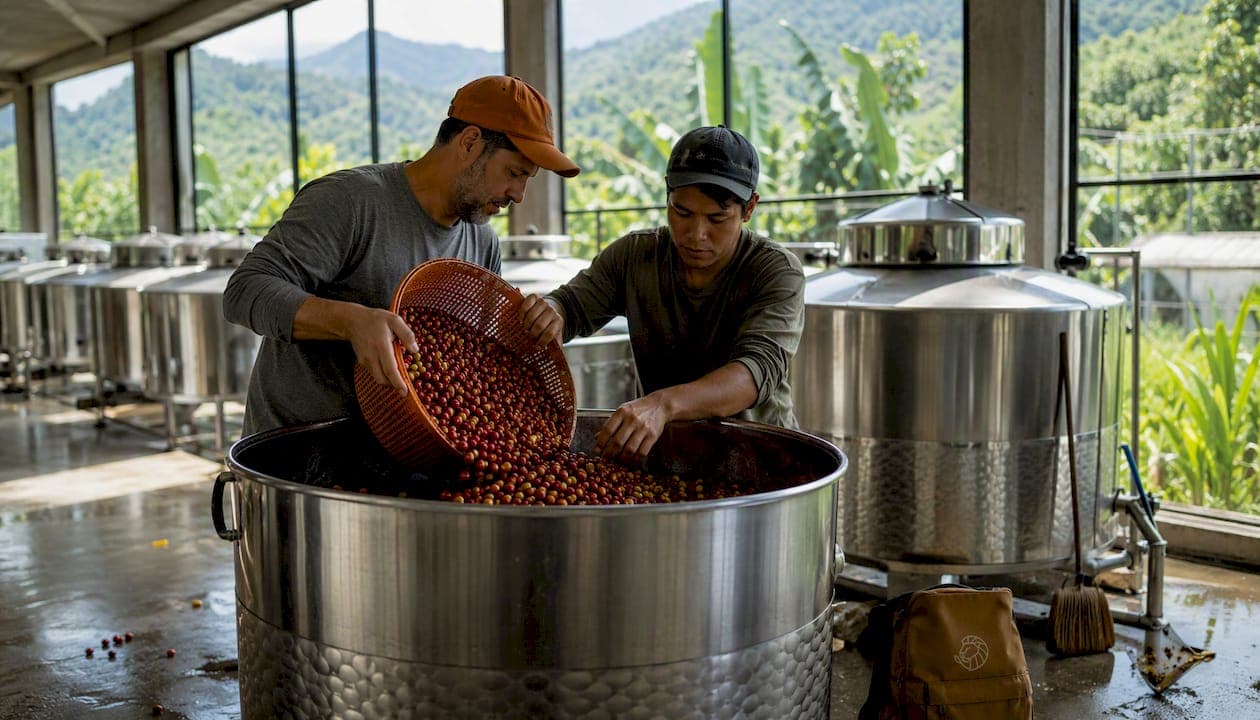
Carbonic maceration coffee is a fermentation technique borrowed directly from winemaking: whole, unpulped cherries are sealed inside a CO2-saturated, oxygen-free tank, triggering intracellular enzymatic reactions that produce intensely fruit-forward, wine-like cup profiles before any microbial fermentation begins. Popularized in specialty coffee by Saša Šestić during his 2015 World Barista Championship work, and widely documented by importers such as Cafe Imports, the method sits at the intersection of precision processing and deliberate flavor design.
Three things distinguish authentic carbonic maceration from other fermentation approaches:
- Whole cherries only (unpulped) loaded into a sealed vessel before CO2 injection
- Active CO2 pre-flush to displace oxygen immediately, suppressing early microbial activity so enzymatic reactions inside each cherry dominate the first phase
- Documented parameters: tank type, CO2 concentration, temperature, duration, and drying schedule should all appear in producer or importer records
When you see "CM" on a bag without supporting process documentation, treat the claim with skepticism.
Table of Contents
- What is carbonic maceration coffee, and where did it come from?
- How the carbonic maceration process works at origin
- How does carbonic maceration compare to anaerobic and natural processing?
- What does carbonic maceration coffee taste like?
- What are the main risks during carbonic maceration and drying?
- How is carbonic maceration labeled, and how do you verify it?
- How should you roast and brew carbonic maceration coffee?
- Common misconceptions about carbonic maceration and anaerobic terminology
- Key Takeaways
- Why carbonic maceration matters more than the hype suggests
- Deepen your understanding with Lyons Den Publishers
- Useful sources for further reading
What is carbonic maceration coffee, and where did it come from?
The term comes directly from winemaking, where it describes whole-grape fermentation inside CO2-filled vessels. In coffee, the adaptation is credited to Saša Šestić, the Australian barista and producer who shaped modern specialty coffee by applying the technique to coffee cherries and presenting the results at championship level. The specialty trade took notice quickly, and within a few years, producers across Colombia, Ethiopia, and Indonesia were experimenting with sealed-tank processing.
What makes carbonic maceration technically distinct from generic anaerobic fermentation is the deliberate pre-flush. True CM loads the tank with food-grade CO2 before the cherries go in, creating an oxygen-free environment from the first moment. That suppresses microbial activity early and allows intracellular enzymatic reactions inside each intact cherry to dominate the opening phase. Anaerobic fermentation, by contrast, may rely on passive CO2 generated by microbes over time, and it can be performed on pulped or whole-cherry lots. The distinction matters because the enzymatic phase is what produces CM's signature aromatic compounds: volatile esters, malic acid transformations, and fruit-derived precursors that no microbial process alone generates.
Cafe Imports has been one of the most widely cited educational references for the technique in the North American trade, publishing process documentation and origin photos that help roasters verify what they are buying. Carbonic maceration is anaerobic by definition, but not every anaerobic coffee is a carbonic maceration, and that distinction is the single most important thing to understand before reading any product label.
Pro Tip: When evaluating a CM lot, ask the importer for tank photos, CO2 injection records, and a drying timeline. A producer who cannot supply those details may be using the label loosely.
How the carbonic maceration process works at origin
The process unfolds in two distinct phases, and the producer's control over each one determines the cup.
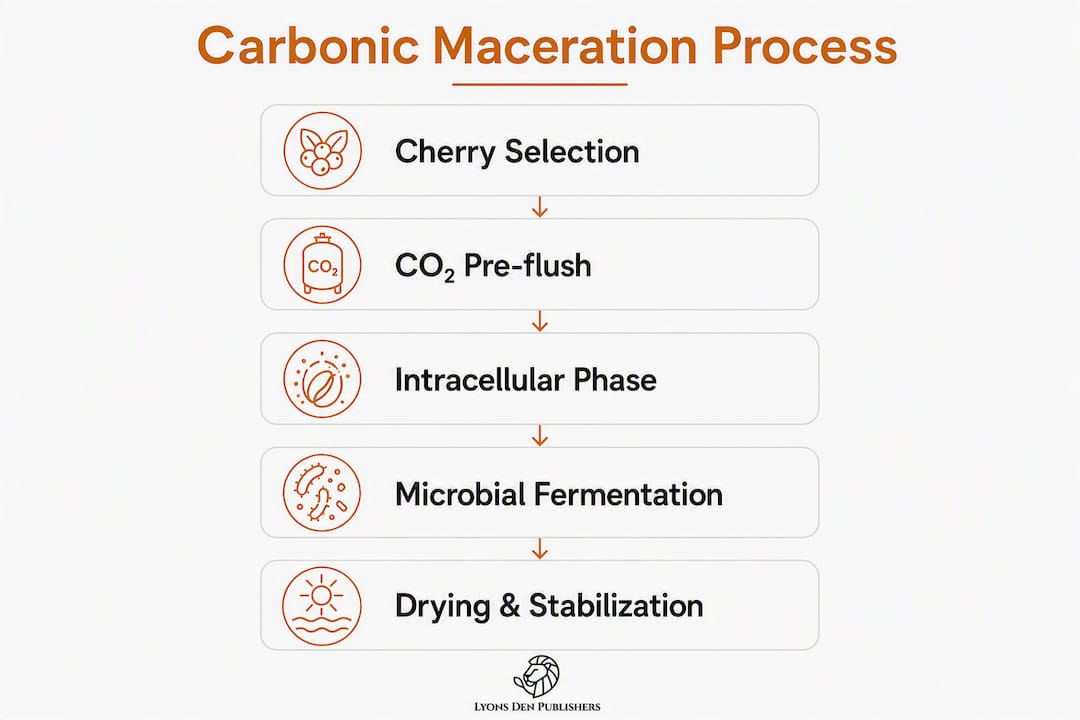
Cherry selection and tank loading
Only ripe, intact cherries qualify. Damaged or underripe fruit introduces inconsistency because broken cell walls allow microbial activity to begin before the intracellular phase is complete. Cherries are sorted by density (flotation tanks are common), cleaned, and loaded directly into the fermentation vessel without pulping.
CO2 pre-flush and intracellular phase
Once the tank is sealed, food-grade CO2 is injected to displace residual oxygen. Trade sources report very high CO2 concentrations during the pre-flush, with temperatures are typically held at cool to moderate levels depending on how quickly the producer wants the process to proceed and whether alcohol buildup is a concern. Lower temperatures slow enzymatic activity and tend to produce cleaner, more floral results; higher temperatures accelerate the process but increase the risk of off-notes.
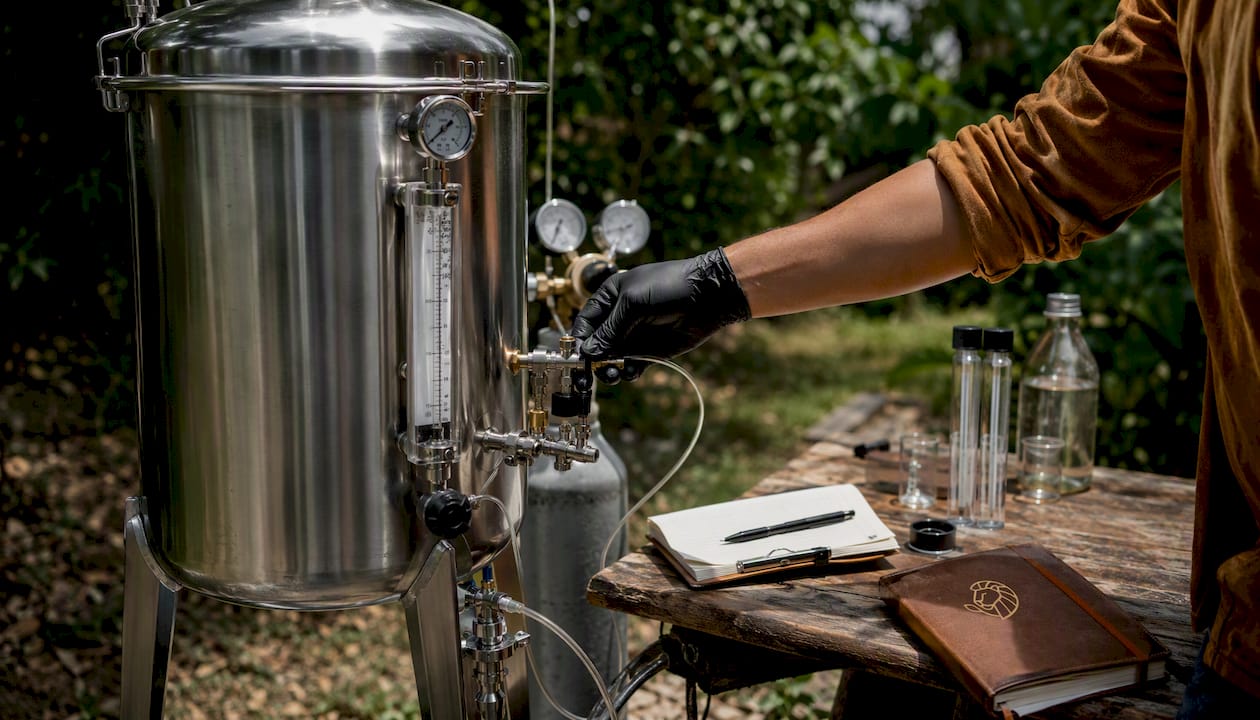
The intracellular phase typically runs for a controlled period of days. During this window, enzymes inside each intact cherry convert malic acid, produce aromatic esters, and generate the volatile precursors that become CM's characteristic fruit notes in the cup.
Microbial phase and tank removal
As cell walls eventually rupture, microbial fermentation begins. Producers who want a cleaner, more wine-like profile remove the cherries before significant microbial activity accumulates. Those seeking more complexity allow the microbial phase to extend, though this increases the risk of acetic or oxidative off-notes.
CM can also be applied to pulped or washed lots, where the cherry skin has been removed before sealing the tank. This "washed CM" variant produces a lighter, more transparent fruit character and requires tighter timing because the protective skin is absent.
Drying and stabilization
Post-fermentation drying is where many CM lots succeed or fail. Trade guidance recommends an extended period from the start of processing to export to ensure quality, covering both fermentation and drying. Rushed drying produces astringency and instability that carries through to the roast.
Key process parameters at a glance:
| Parameter | Typical Range | Notes |
|---|---|---|
| CO2 concentration | — | Pre-flush to displace oxygen fully |
| Temperature | 8–22°C | Lower = cleaner/floral; higher = faster/riskier |
| Intracellular phase | 48–96 hours | Enzymatic reactions; cell walls intact |
| Total processing to export | at least 45 days | Includes fermentation and drying |
| Stainless steel tank | — | Food-grade plastic used as budget alternative |
Pro Tip: Install a sampling valve on every tank so you can draw small volumes for aroma and pH checks without breaking the seal. A pH drop below 3.5 during the intracellular phase is an early warning sign of uncontrolled acidity.
How does carbonic maceration compare to anaerobic and natural processing?
The three methods share fermentation as a mechanism but differ in ways that produce measurably different cups.
| Dimension | Carbonic maceration | Anaerobic fermentation | Natural process |
|---|---|---|---|
| Fruit state | Whole cherry, unpulped | Whole or pulped | Whole cherry, dried on skin |
| CO2 source | Injected (active pre-flush) | Passive microbial generation | Open-air or passive |
| Typical duration | few days intracellular + drying | Hours to several days | Weeks (drying-dominated) |
| Dominant flavor outcomes | Wine-like, stone fruit, floral, candy clarity | Funky, tropical, fermented, variable | Berry, dried fruit, heavy body, earthy |
| Primary QC risks | Contamination, alcohol buildup, rushed drying | Uncontrolled microbial activity | Uneven drying, mold, over-fermentation |
The clearest practical distinction: CM's enzymatic phase happens inside the intact cherry, driven by the cherry's own enzymes rather than external microbes. That is why a well-executed CM tends toward aromatic clarity rather than the heavy, fermented character that marks many anaerobic extremes. CM uses injected CO2; anaerobic fermentation may rely on passive microbial CO2 and can be done pulped or unpulped, which is why the two terms are not interchangeable even though CM is technically a subset of anaerobic processing.
Natural processing, by comparison, is slower and drying-dominated. The fruit sugars and microbes interact over weeks on raised beds, producing heavier body and dried-fruit sweetness rather than the wine-like acidity and floral lift that CM targets. For readers who want a deeper comparison of coffee processing methods, the full spectrum from washed to natural to experimental processes is covered in detail.
What does carbonic maceration coffee taste like?
The sensory profile of a well-executed CM lot is distinctive enough that experienced cuppers can often identify it blind. Common descriptors include:
- Stone fruit: peach, apricot, plum
- Red and tropical fruit: cherry, raspberry, passion fruit, lychee
- Floral and candy notes: jasmine, hibiscus, fruit punch, rose
- Wine-like acidity: bright, clean, malic rather than sharp citric
- Texture: silky, low astringency, medium-to-light body
The intensity of these characteristics depends on cherry maturity, fermentation duration, temperature, and post-CM processing. A natural CM (whole cherry dried on the skin after fermentation) amplifies fruit sweetness and body. A washed CM produces more transparency and acidity with less residual sweetness.
Aromas are trapped during CM because volatile precursors are generated inside intact cells; the beans absorb these compounds during the intracellular phase, which explains why CM often produces "cooked fruit" aromatics that are distinct from other processes. The chemistry behind these aromatic compounds involves ester formation and malic acid conversion that standard washed or natural processing does not replicate.
For cupping, use the SCA flavor wheel to map descriptors systematically. Evaluate the sample both immediately after breaking the crust and again after 10 minutes of cooling, when fruit clarity and acidity become more legible.
Pro Tip: A well-executed CM shows layered aromatics that evolve as the cup cools. If the fruit notes are flat from the first sip and do not develop, or if you detect sharp acetic or nail-polish notes, the lot was likely over-fermented or poorly dried.
What are the main risks during carbonic maceration and drying?
CM's complexity is also its vulnerability. The same conditions that produce extraordinary aromatics can produce undrinkable coffee if any variable slips.
Primary risks:
- Contamination: residual oxygen, dirty tanks, or damaged cherries introduce unwanted microbes that compete with the intracellular enzymatic phase
- Alcohol buildup: elevated temperatures accelerate fermentation and can push ethanol levels high enough to produce solvent off-notes
- Uneven drying: moisture gradients across a drying bed cause some beans to stabilize while others continue fermenting, producing inconsistency in the roast
- Moisture fluctuation: rain or humidity spikes during drying reactivate microbial activity in partially dried lots
- Masking of origin character: excessive fermentation time can overwrite terroir-driven flavor with process-driven notes, reducing traceability
Specialty educators identify oxygen, moisture, heat, and light as the four primary threats to CM aromatics after fermentation ends. These enemies are most dangerous during the drying and storage phases, when the aromatic compounds generated during CM are still volatile and easily degraded.
Quality-control practices that matter most:
- Clean tanks with food-grade sanitizer before every batch; rinse thoroughly
- Monitor pH and temperature at regular intervals using sampling valves
- Target moisture content of 10–11% at the end of drying before bagging
- Use hermetic or vacuum-sealed bags for export to protect volatile aromatics
- Log every parameter: CO2 injection time, temperature readings, pH at removal, drying duration, and final moisture
Pro Tip: When receiving CM green coffee, check the bag seal integrity first, then open and assess aroma immediately. A flat or musty aroma on opening is a reliable indicator of compromised drying or packaging failure, regardless of what the process documentation says.
How is carbonic maceration labeled, and how do you verify it?
Label conventions for CM are not standardized across the industry, which creates real risk for buyers. Common abbreviations include CM (carbonic maceration), CMN (carbonic maceration natural), and CMW (carbonic maceration washed). Some producers use "CM selection" to indicate a specific lot processed under controlled CM conditions. None of these terms carry a legal or certification-backed definition, so documentation is the only verification tool available.
Questions to ask any supplier before purchasing a CM lot:
- Was CO2 actively injected, or did the tank become anaerobic passively?
- Were cherries whole and unpulped, or was the fruit pulped before sealing?
- What were the exact fermentation duration and temperature range?
- What was the drying method (raised beds, mechanical, patio), and how long did drying take?
- How was the green coffee packaged for export (hermetic bag, vacuum, GrainPro)?
Red flags that suggest loose labeling:
- No CO2 injection records or tank type specified
- Drying timeline absent or described only as "standard"
- No photos of the fermentation setup
- Duration described as "a few days" with no temperature data
CM lots can command premiums in specialty trade channels precisely because the infrastructure and labor requirements are real. A producer who cannot document those requirements likely did not incur them. Request origin photos, tank certification, and export packaging details as a baseline before committing to a purchase.
How should you roast and brew carbonic maceration coffee?
Roasting guidance
CM lots are sensitive to heat. The volatile aromatic compounds generated during fermentation degrade quickly at high temperatures, so the roast profile should prioritize fruit clarity over caramelization. Practical targets:
- Roast level: light to medium-light; first crack development of 20–25% of total roast time
- Profile goal: preserve malic acidity and ester-driven fruit notes; avoid extended Maillard phases that push toward burnt-sugar or roasty character
- Development time: keep it short relative to total roast time; a longer development phase at high temperatures will flatten the fruit profile
For detailed roast profile approaches, specialty roasting profiles for experimental lots provide a practical framework.
Brewing by method
- Pour-over (V60, Chemex): use 92–94°C (198–201°F) water; a slightly coarser grind than your standard setting; a 3-minute total brew time. The clarity of pour-over highlights CM's floral and stone-fruit notes better than most other methods. Pour-over technique details are worth reviewing if you are dialing in a new lot.
- Aeropress: brew at 88–91°C (190–196°F) with a 2–2.5 minute steep; invert method works well to extend contact time without over-extraction. The lower temperature preserves delicate aromatics that would volatilize at higher brew temperatures.
- Espresso: pull at 91–93°C (196–199°F); a slightly longer pre-infusion (8–10 seconds) helps even extraction across the dense, fruit-saturated grounds. Expect a shorter, sweeter shot rather than a classic espresso bitterness.
- Immersion (French press, Clever): use 90–92°C (194–198°F); steep 4 minutes; decant immediately. Immersion methods amplify body and sweetness but can mute the brightness that defines CM at its best.
Temperature and extraction science explains why even a 2–3°C difference in brew temperature produces noticeably different results with high-ester, fruit-forward coffees.
Pro Tip: Rest CM green coffee for at least 4–6 weeks after roasting before opening a bag for retail. The aromatic compounds continue stabilizing post-roast, and early-opened bags often show flat or muted fruit notes that improve significantly with additional rest.

Common misconceptions about carbonic maceration and anaerobic terminology
The specialty coffee trade has produced significant marketing slippage around CM, and correcting it protects both buyers and producers who invest in genuine process control.
- "Anaerobic" and "carbonic maceration" are not synonyms. CM is a specific subset of anaerobic processing defined by active CO2 injection and whole-cherry intracellular fermentation. Calling any sealed-tank lot a CM is technically incorrect and commercially misleading.
- CM flavor is not the same as fermentation funk. A well-executed CM emphasizes aromatic clarity and wine-like fruit rather than generic funk; heavy fermented or acetic notes indicate poor execution, not the process itself.
- CM is not quick or cheap. The tank infrastructure, CO2 supply, monitoring equipment, and extended drying schedule represent a real cost. A large stainless steel tank is a significant investment, while food-grade plastic options are more budget-friendly but may have sanitation trade-offs.
- The intracellular phase is the defining mechanism. Without an oxygen-free environment from the moment of loading, the intracellular enzymatic reactions that produce CM's signature compounds cannot dominate. Passive oxygen displacement is not the same as active CO2 pre-flush.
- Sensory expectations should be set carefully. Experts caution that CM used loosely on product listings can mislead buyers about expected cup clarity. A CM label without documentation is a marketing claim, not a process guarantee.
- Fermentation science underpins all of this. Understanding how fermentation shapes coffee flavor at a biochemical level makes it far easier to evaluate CM claims critically and to distinguish genuine process differentiation from label inflation.
Key Takeaways
Carbonic maceration coffee produces its distinctive wine-like, fruit-forward cup profile through intracellular enzymatic reactions triggered by CO2 injection, not microbial fermentation alone, and that distinction requires active process control and documentation at every stage.
| Point | Details |
|---|---|
| CM requires active CO2 injection | Whole cherries in a pre-flushed, oxygen-free tank; passive anaerobic is a different process. |
| Intracellular phase runs few days | Temperature (8–20°C) and duration together determine aromatic profile and risk level. |
| Drying takes an extended period total | Rushed drying produces astringency and instability that persists through roast and into the cup. |
| Brew at lower temperatures | 88–94°C depending on method; lower heat preserves the volatile esters that define CM's fruit character. |
| Lyons Den Publishers covers the full process | The Complete World of Coffee and the coffee science topic pages provide deeper technical grounding for roasters and producers. |
Why carbonic maceration matters more than the hype suggests
Carbonic maceration arrived in specialty coffee at a moment when the industry was hungry for differentiation, and it delivered something genuinely new: a processing method that could be tuned like a recipe, producing repeatable flavor targets rather than relying entirely on terroir or variety. That is its real contribution, and it is worth separating from the noise.
The technique is not a universal improvement. Applied carelessly, it obscures origin character behind process-driven fruit notes that tell you more about the producer's tank than the farm's soil. Applied with precision, it can reveal aromatic dimensions in a cherry that no other method surfaces. The difference between those two outcomes is documentation, infrastructure, and patience during drying. None of those things are glamorous, which is perhaps why the marketing often skips them.
There is also a market-positioning reality worth acknowledging. CM lots command premiums because they are expensive to produce correctly. When that premium is not backed by verifiable process records, buyers are paying for a label rather than a technique. The specialty coffee trade has built its credibility on traceability, and CM is a test of whether that credibility extends to processing claims as rigorously as it does to farm location and variety.
For professionals, the practical takeaway is straightforward: treat CM as a flavor-design tool with specific technical requirements, evaluate it against documented parameters, and brew it at temperatures that respect its volatile aromatics. For enthusiasts, the reward for understanding the process is a much richer experience in the cup.
Deepen your understanding with Lyons Den Publishers
The science behind carbonic maceration sits at the intersection of fermentation biochemistry, sensory evaluation, and post-harvest agronomy. The Complete World of Coffee by Keith Lyons covers all three in depth, from the enzymatic reactions inside a sealed tank to the extraction chemistry that determines what ends up in your cup. For readers who want structured, reference-quality material on coffee processing, roasting, and sensory analysis, the coffee science topic pages at Lyons Den Publishers provide a direct path to that content. Whether you are a roaster dialing in your first CM lot, a barista building a cupping vocabulary, or a producer evaluating tank investment, the resources there are built for exactly that level of inquiry. Browse the full library and find the depth your practice requires.
Useful sources for further reading
The following sources were used in preparing this guide and are recommended for readers who want greater technical detail on specific aspects of carbonic maceration.
- What is carbonic maceration coffee? A mini review on production and quality (IOPscience): Peer-reviewed academic overview of CM production parameters and cup quality outcomes; useful for producers and researchers seeking primary literature.
- Carbonic Maceration in Coffee (BrewFYI): Detailed trade guide covering phase durations, CO2 concentration ranges, and temperature parameters; the most technically specific freely available English-language resource.
- Carbonic maceration in coffee: the ultimate guide for roasters (MTPak Coffee): Practical coverage of equipment costs, drying requirements, packaging, and the four enemies of CM aromatics; written for roasters and importers.
- What is carbonic maceration coffee? (Routes Coffee): Accessible explainer that clearly distinguishes CM from broader anaerobic fermentation; good starting point for enthusiasts.
- Carbonic maceration coffee (Green Coffee Collective): Sensory-focused discussion of quality markers and the risks of loose CM labeling; useful for buyers and cuppers.
- CM selections (Project Origin): Origin-level documentation of washed and natural CM variants with producer context; illustrates how process variants shift sensory outcomes.
- Understanding coffee processes: carbonic maceration explained (Opal Coffee): Clear attribution of Saša Šestić's role and a readable overview of the technique's adoption in specialty coffee.
- How fermentation shapes coffee flavor (Qahwat Al'ard): Fermentation science overview that provides biochemical context for understanding CM's enzymatic mechanisms.