Coffee is a complex chemical matrix dominated by a handful of compound classes — caffeine, chlorogenic acids, trigonelline, diterpenes, and volatile aroma molecules — that together produce its stimulation, bitterness, body, and signature aroma. Roasted coffee contains over 1,000 identified compounds, yet sensory experience is driven by a surprisingly small roster: volatile sulfur compounds like 2-furfurylthiol define the roasted smell, chlorogenic acids and organic acids shape taste, and caffeine anchors the physiological kick. Understanding which molecules do what transforms how you taste, brew, and choose coffee.
The most important things to know at the outset:
- Aroma is dominated by volatile Maillard-derived molecules, especially 2-furfurylthiol, pyrazines, furans, and guaiacol, formed almost entirely during roasting.
- Taste (bitterness, acidity, body) is controlled by nonvolatile compounds: chlorogenic acids, organic acids, lipids, and melanoidins.
- Stimulation comes from caffeine, but the full physiological picture involves chlorogenic acids, trigonelline, cafestol, kahweol, and melanoidins acting together.
Table of Contents
- What chemical compounds are in coffee, and how are they organized?
- Major nonvolatile compound groups: what's in the bean
- Which volatile molecules create coffee's aroma?
- How roasting transforms coffee's chemistry
- Physiologically active compounds beyond caffeine
- How species and processing shape coffee's chemical profile
- How scientists measure coffee compounds
- What coffee chemistry means for brewing and tasting
- Enzymatic reactions and microbial activity during fermentation
- Health effects of coffee compounds beyond caffeine
- Roasting kinetics: how light, medium, and dark profiles differ chemically
- How compounds interact to create flavor complexity
- Key Takeaways
- Why coffee chemistry matters more than most guides admit
- Go deeper into coffee science with Lyons Den Publishers
- Useful sources and further reading
What chemical compounds are in coffee, and how are they organized?
Roasted coffee beans contain more than 1,000 volatile and nonvolatile compounds. That number reflects both the original chemistry of the green bean and the hundreds of new molecules generated during roasting. In practice, the figure matters because it explains why coffee aroma is so difficult to replicate synthetically: no single molecule captures it, and the balance among dozens of trace compounds shifts with every roast.
The most useful organizing principle is the volatile/nonvolatile split. Nonvolatile components — lipids, chlorogenic acids, organic acids, sugars, and melanoidins — largely determine taste attributes such as bitterness, acidity, and body. Volatile compounds, by contrast, are responsible for aroma. A second useful frame is green bean versus roasted bean: green beans contain the precursors (sucrose, amino acids, chlorogenic acids, trigonelline), while roasting converts those precursors into the flavor-active molecules you actually smell and taste.
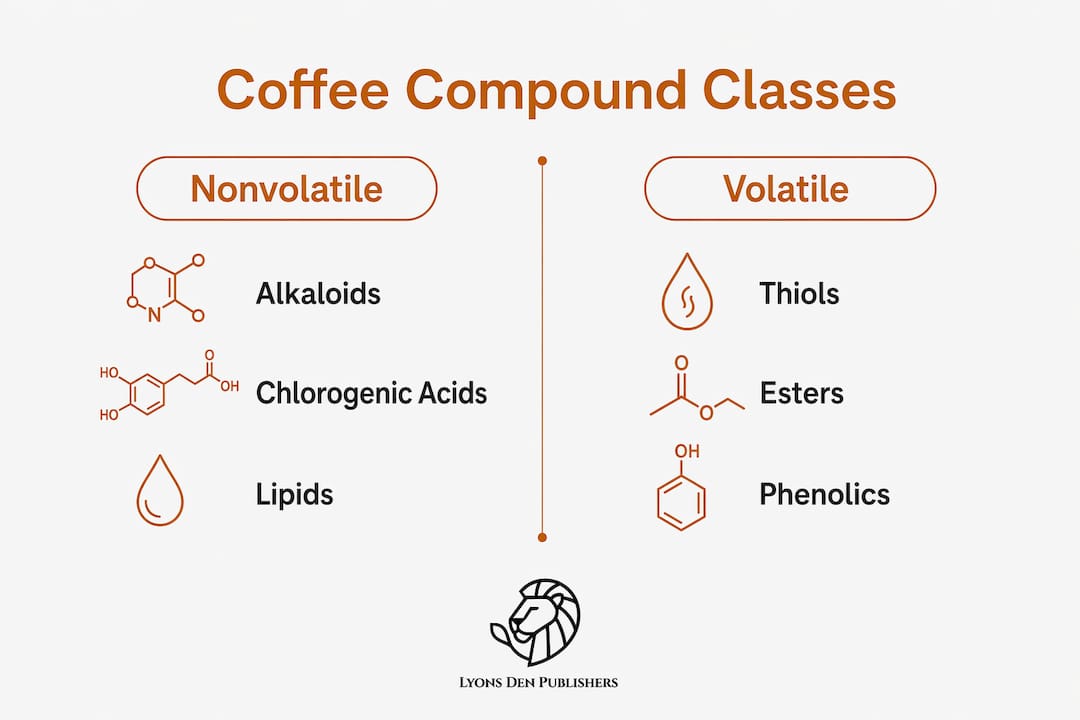
| Compound class | Key examples | Sensory / functional role | Relative presence |
|---|---|---|---|
| Alkaloids | Caffeine, theobromine, theophylline | Bitterness, CNS stimulation | Arabica: up to ~1.0% dry weight (caffeine); Robusta: ~2% dry weight (caffeine) |
| Chlorogenic acids (phenolics) | 5-O-caffeoylquinic acid | Bitterness, astringency, antioxidant | High in green beans; reduced by roasting |
| Lipids / diterpenes | Cafestol, kahweol, triglycerides | Body, mouthfeel, LDL effects | Significant lipid content in dry weight (total lipid) |
| Carbohydrates | Sucrose, polysaccharides, cellulose | Maillard precursors, body | Major proportion of dry weight |
| Proteins / amino acids | Various free amino acids | Maillard precursors, Strecker aldehydes | Notable fraction of dry weight |
| Melanoidins | High-MW brown polymers | Color, body, antioxidant capacity | Formed during roasting |
| Volatile aroma compounds | 2-furfurylthiol, pyrazines, furans | Aroma, flavor nuance | Trace concentrations, high impact |
Carbohydrates account for roughly 60% of raw green bean dry weight, making them the dominant precursor pool for Maillard chemistry. Caffeine content varies by species: Arabica beans typically contain up to ~1.0% caffeine by dry weight, while Robusta beans commonly reach ~2%.
Major nonvolatile compound groups: what's in the bean
Alkaloids
Caffeine is the primary alkaloid in coffee and the most studied psychoactive compound in the human diet. Arabica beans typically contain up to ~1.0% caffeine by dry weight; Robusta beans commonly reach ~2%. Beyond stimulation, caffeine contributes a clean, persistent bitterness. Theobromine and theophylline are present in smaller amounts and contribute mild stimulant and bronchodilatory effects respectively.
Chlorogenic acids
Chlorogenic acids (CGAs) are the dominant phenolic compounds in coffee, present at high concentrations in green beans. They drive bitterness and astringency, and their thermal degradation during roasting produces lactones and phenylindanes that intensify bitterness in darker roasts. CGAs are also potent antioxidants and influence glucose metabolism.
Trigonelline
Trigonelline ranges from approximately 0.6–1.3% in Arabica and 0.3–0.9% in Robusta green beans. It degrades substantially during roasting, converting to nicotinic acid (niacin) and volatile pyridine derivatives that contribute to aroma. Dark roasting leaves only 0.1–0.2% of the original trigonelline intact.
Lipids and diterpenes
Coffee lipids constitute a significant portion of green bean dry weight. The diterpenes cafestol and kahweol are the most bioactively significant fraction. They contribute to the rich mouthfeel of espresso and French press, but they also raise blood LDL cholesterol when consumed regularly in unfiltered form.
Carbohydrates, proteins, and melanoidins
Polysaccharides contribute to body and viscosity in the cup. Sucrose and free amino acids are the primary Maillard precursors. Melanoidins, the high-molecular-weight brown polymers formed during roasting, give coffee its color, contribute to body, and carry antioxidant activity.
Sensory links at a glance:
- Chlorogenic acids and phenylindanes → bitterness and astringency
- Organic acids (citric, malic, acetic) → perceived acidity
- Lipids and polysaccharides → mouthfeel and body
- Melanoidins → color, body, and roast character
- Caffeine → clean bitterness and stimulation
Which volatile molecules create coffee's aroma?
Volatiles matter because of their extraordinarily low odor thresholds. A compound present at parts-per-billion can dominate perceived aroma if its threshold is low enough. Sensory impact is typically assessed using odor activity values (OAV), which compare a compound's concentration to its detection threshold. Trace changes in thiol and pyrazine concentrations can shift perceived aroma dramatically, which is why a 10-second difference in roast time can change a cup's character noticeably.
2-Furfurylthiol and related sulfur-containing thiols are among the most potent aroma contributors in roasted coffee, producing the characteristic roasted, browned, sulfury note that most people recognize as "coffee smell." Their odor thresholds are so low that even trace concentrations dominate the headspace.
| Volatile class | Illustrative molecules | Common sensory notes |
|---|---|---|
| Thiols / sulfur compounds | 2-furfurylthiol, methyl mercaptan, dimethyl trisulfide | Roasted, sulfury, coffee-like |
| Pyrazines | 2-ethyl-3,5-dimethylpyrazine | Nutty, earthy, roasted |
| Furans | Furfural, 2-acetylfuran, 5-methylfurfural | Caramel, cooked sugar, sweet |
| Phenols | Guaiacol, 4-ethylguaiacol, 4-vinylguaiacol | Smoky, spicy, phenolic |
| Aldehydes / esters | Isobutyraldehyde, isovaleraldehyde, ethyl acetate | Fruity, green, floral |
| Furanones / ketones | butanedione, 4-hydroxy-2,5-dimethyl-3(2H)-furanone | Buttery, caramel, sweet |
| Vanillin | Vanillin | Vanilla, sweet |
Guaiacol and its ethyl and vinyl derivatives are responsible for the smoky, spicy phenolic notes that increase with roast degree. Vanillin, though present in modest amounts, contributes a recognizable vanilla sweetness that rounds out medium-roast profiles. Pyrazines build the nutty, earthy backbone that many drinkers associate with a well-developed roast.
Pro Tip: To emphasize floral and fruity ester notes, choose a light roast and brew at 93–96°C (199–205°F) with a shorter contact time. To bring out caramel furans and nutty pyrazines, move toward a medium roast and extend extraction slightly. Dark roasts amplify guaiacol and sulfur compounds, which can overwhelm the subtler volatiles if extraction runs long.
How roasting transforms coffee's chemistry
Most of coffee's aroma volatiles do not exist in the green bean. Roasting transforms sugars and amino acids into aroma compounds and high-molecular-weight melanoidins through Maillard and caramelization chemistry. This means cup aroma is a transformation product, not a fixed property of the origin.
The Maillard reaction begins around 150°C (302°F) when reducing sugars react with free amino acids. The cascade produces hundreds of volatile intermediates including pyrazines, furans, furanones, and thiols, as well as the brown melanoidin polymers. Strecker degradation is a subset of this chemistry: specific amino acids break down into shorter-chain aldehydes (Strecker aldehydes) that contribute green, malty, and caramel notes depending on the precursor amino acid.
Caramelization of sucrose and other sugars runs parallel to Maillard chemistry above 170°C (338°F), producing additional furans, diacetyl, and hydroxymethylfurfural. Thermal degradation of trigonelline generates nicotinic acid and volatile pyridines. CGA degradation produces lactones and, at darker roast levels, phenylindanes, which are among the most bitter compounds in coffee.
The timeline of roast-level changes:
- Light roast (first crack, ~196–205°C / 385–401°F): Maillard products begin forming; fruit and floral notes from esters and aldehydes are preserved; high residual CGA and sucrose; lower melanoidin content.
- Medium roast (~210–220°C / 410–428°F): Caramel furans and nutty pyrazines peak; sucrose largely consumed; CGA degradation accelerates; balanced bitterness and acidity.
- Dark roast (>225°C / 437°F): Guaiacol and sulfur compounds dominate; phenylindanes accumulate from CGA breakdown; trigonelline nearly fully degraded; melanoidin content high; acidity perceived as lower.
The Maillard reaction is the single most important chemical event in coffee roasting, and understanding its kinetics explains why roast development time matters as much as final temperature.
Physiologically active compounds beyond caffeine
Coffee's bioactivity is not a caffeine story alone. The full effect reflects a synergistic interaction among chlorogenic acids, trigonelline, diterpenes, and melanoidins, which is why whole-beverage studies consistently show different outcomes from isolated caffeine trials.
Arabica beans contain up to ~1.0% caffeine by dry weight; Robusta beans reach ~2%. Caffeine blocks adenosine receptors in the central nervous system, producing wakefulness and reducing perceived fatigue. It also contributes a clean, persistent bitterness to the cup.
Chlorogenic acids carry significant antioxidant capacity and have been studied for their influence on glucose and insulin response. Trigonelline shows neuroprotective and anti-inflammatory signals in research models, and its roasting-derived product nicotinic acid (niacin) is a recognized B vitamin. Cafestol and kahweol remain in unfiltered brews such as French press and espresso and have been shown to raise LDL cholesterol with regular consumption; paper filtration removes most of both diterpenes. Melanoidins contribute antioxidant activity and may support gut microbiota.
For readers interested in the detailed pharmacology of caffeine, the caffeine chemistry resource at Lyons Den Publishers covers receptor binding, metabolism, and tolerance in depth.
How species and processing shape coffee's chemical profile
Species and post-harvest processing are two of the strongest levers on chemical composition, and both are visible on the bag label.
Arabica vs. Robusta:
- Arabica contains up to ~1.0% caffeine; Robusta reaches ~2% — roughly double.
- Arabica has higher sucrose content, which feeds more nuanced Maillard chemistry and supports sweeter, more complex cup profiles.
- Robusta carries a different chlorogenic acid profile and generally higher total CGA, contributing to its characteristically stronger, more astringent bitterness.
- Arabica's aromatic precursor pool tends to produce more floral and fruity volatile notes; Robusta's higher alkaloid content pushes toward harsher, more rubbery notes at equivalent roast levels.
Processing methods and fermentation:
- Washed (wet) process: Mucilage is removed before drying, limiting fermentation contact. The result is a cleaner cup with higher perceived acidity from preserved organic acids (citric, malic). Volatile precursors reflect the bean's intrinsic chemistry more than microbial input.
- Natural (dry) process: The whole cherry dries intact for weeks. Extended contact with fruit sugars and active microorganisms introduces fruity esters and alcohols — ethyl acetate, isoamyl acetate — that produce the berry-like, wine-like notes natural-processed coffees are known for.
- Honey and pulped natural: Partial mucilage retention sits between the two extremes. Sugar availability during fermentation is higher than washed but lower than natural, producing a middle register of sweetness and fruit complexity.
Fermentation, whether intentional or ambient, is a microbial chemistry event. Yeasts and bacteria metabolize sugars and amino acids into alcohols, organic acids, and esters that become volatile precursors in the roasted bean. The coffee processing methods resource at Lyons Den Publishers maps these pathways in detail for each method.
Pro Tip: When you see "natural process" on a bag, expect elevated fruity esters and a heavier body from higher residual sugars. "Washed" signals cleaner acidity and a more transparent expression of the bean's intrinsic chemistry. The processing method is, in chemical terms, a flavor intervention.
How scientists measure coffee compounds
The evidence base for coffee chemistry rests on a set of well-established analytical techniques. Understanding them helps you evaluate claims in research papers and tasting notes critically.
Common analytical workflows include SPME–GC–MS for headspace volatiles, GC–olfactometry for odor-active compounds, and HPLC/LC–MS for chlorogenic acids and caffeine quantification. Each method has a specific scope and set of limitations.
- GC–MS (gas chromatography–mass spectrometry): The standard tool for volatile profiling. Separates compounds by boiling point and identifies them by mass fragmentation pattern. Results are reported as relative peak areas or, when standards are available, as concentrations in µg/kg or mg/L.
- SPME (solid-phase microextraction): A headspace sampling technique used before GC–MS. A fiber absorbs volatiles from the sample headspace, then desorbs them into the instrument. Highly sensitive but can introduce matrix-dependent bias depending on roast level, grind, and moisture.
- HPLC / LC–MS (high-performance liquid chromatography / liquid chromatography–mass spectrometry): Used for nonvolatile quantification: chlorogenic acids, caffeine, trigonelline, and melanoidins. Results are typically expressed as mg per gram of dry coffee or mg per serving.
- GC–olfactometry: A human sensory panel sniffs the GC effluent in real time, assigning odor descriptors and intensity scores to individual peaks. This is how researchers identify which of the hundreds of GC–MS peaks actually matter to perceived aroma.
- Sensory panels: Trained tasters using standardized protocols (such as the Specialty Coffee Association's cupping format) provide the perceptual ground truth that analytical data must ultimately explain.
A key limitation across all methods: the roast and brew matrix affects extraction efficiency. A compound detected at high concentration in a headspace SPME analysis of ground coffee may be partially lost during brewing, adsorbed onto filter paper, or transformed by hot water. Published figures are therefore method-specific and not always directly comparable across studies.
What coffee chemistry means for brewing and tasting
Chemistry translates directly into brewing decisions, and the connections are more precise than most tasting guides acknowledge.
Roast degree and extraction balance:
- Light roasts retain more sucrose, organic acids, and intact CGAs, which means higher perceived acidity and a lighter body. Extraction science shows that these compounds are highly soluble and extract early in the brew.
- Dark roasts have consumed most sucrose through Maillard and caramelization reactions, leaving melanoidins, phenylindanes, and guaiacol as the dominant extractable compounds. Bitterness rises and acidity drops.
Brewing variables:
- Grind size: Finer grinds increase surface area and accelerate extraction of all compound classes, including bitter phenylindanes. Coarser grinds slow extraction and can under-extract the sweeter, more soluble compounds.
- Water temperature: Higher temperatures (above 93°C / 199°F) extract bitter compounds more aggressively. Brewing light roasts at the higher end of the range helps dissolve the more soluble organic acids and sugars; dark roasts often benefit from slightly lower temperatures to avoid amplifying bitterness.
- Brew time and method: Unfiltered methods (French press, espresso) retain cafestol and kahweol in the cup. Paper-filtered methods (pour-over, drip) remove most diterpenes, changing both the mouthfeel and the bioactive profile.
Practical examples:
- To highlight floral and fruity notes in a light-roast Ethiopian: use a medium-fine grind, 93–96°C water, and a pour-over method with a short total brew time (2.5–3.5 minutes).
- To balance the caramel and nutty notes of a medium roast: aim for a full extraction (3–4 minutes), slightly coarser grind, and water around 91–93°C.
- To manage bitterness in a dark roast: use a coarser grind, lower water temperature (88–91°C), and a shorter contact time to limit phenylindane extraction.
Pro Tip: Bitterness in coffee is not solely from caffeine. Chlorogenic acid-derived phenylindanes are a major source, especially in dark roasts. If a dark roast tastes unpleasantly bitter rather than richly roasted, try lowering brew temperature by 3–4°C before adjusting grind or dose.
Enzymatic reactions and microbial activity during fermentation
Fermentation is a phase of post-harvest processing where chemistry is actively rewritten. During wet and natural processing, the coffee cherry's mucilage layer is broken down by a combination of the bean's own endogenous enzymes and the metabolic activity of naturally occurring microorganisms, primarily yeasts and lactic acid bacteria.
Endogenous pectinases and cellulases degrade the mucilage's pectin matrix, releasing simple sugars that become substrates for microbial fermentation. Yeasts convert these sugars primarily into ethanol and carbon dioxide, while lactic acid bacteria produce lactic and acetic acids. These organic acids alter the bean's pH environment and can diffuse into the seed, shifting the organic acid profile of the final cup. Ethanol and other fermentation alcohols serve as precursors to fruity esters in the roasted bean.
Microbial diversity during fermentation is not random. The ambient temperature, water activity, cherry density, and processing infrastructure all select for different microbial communities, which is why the same variety processed at two different farms can produce distinct cup profiles. Controlled fermentation experiments using inoculated starter cultures of specific yeast strains have demonstrated that the volatile precursor profile of the green bean can be deliberately shifted, producing more pronounced fruity, floral, or wine-like notes in the roasted cup.
The enzymatic activity does not stop at mucilage breakdown. Proteases and lipases within the bean itself continue to act during the drying phase, modifying amino acid and fatty acid pools that will later feed Maillard chemistry during roasting. This is one reason that extended drying on raised beds, which allows more controlled enzymatic activity, tends to produce more complex cup profiles than rapid mechanical drying.
Health effects of coffee compounds beyond caffeine
The health research on coffee has moved well past caffeine as the sole active agent. Several compound classes carry documented physiological effects that operate independently of adenosine receptor antagonism.
Chlorogenic acids are the most studied non-caffeine bioactives. They are potent free-radical scavengers and have been shown in clinical studies to influence postprandial glucose and insulin response. Their antioxidant capacity is substantially higher in green coffee than in dark-roasted coffee because roasting degrades a significant portion of the CGA pool into lactones and phenylindanes. This is the chemical basis for the interest in green coffee extracts as a dietary supplement.
Diterpenes (cafestol and kahweol) present a more nuanced picture. Both compounds show anti-inflammatory and potentially anticarcinogenic properties in cell and animal models, yet regular consumption of unfiltered coffee raises LDL cholesterol in human trials. The net effect depends on brewing method and individual lipid metabolism. Paper-filtered coffee removes most diterpenes, making filtered brewing the lower-risk choice for people managing cardiovascular risk factors.
Trigonelline has attracted research interest for neuroprotective effects, potential anti-diabetic activity through insulin secretion pathways, and inhibition of platelet aggregation. Its roasting-derived product, nicotinic acid, contributes to the B-vitamin content of roasted coffee.
Melanoidins are the least characterized class but carry antioxidant activity, prebiotic potential (supporting beneficial gut bacteria), and possible anti-inflammatory properties. Because they form during roasting, darker roasts contain more melanoidins, partially compensating for the CGA losses that occur at higher temperatures.
The practical implication: the health profile of a cup of coffee is not fixed. It shifts with roast level, brewing method, and species. Filtered light-roast Arabica maximizes CGA antioxidant delivery; unfiltered dark-roast Robusta espresso maximizes melanoidins and diterpenes but delivers less intact CGA.
Roasting kinetics: how light, medium, and dark profiles differ chemically
Roasting is not a single event but a sequence of overlapping chemical reactions whose relative rates depend on temperature, time, and bean moisture. Understanding the kinetics helps explain why two roasters targeting the same "medium roast" color can produce cups with different flavor profiles.
Early roasting phase (drying and yellowing, up to ~150°C / 302°F): Free moisture evaporates, and the bean transitions from green to yellow. Enzymatic activity ceases. Maillard reactions begin at the lower end of this range, producing the first volatile intermediates. Sucrose begins to hydrolyze into glucose and fructose, increasing the pool of reducing sugars available for Maillard chemistry.
First crack and light roast development (~196–205°C / 385–401°F): Steam and CO₂ pressure build until the bean's cell walls fracture audibly. Maillard and Strecker reactions accelerate sharply. Furans, pyrazines, and early thiol precursors form rapidly. The CGA pool begins significant degradation. Sucrose is largely consumed. Organic acids (citric, malic) are still largely intact, supporting bright acidity in the cup.
Medium roast development (~210–220°C / 410–428°F): Caramelization of residual sugars intensifies, producing diacetyl, hydroxymethylfurfural, and additional furans. Pyrazine concentrations peak. Trigonelline degradation accelerates, releasing pyridines and nicotinic acid. CGA lactones accumulate, contributing a mild, rounded bitterness. The bean's color deepens from cinnamon to medium brown.
Dark roast and second crack (>225°C / 437°F): Guaiacol and 4-vinylguaiacol concentrations rise steeply, producing the smoky, phenolic character of dark roasts. Phenylindanes accumulate from advanced CGA degradation and are among the most bitter compounds in the cup. Sulfur compounds including 2-furfurylthiol can degrade at very high temperatures, paradoxically reducing the "roasted coffee" note in over-roasted beans. Melanoidin content is at its maximum. Acidity is perceived as low because most organic acid precursors have been consumed or transformed.
The rate of temperature increase (the "rate of rise" in roaster terminology) matters as much as the final temperature. A fast rate of rise through the Maillard window produces more pyrazines and furans relative to guaiacol; a slower development time at the same final temperature allows more complete Maillard chemistry and a more nuanced volatile profile. This is the chemical basis for the specialty roasting practice of managing development time ratio.
How compounds interact to create flavor complexity
Coffee's flavor is not the sum of individual compounds tasted in isolation. The interactions among molecules, both synergistic and masking, are what produce the layered complexity that distinguishes a well-roasted specialty coffee from a flat, one-dimensional cup.
Synergistic effects occur when two compounds together produce a stronger or qualitatively different sensory impression than either alone. Caffeine and chlorogenic acids interact synergistically to produce a bitterness that is more persistent and complex than caffeine's clean bitterness in isolation. This is why decaffeinated coffee, even when CGA levels are preserved, tastes different from its caffeinated counterpart. Similarly, 2-furfurylthiol at trace concentrations amplifies the overall "roasted coffee" impression of the volatile blend, even when its individual concentration is below the threshold for a sulfury off-note.
Masking effects are equally important. Sucrose and other sugars suppress perceived bitterness from caffeine and CGAs, which is why light roasts with higher residual sugar taste less bitter despite containing comparable caffeine. Lipids coat the palate and reduce the perceived intensity of water-soluble bitter compounds, explaining why full-fat milk reduces coffee bitterness more effectively than skim milk. Melanoidins can bind volatile aroma compounds, effectively reducing their headspace concentration and softening the perceived aroma intensity of dark roasts.
Matrix interactions during brewing add another layer. The pH of the brew affects the ionization state of chlorogenic acids and organic acids, shifting perceived sourness and astringency. Water hardness influences which compounds are preferentially extracted: calcium ions can bind to certain organic acids and reduce their extraction, while bicarbonate alkalinity neutralizes acidity in the cup. These water chemistry effects are not trivial — they can shift the perceived flavor balance of the same coffee as dramatically as a change in grind size.
The practical implication for tasters: when a cup tastes flat or one-dimensional, the problem is often not a missing compound but a missing interaction. A coffee that lacks sweetness will have its bitterness unmasked; a coffee brewed with high-alkalinity water will have its acidity neutralized and its complexity flattened. Flavor complexity is a chemical relationship, not a property of any single molecule.
Key Takeaways
Coffee's aroma, taste, and physiological effects arise from the interaction of more than 1,000 identified compounds, with a small number of classes — volatile Maillard products, chlorogenic acids, caffeine, and diterpenes — doing most of the sensory and bioactive work.
| Point | Details |
|---|---|
| Over 1,000 compounds identified | Roasted coffee contains more than 1,000 volatile and nonvolatile compounds; most aroma volatiles form during roasting, not in the green bean. |
| Roasting creates most aroma | Maillard reactions and Strecker degradation convert green-bean precursors into the thiols, pyrazines, furans, and phenols that define coffee's smell. |
| Bitterness has multiple sources | Caffeine, chlorogenic acid-derived phenylindanes, and CGA lactones all contribute to bitterness; dark roasts amplify phenylindane levels significantly. |
| Brewing method changes bioactives | Unfiltered methods (French press, espresso) retain cafestol and kahweol; paper filtration removes most diterpenes, altering both mouthfeel and LDL impact. |
| Lyons Den Publishers | The coffee science resources at Lyons Den Publishers cover extraction, Maillard chemistry, caffeine, and water chemistry in depth for enthusiasts and professionals. |
Why coffee chemistry matters more than most guides admit
Coffee chemistry is often presented as a curiosity — interesting background for enthusiasts but not something that changes how you brew or buy. That framing undersells it considerably.
The most overlooked insight in popular coffee writing is that bitterness is not a single sensation with a single cause. Caffeine contributes a clean, relatively short-lived bitterness. Chlorogenic acid lactones add a rounder, more persistent bitterness in medium roasts. Phenylindanes, which accumulate specifically in dark roasts, produce a harsh, lingering bitterness that no amount of grind adjustment fully resolves because it is a roast-chemistry problem, not an extraction problem. Knowing this changes the diagnostic question when a cup tastes wrong.
The fermentation chemistry section of this guide points to another underappreciated area: the green bean arriving at the roastery is already a chemically transformed object, shaped by weeks of microbial activity. The roaster is working with a substrate whose volatile precursor profile was partly written by yeasts and bacteria on a drying bed in Ethiopia or Colombia. Specialty coffee's current obsession with processing method transparency is, at its core, a chemistry conversation.
What the research does not yet fully resolve is the interaction between individual metabolism and coffee's bioactive compounds. Caffeine metabolism varies significantly by CYP1A2 genotype; chlorogenic acid absorption differs by gut microbiome composition. The health picture for any individual is more variable than population-level studies suggest. That is an honest gap worth acknowledging.
Go deeper into coffee science with Lyons Den Publishers
The chemistry covered in this guide is the foundation of everything that happens between the coffee plant and the cup. For readers who want to move from understanding to application, Lyons Den Publishers offers a structured path through the science.
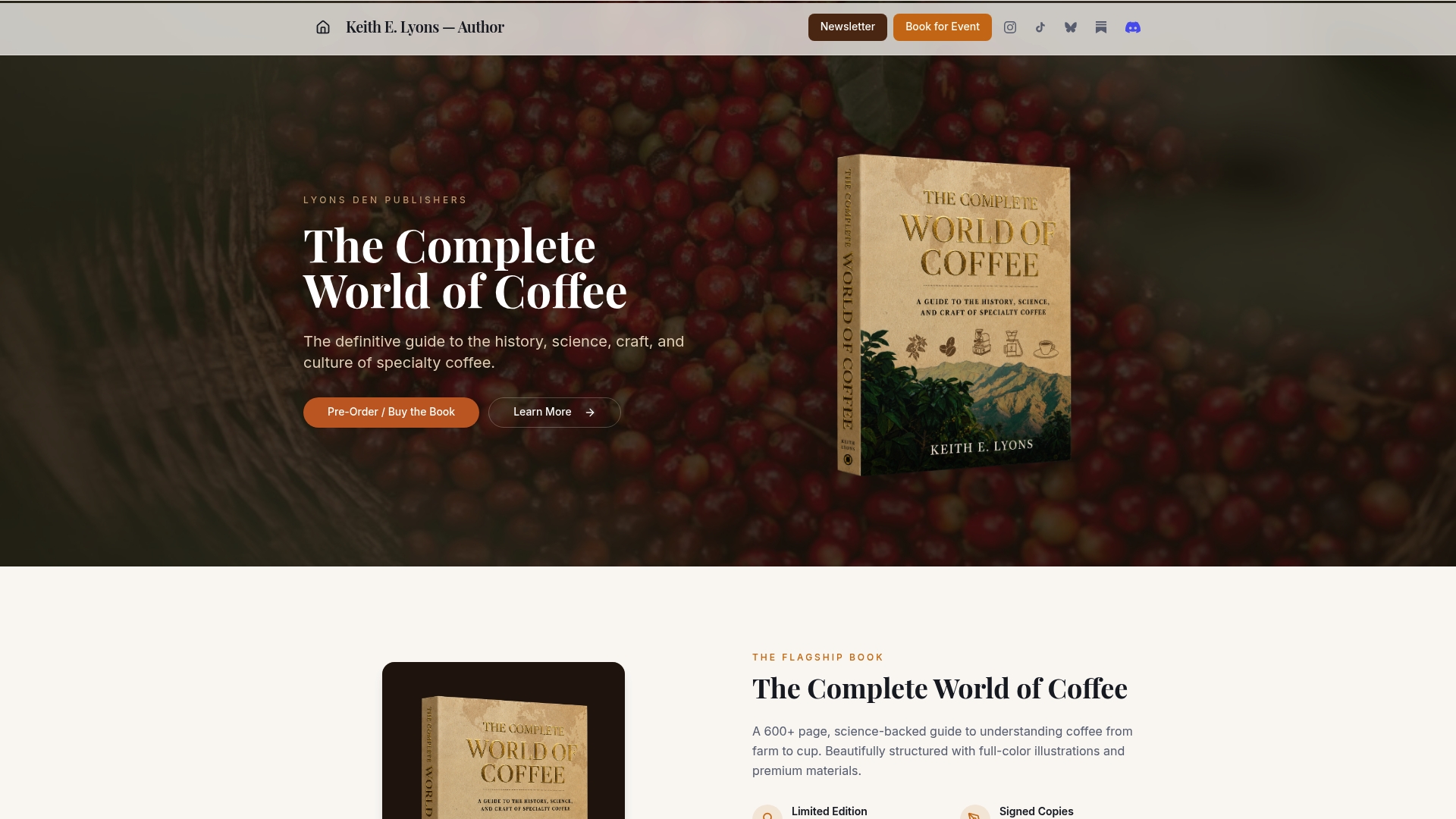
The coffee science topics section at Lyons Den Publishers covers extraction principles, Maillard reaction kinetics, caffeine chemistry, and water chemistry in the same evidence-based depth as this guide. Keith Lyons's book, The Complete World of Coffee, brings together the full arc from cultivation and processing through roasting, brewing, and sensory evaluation in a single comprehensive reference. Whether you are a home brewer working to understand why your extraction tastes flat, a barista preparing for a sensory certification, or a professional roaster refining development profiles, the resources at Lyons Den Publishers are built for exactly that level of engagement. Visit the coffee science page to explore the full library.
Useful sources and further reading
The sources below represent the most authoritative peer-reviewed and reference material used in this guide. Each entry notes what it is best used for.
| Source | What it covers | Best for |
|---|---|---|
| Relationship between the Chemical Composition and the Biological Functions of Coffee (PMC) | Comprehensive review of alkaloids, phenolics, flavonoids, terpenoids, and flavor compounds; includes raw bean composition table | Full chemical overview; green bean composition data |
| Bioactive compounds in coffee and their role in lowering the risk of major public health consequences (PMC) | CGA ranges, nonvolatile taste chemistry, synergistic bioactivity, health outcomes | Health effects; bitterness and antioxidant chemistry |
| Relationship between the Chemical Composition and the Biological Functions of Coffee (MDPI Molecules) | Maillard and caramelization pathways; thiol and sulfur compound aroma impact; melanoidin formation | Roasting chemistry; aroma volatile formation |
| A Detail Chemistry of Coffee and Its Analysis (IntechOpen) | Trigonelline ranges by species; analytical methods (SPME–GC–MS, HPLC); phenylindane bitterness | Analytical methods; trigonelline and bitterness chemistry |
| Coffee: biochemistry and potential impact on health (Food & Function, RSC) | Diterpene (cafestol, kahweol) chemistry; filtered vs. unfiltered brewing effects on LDL | Diterpene bioactivity; brewing method health implications |
| Metabolism of alkaloids in coffee plants (Brazilian Journal of Pharmacognosy) | Caffeine content by species (Arabica ~1.0%, Robusta ~2%); trigonelline metabolism; species variation | Species comparison; alkaloid chemistry |
| List of chemical compounds in coffee (Wikipedia) | Catalogued list of identified volatile and nonvolatile compounds; >1,000 compound count | Quick reference; compound identification |