The most recognized figures in specialty coffee today include James Hoffmann, Jack Simpson, Mikael Jasin, Morgan Eckroth, Sasa Sestic, Miki Suzuki, Taka Ishitani, and Charlotte Malaval — each notable for a distinct combination of competition results, published work, roastery leadership, or digital education. Here is why each name carries weight:
- James Hoffmann — 2007 World Barista Champion, co-founder of Square Mile Coffee Roasters, author of The World Atlas of Coffee, and one of the most-watched coffee educators on YouTube.
- Jack Simpson — Won the 2025 World Barista Championship in Milan after seven years of preparation; used Finca Deborah Jamison Savage's Aether coffee in his winning routine.
- Mikael Jasin — 2024 World Barista Champion, representing Indonesia and demonstrating the growing depth of Southeast Asian specialty coffee.
- Morgan Eckroth — U.S. Barista Champion with a substantial social media following, widely credited with bringing barista culture to younger audiences through content creation.
- Sasa Sestic — 2015 World Barista Champion, founder of ONA Coffee in Australia, and a key figure in advancing coffee processing research and origin sourcing.
- Miki Suzuki — The first woman from Japan to win a World Barista Championship, a milestone for global representation in elite competition.
- Taka Ishitani — Multiple Japanese national champion with a top-4 WBC placement, active in shop direction, training, and concept development.
- Charlotte Malaval — French barista and competitor recognized for her technical precision and advocacy for barista education in Europe.
- Berg Wu — Taiwanese champion and co-founder of Berg Wu Coffee, known for elevating Asian specialty coffee on the world stage.
- Lex Wenneker — Dutch barista and educator whose work in training and sensory development has influenced coffee culture across Europe.
- Yoshikazu Iwase — Japanese barista champion whose meticulous approach to extraction and presentation has earned consistent recognition at the international level.
Table of Contents
- What makes a barista famous today?
- Profiles of notable baristas worth knowing
- What is the World Barista Championship, and why does it matter?
- How to follow and learn from the world's best baristas
- How to build a career that earns real recognition
- What "famous" actually means in coffee — and why it matters to you
- Key Takeaways
- The barista fame model needs a longer lens
- Deepen your coffee knowledge with Lyons Den Publishers
- Useful sources and further reading
What makes a barista famous today?
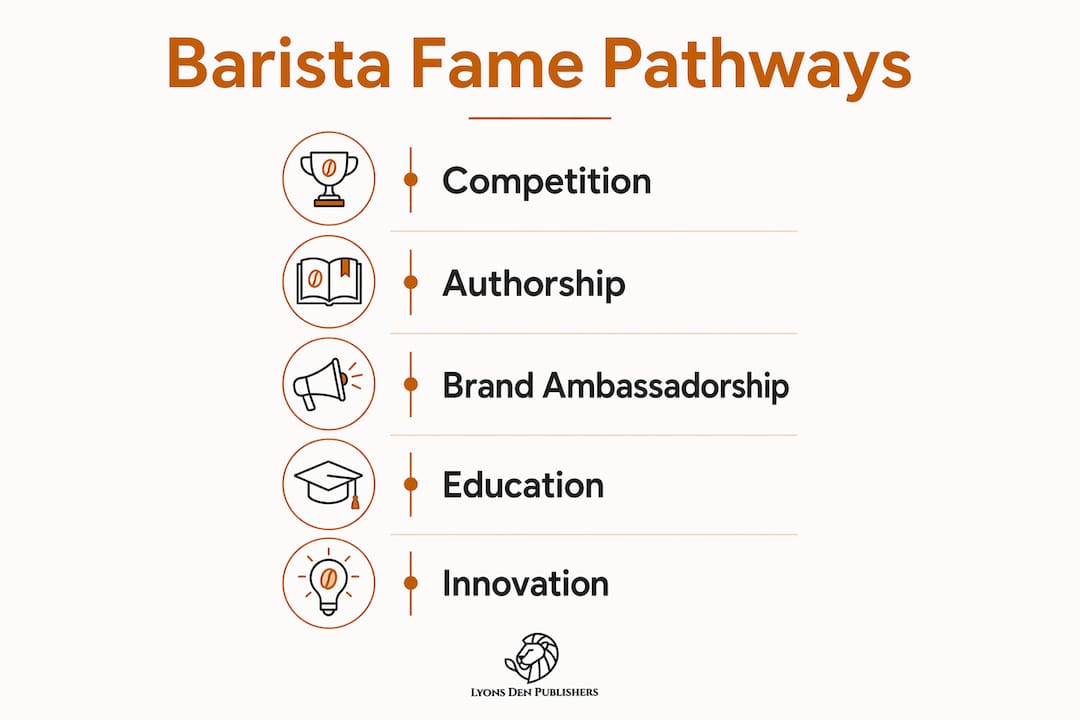
Fame in the coffee world has never rested on a single credential. Competition titles, published authorship, roastery ownership, and digital reach each contribute — and the weight of each has shifted considerably over the past decade.
The clearest signals of recognized standing remain:
- World or national championship titles — verified through World Coffee Events records.
- Published works — books, longform guides, or peer-reviewed contributions that demonstrate sustained expertise.
- Roastery or business leadership — founding or directing a respected roasting company.
- Teaching and training roles — running accredited programs, workshops, or mentorship at scale.
- Digital audience — YouTube channels, social platforms, and newsletters that consistently deliver substantive coffee education.
The modern shift is significant. High-profile baristas now combine competition credentials with brand ambassadorships and content creation to build diversified income streams. A competition trophy alone rarely sustains a career; the baristas who remain visible over years tend to pair technical credibility with communication skills and entrepreneurial thinking.
Pro Tip: To verify a barista's claimed credentials, check the World Coffee Events live results database for competition records, look for ISBN-registered publications under their name, and confirm teaching engagements through accredited institutions rather than self-reported bios.
Profiles of notable baristas worth knowing
The following profiles span competition champions, educators, roastery founders, and content creators — a deliberately global selection that reflects the actual breadth of the field.
-
James Hoffmann — Won the WBC in 2007, then built one of specialty coffee's most respected educational platforms: Square Mile Coffee Roasters, The World Atlas of Coffee, and a YouTube channel with millions of subscribers. His career is the clearest example of converting competition credibility into lasting educational influence.
-
Jack Simpson (Australia) — The 2025 WBC winner in Milan, Simpson prepared for seven years before his title, selecting Finca Deborah Jamison Savage's Aether coffee for his routine. His win underscores how much preparation, origin research, and sensory storytelling now factor into elite competition.
-
Mikael Jasin (Indonesia) — 2024 World Barista Champion, Jasin's victory reflected the rapid rise of Southeast Asian specialty coffee and drew global attention to Indonesian producers and processing methods.
-
Sasa Sestic (Australia/Bosnia) — 2015 WBC champion and founder of ONA Coffee, Sestic has been as influential off the competition stage as on it, driving research into coffee processing and direct-trade sourcing that has shaped how roasters worldwide think about green coffee selection.
-
Morgan Eckroth (USA) — A multiple-time U.S. Barista Champion whose social media presence has made barista craft accessible to audiences far beyond the specialty coffee bubble. Eckroth represents the content-creator pathway to recognition that did not exist a generation ago.
-
Miki Suzuki (Japan) — The first woman from Japan to win a World Barista Championship, Suzuki's achievement carries significance beyond the trophy: it expanded the conversation about representation and diversity at the highest levels of competition.
-
Taka Ishitani (Japan) — A four-time national champion with a top-4 WBC finish, Ishitani has channeled competition experience into shop direction, barista training, and commercial concept development, demonstrating the breadth of roles that competition credibility can open.
-
Berg Wu (Taiwan) — Co-founder of Berg Wu Coffee and a consistent presence in Asian specialty coffee, Wu helped establish Taiwan as a serious force in the global competition circuit.
-
Charlotte Malaval (France) — A French barista and competitor recognized for technical precision and a commitment to barista education, Malaval has contributed to raising professional standards in European coffee culture.
-
Lex Wenneker (Netherlands) — An educator and competitor whose sensory training work has shaped barista development programs across Europe, Wenneker illustrates how teaching can be as influential as competing.
-
Yoshikazu Iwase (Japan) — A Japanese champion whose focus on extraction science and presentation detail has earned him repeated recognition at international competitions and respect among peers.
What is the World Barista Championship, and why does it matter?
The World Barista Championship (WBC) is the most visible competition in specialty coffee, organized under the World Coffee Events umbrella alongside the Brewers Cup, the Latte Art World Championship, and several other disciplines. Together, these events set the global benchmark for technical skill, sensory literacy, and coffee storytelling.
The WBC began in Monte Carlo in 2000 and has grown into an annual event that draws national champions from dozens of countries. Each competitor prepares four espressos, four milk-based drinks, and four signature beverages within a 15-minute window, judged on technical execution, sensory quality, and presentation. Scores combine technical judge assessments with sensory panel evaluations, making both precision and palate equally important.
Why do competition results matter as credibility signals? Because the judging process is transparent, documented, and peer-reviewed in real time. A WBC placement is verifiable in a way that social media follower counts are not.
The economics of competition are worth understanding. WBC winners receive a trophy, an origin trip, and a cash prize recently reported at around €5,000, while competitors may spend over US$10,000 on training and travel to reach the final. That gap explains why the most successful champions treat competition as a platform for brand-building rather than a financial end in itself.
Recent WBC winners:
| Year | Champion | Country |
|---|---|---|
| 2025 | Jack Simpson | Australia |
| 2024 | Mikael Jasin | Indonesia |
| 2007 | James Hoffmann | United Kingdom |
Other major competitions under the World Coffee Events umbrella include the World Brewers Cup, World Latte Art Championship, World Coffee in Good Spirits Championship, and World Cup Tasters Championship — each rewarding a distinct skill set.
How to follow and learn from the world's best baristas
The fastest learning path combines long-form content with hands-on practice. Books and YouTube channels provide the conceptual framework; workshops and structured courses build the muscle memory and sensory vocabulary that reading alone cannot.
Where to find authoritative teaching:
- Books — James Hoffmann's The World Atlas of Coffee remains the most widely recommended single-volume reference. For readers building a professional library, the best coffee books for professionals curated by Lyons Den Publishers covers the field systematically.
- YouTube and longform video — Hoffmann's channel is the clearest example of competition-to-education conversion. Several other champions maintain channels or appear in documented competition footage on the World Coffee Events platform.
- Workshops and live events — National barista competitions frequently include open judging sessions and side events. SCA-aligned training centers offer structured curricula that mirror competition preparation.
- Certifications — The Q Grader program (Coffee Quality Institute) and SCA-aligned courses provide verifiable credentials. An overview of recognized titles is available in the coffee expert credentials guide at Lyons Den Publishers.
- Online resources — The three coffee education resources hub and science-backed online courses at Lyons Den Publishers offer structured starting points for both enthusiasts and working professionals.
- Partner resources — For practical espresso technique, the espresso brewing guide at ADIRA Coffee provides accessible, hands-on instruction from a specialty roaster.
Pro Tip: When evaluating an instructor or online course, look for three things: a verifiable competition record or published work, consistent teaching engagements at accredited institutions, and student outcomes that go beyond testimonials — such as competition placements or career transitions.
How to build a career that earns real recognition
The most reliable route to recognition in specialty coffee combines technical mastery, structured credentials, diversified income, and public-facing work. No single element is sufficient on its own.
Industry experts advise champions to pursue brand ambassadorships, content creation, consulting, or education rather than relying solely on café operations. The baristas who sustain careers over decades tend to treat each of these as a parallel track, not a sequential one.
Career checklist for aspiring coffee professionals:
- Build foundational sensory skills — Develop palate through systematic cupping, extraction calibration, and water chemistry study. This is the non-negotiable base.
- Pursue structured credentials — Q Grader certification, SCA-aligned courses, and accredited training programs provide verifiable proof of competence that self-study cannot replicate.
- Enter competitions — Even without winning, the iterative feedback loop of competition preparation — palate work, sensory evaluation, storytelling practice — accelerates professional development in ways that café shifts alone do not.
- Develop communication skills — Sensory literacy paired with public speaking and project management makes a barista hireable across roasting, quality management, training, and education roles.
- Create public-facing work — Write, teach, or produce video content. Published work and documented teaching engagements are EEAT signals that competition results alone cannot provide.
- Build partnerships and ambassadorships — Align with producers, roasters, or equipment brands whose values match your own. These relationships generate income and visibility simultaneously.
- Diversify income streams — Sustainable careers in coffee typically span multiple roles: quality management, roastery consulting, education, and authored works, rather than a single employer or revenue source.
Pro Tip: Treat every competition entry as a research project. The sensory and storytelling discipline required to prepare a 15-minute WBC routine transfers directly to training presentations, client consultations, and content creation — regardless of your final placement.
For readers interested in the science underlying extraction and sensory evaluation, the coffee science topics hub at Lyons Den Publishers provides a structured reference that complements hands-on training.
What "famous" actually means in coffee — and why it matters to you
Fame in specialty coffee is more useful as a learning framework than as a status to pursue. The baristas on this shortlist are notable not because they are celebrities in the mainstream sense, but because their work — competition routines, published references, training programs, and roastery decisions — is documented, verifiable, and repeatable by anyone willing to study it.
The pathways to recognition are genuinely plural. James Hoffmann's route ran through competition and then authorship. Sasa Sestic's ran through competition and then origin sourcing. Morgan Eckroth's runs largely through content. Miki Suzuki's achievement carries historical significance independent of any single competition cycle. None of these paths is more legitimate than another; they reflect different strengths applied consistently over time. The practical takeaway is to identify which combination of technical skill, communication, and entrepreneurship fits your own profile, then build credentials in that direction rather than trying to replicate someone else's exact trajectory.
Key Takeaways
The most recognized baristas combine verifiable competition results with at least one additional platform — authorship, roastery leadership, or sustained public education — making that combination the clearest signal of lasting influence in specialty coffee.
| Point | Details |
|---|---|
| Competition is a platform, not a destination | WBC winners receive a trophy, an origin trip, and a cash prize reported at around €5,000, while competitors may spend over US$10,000 on training and travel to compete; the real return is visibility and brand-building opportunity. |
| Diverse pathways create fame | Champions, authors, roastery founders, and content creators all reach recognition; the common thread is documented, verifiable expertise. |
| Credentials matter more than follower counts | Q Grader certification, SCA-aligned training, and published works are verifiable signals; social metrics alone are not. |
| Career diversification sustains longevity | Sustainable coffee careers span quality management, education, consulting, and authored works — not a single café role. |
| Lyons Den Publishers supports the learning path | The coffee science and education resources at Lyons Den Publishers provide structured, evidence-based references for enthusiasts and professionals building expertise. |
The barista fame model needs a longer lens
The conversation around famous baristas tends to compress careers into a single highlight: the championship win, the viral video, the book deal. What that framing misses is the decade of deliberate practice that precedes each of those moments — and the decade of diversified work that follows, if the career is to last.
Jack Simpson's seven-year preparation for his WBC win is the clearest recent example. That timeline is not unusual among elite competitors; it is simply rarely discussed because it is less photogenic than the trophy. The baristas who sustain influence over the long term are, almost without exception, the ones who treated every competition, every training session, and every published piece as a compounding investment rather than a one-time event.
The other underappreciated point is that the most transferable skill in this field is not extraction technique or latte art. It is the ability to communicate coffee knowledge clearly to different audiences — producers, roasters, consumers, and students. That skill is what converts a competition result into a book contract, a training program, or a brand partnership. Technical mastery earns entry to the conversation; communication determines how long you stay in it.
Deepen your coffee knowledge with Lyons Den Publishers
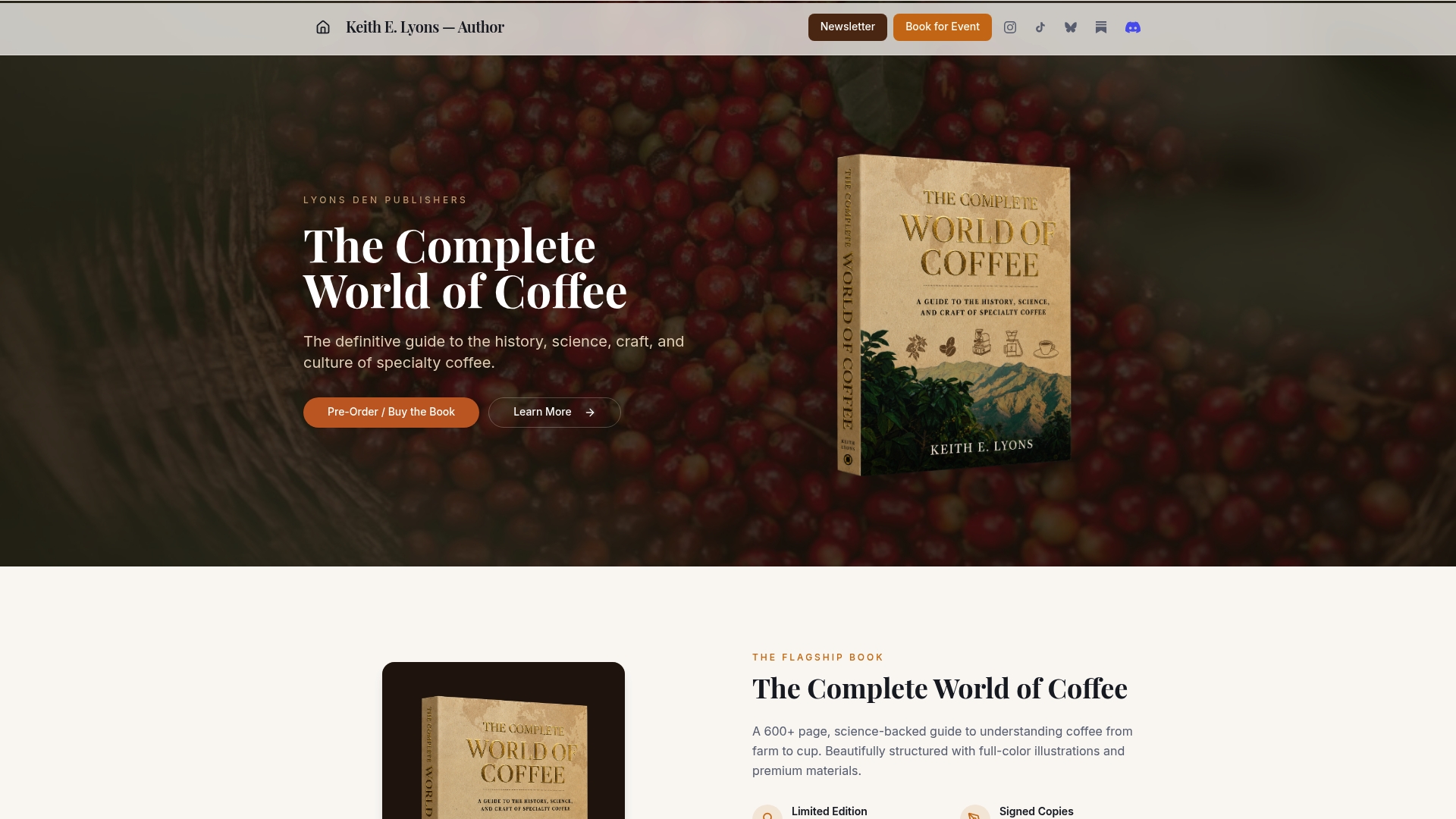
For readers who want to move beyond the shortlist and build genuine expertise, Lyons Den Publishers offers a structured path. Keith Lyons's The Complete World of Coffee covers the history, science, cultivation, processing, roasting, brewing, espresso, and sensory evaluation of specialty coffee in a single authoritative reference — the kind of foundation that complements competition study and barista training equally well.
The coffee science topics hub at Lyons Den Publishers is the recommended starting point for professionals focused on extraction science, sensory analysis, and the technical principles that underpin elite barista work. For those interested in the cultural and historical context that shapes how famous coffee shops and barista culture developed, the specialty coffee revolution page provides that grounding. Paid virtual and in-person education sessions are also available for individuals, teams, and professional groups seeking structured instruction. Visit keithlyons.org to explore the full range of resources.
Useful sources and further reading
- World Coffee Events — Live Results — The primary database for WBC and all World Coffee Events competition results; use this to verify any championship claim.
- James Hoffmann — Wikipedia — Documented overview of Hoffmann's competition record, publications, and roastery work.
- Behind Jack Simpson's WBC Triumph — BeanScene — Detailed profile of the 2025 World Barista Champion and his preparation process.
- Winning Competitions Isn't Enough — Perfect Daily Grind — Industry analysis of why champions must build brands beyond the trophy, including competition economics.
- Miki Suzuki — Japanese Coffee Co. — Profile of the first female World Barista Champion from Japan.
- Taka Ishitani — Official Site — Primary source for Ishitani's competition record, training work, and career trajectory.
- Coffee Tips and Guides — ADIRA Coffee — Practical barista and brewing guidance from a specialty roaster, useful for technique development alongside competition study.