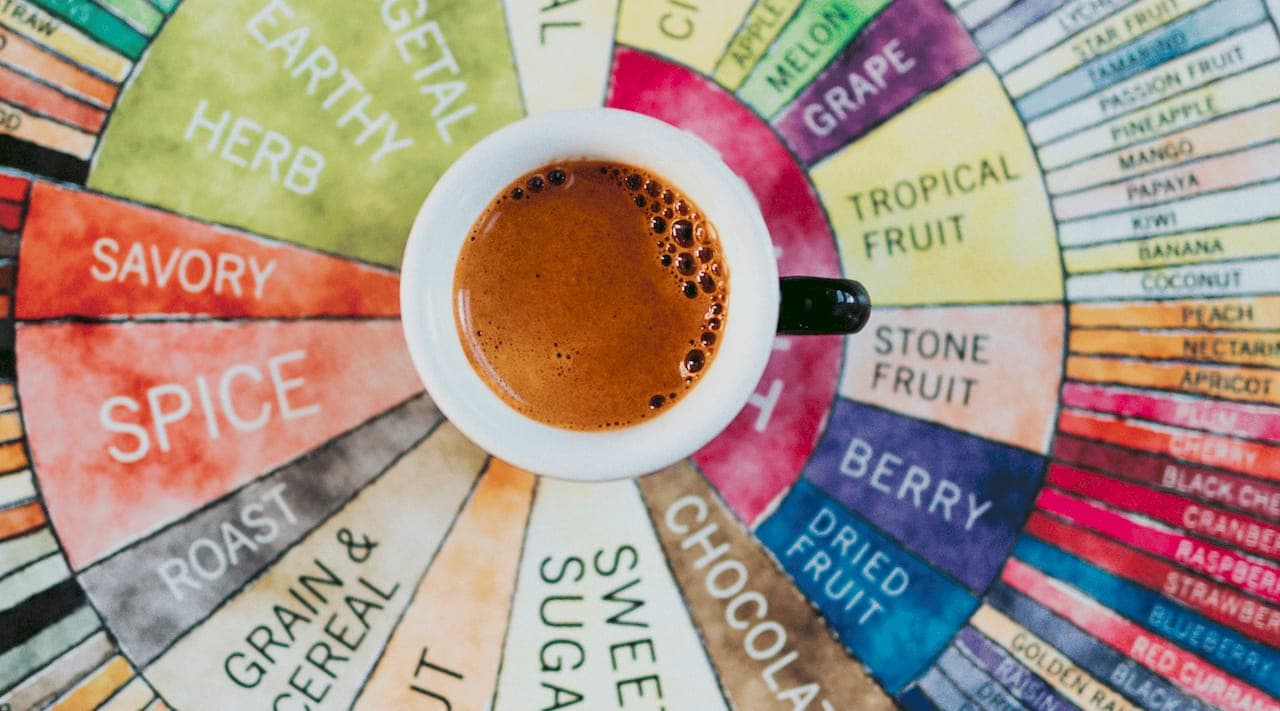
The Specialty Coffee Association’s Coffee Taster’s Flavor Wheel is defined as the global sensory standard for identifying, naming, and communicating coffee flavor. First published in 1995 and comprehensively revised in 2016 through blind sensory panels with hundreds of trained evaluators, the wheel maps over 100 distinct flavor attributes validated by sensory science. For home brewers and coffee enthusiasts, the flavor wheel is not a test to pass. It is a shared vocabulary that turns vague impressions like “tastes fruity” into precise, repeatable language like “dried apricot with a hint of tamarind.” Lyons Den Publishers covers this tool in depth because it sits at the center of every serious sensory education in specialty coffee.
How is the flavor wheel coffee structured?
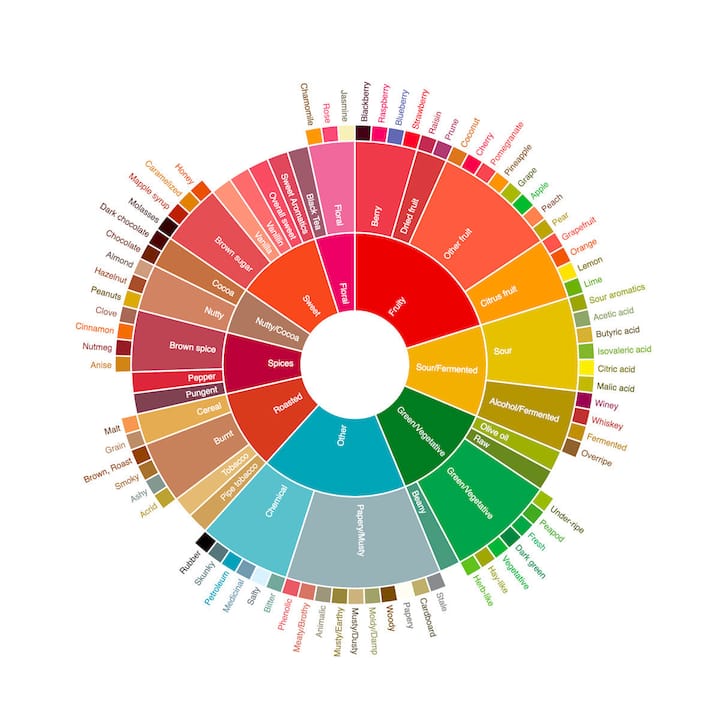
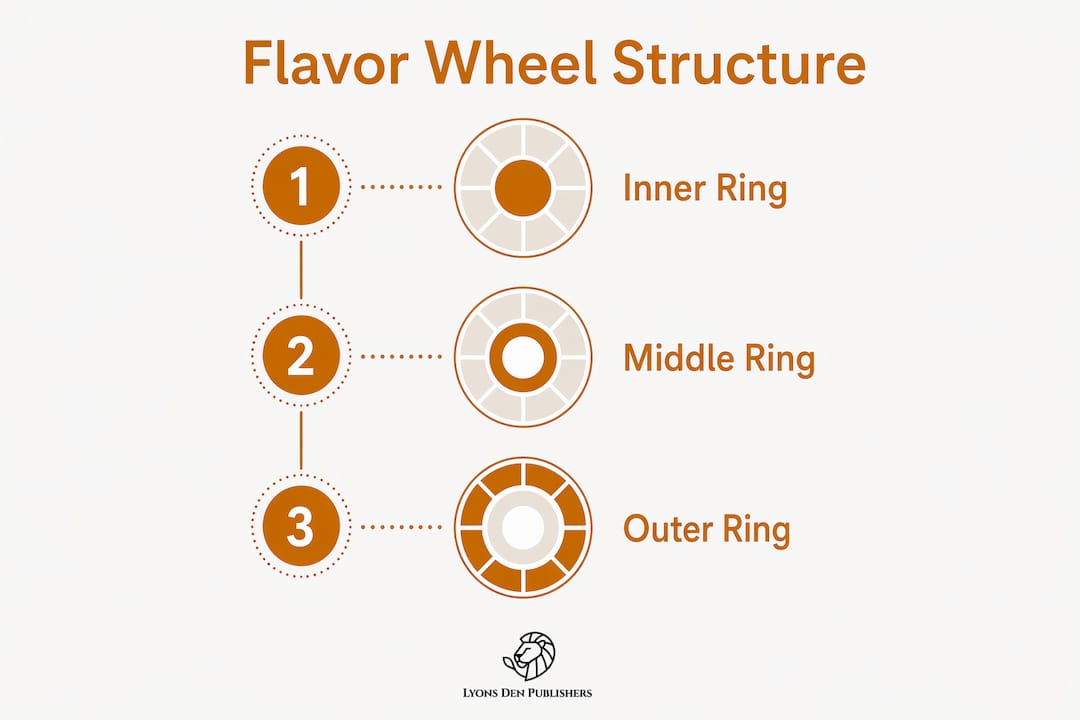
The coffee tasting wheel is organized into three concentric rings, each representing a different level of sensory specificity. Reading the wheel correctly means moving from the inside out, not the other way around.
The innermost ring holds nine broad flavor categories. These are the starting points for any tasting session. The nine major categories are:
-
Fruity (berry, citrus, dried fruit, other fruit)
-
Floral (black tea, floral)
-
Sweet (vanilla, vanillin, overall sweet, sweet aromatics)
-
Nutty/Cocoa (nutty, cocoa)
-
Roasted (pipe tobacco, tobacco, burnt, cereal)
-
Spices (pungent, pepper, brown spice)
-
Sour/Fermented (sour aromatics, alcohol/fermented, acetic acid, butyric acid, isovaleric acid, citric acid, malic acid)
-
Green/Vegetative (olive oil, raw, green/vegetative, beany)
-
Other (chemical, papery/musty, phenolic)
The middle ring breaks each category into subcategories. “Fruity” splits into berry, citrus, dried fruit, and other fruit. This level is where most home brewers spend the bulk of their tasting time, narrowing down a general impression before committing to a specific word.
The outer ring holds the most precise descriptors. These are terms like “blackberry,” “lemon,” “dark chocolate,” or “jasmine.” Color coding groups perceptually related flavors together, so adjacent segments on the wheel share sensory characteristics. The spacing between segments reflects how different those flavor families are from each other. A wide gap between “Roasted” and “Floral” signals that those two categories rarely overlap in a single cup.
| Ring | Level of Specificity | Example |
|---|---|---|
| Inner | Broad category | Fruity |
| Middle | Subcategory | Berry |
| Outer | Precise descriptor | Blackberry |
What is the best method for using the coffee wheel?
The recommended tasting approach is called the funnel method. You start at the center of the wheel and move outward only when you feel confident about the broader category. Jumping straight to outer-ring descriptors is the most common mistake new tasters make. It produces unreliable notes that do not reflect what is actually in the cup.
A systematic eight-step workflow produces the most accurate results:
-
Smell the dry grounds. Aroma before brewing reveals volatile compounds that disappear with heat.
-
Smell the wet grounds or brewed cup. Note whether the aroma shifts toward fruity, roasted, or floral.
-
Identify acidity type. Is it bright and citric, or soft and malic? Acidity type points toward origin and processing.
-
Assess sweetness. A well-developed roast produces natural sweetness. Its absence signals under-development or defects.
-
Assess bitterness. Mild bitterness is normal. Harsh or lingering bitterness suggests over-extraction or a dark roast.
-
Evaluate body. Body is the weight and texture of the coffee on your palate. Light, medium, and full are the three reference points.
-
Identify flavor notes. Now consult the wheel. Start at the inner ring, confirm a broad category, then move outward.
-
Note the finish. Does the flavor linger cleanly, or does it fade quickly with an off-note?
Experienced tasters avoid assigning outer-ring descriptors until steps 1 through 6 are complete. Skipping ahead produces invented notes rather than genuine sensory observations.
Pro Tip: Taste the same coffee three times in one session. Your first impression is often the least accurate. By the third pass, your palate has calibrated and your notes will be sharper and more consistent.
How can home brewers use the coffee tasting wheel to improve?
Home cupping requires minimal equipment and delivers maximum sensory feedback. You need freshly ground coffee, a scale, a timer, hot water, and two cups. The process involves coarse grinding, timed steeping, breaking the crust to smell the released aromatics, and slurping the coffee at specific temperatures to engage the full palate.
The real value for home brewers comes from connecting tasting notes to brewing variables. If your notes land in the “Sour/Fermented” category, your extraction is likely too short or your water temperature too low. If your notes shift toward “Roasted” or “Burnt,” you are likely over-extracting or using water that is too hot. The coffee wheel becomes a diagnostic tool, not just a vocabulary list.
Comparing your personal notes with the roaster’s bag descriptors is one of the most effective calibration exercises available. Discrepancies between your notes and the roaster’s are not failures. They are feedback. If the bag says “peach and jasmine” and you taste “mild citrus and grain,” that gap tells you something about your palate, your brew method, or your water quality. Investigating that gap is how sensory skills grow.
Building a physical reference library accelerates vocabulary development faster than any other method. Keep small samples of reference ingredients in your kitchen:
-
Fruits: fresh lemon, dried apricot, blackberry jam, maraschino cherry
-
Spices: cinnamon stick, black pepper, cardamom
-
Chocolates: dark chocolate (70%+), milk chocolate, cocoa powder
-
Nuts: roasted almonds, hazelnut spread
Smell and taste each reference before a cupping session. Your brain will form stronger connections between the physical experience and the words on the wheel.
Pro Tip: The goal of the flavor wheel is to capture notes that improve your brewing and buying decisions, not to impress anyone with complexity. If “dark fruit” is as specific as you can get today, that is a legitimate and useful note.
What flavor categories and regional origins appear most on the wheel?
Regional coffee origins align reliably with dominant flavor wheel categories. Understanding this relationship helps you set accurate expectations before the first sip and confirms your notes against a known reference point.
Ethiopian coffees, particularly those from Yirgacheffe, are known for Fruity and Floral profiles. Strawberry, jasmine, and bergamot appear frequently in washed-process lots. Natural-process Ethiopian coffees push further into berry and wine-like fermented notes. Colombian coffees typically present in the Sweet and Fruity categories, with caramel, red apple, and mild citrus as common descriptors. Brazilian coffees sit firmly in the Nutty/Cocoa range, with milk chocolate, hazelnut, and low acidity defining most profiles. Sumatran coffees from the Mandheling region often land in the Green/Vegetative and Earthy subcategories, with cedar, dark chocolate, and herbal notes.
| Origin | Dominant Category | Typical Descriptors |
|---|---|---|
| Ethiopian Yirgacheffe | Fruity, Floral | Strawberry, jasmine, bergamot |
| Colombian | Sweet, Fruity | Caramel, red apple, mild citrus |
| Brazilian | Nutty/Cocoa | Milk chocolate, hazelnut |
| Sumatran Mandheling | Green/Vegetative | Cedar, dark chocolate, herbal |
| Kenyan | Sour/Fruity | Blackcurrant, tomato, bright citric acid |
Processing method shifts these profiles significantly. A natural-process Colombian coffee will taste closer to an Ethiopian natural than to a washed Colombian. Roast level compresses or amplifies origin character. Light roasts preserve origin-driven Fruity and Floral notes. Dark roasts push most coffees toward the Roasted and Bitter categories regardless of origin.
The flavor wheel functions as a shared language that reduces vague, emotive descriptions into research-backed vocabulary. This matters for home brewers because it makes it possible to communicate precisely with roasters, baristas, and other enthusiasts. Saying “I’m getting a sour, fermented note with low sweetness” gives a roaster far more useful information than “it tastes a bit off.”
Repeated use of the wheel calibrates the palate over time, reducing ambiguity and improving communication with professionals and suppliers. The wheel is not a static reference. It becomes more useful the more you use it.
Key Takeaways
The Coffee Taster’s Flavor Wheel is the most effective tool for converting subjective tasting impressions into precise, repeatable language that improves both brewing decisions and sensory communication.
| Point | Details |
|---|---|
| Start at the center | Always identify a broad inner-ring category before moving to specific outer-ring descriptors. |
| Use the funnel method | Work through aroma, acidity, sweetness, bitterness, and body before naming flavor notes. |
| Connect notes to brewing | Sour notes signal under-extraction; roasted or burnt notes signal over-extraction or excess heat. |
| Compare with roaster notes | Gaps between your notes and bag descriptors are calibration opportunities, not errors. |
| Build a reference library | Physical samples of fruits, spices, and chocolates accelerate vocabulary development faster than reading alone. |
The wheel is a compass, not a destination
I have used the Coffee Taster’s Flavor Wheel in cupping sessions across three continents, and the single most common mistake I see is treating it as a test. Tasters, especially beginners, feel pressure to land on the “right” outer-ring descriptor. That pressure produces exactly the wrong result. It pushes people toward guessing rather than observing.
The wheel is a calibration tool. Its value is not in the specific word you land on. Its value is in the discipline of moving from broad to specific, from sensation to language. That discipline, practiced consistently, is what builds a genuine palate. I have seen home brewers develop sharper sensory acuity than trained baristas simply because they approached every cup with curiosity and a willingness to be wrong.
Patience matters more than talent in sensory training. The first time you use the wheel, you will likely identify one or two broad categories and feel uncertain about everything else. That is correct. That is where everyone starts. After thirty sessions, you will find that specific descriptors arrive naturally, without forcing. The wheel did not change. Your palate did.
The most practical advice I can offer is this: taste the same coffee every day for a week. Use the wheel each time. Write your notes down. Watch how your language becomes more specific and more confident by day seven. That progression is the real product of the flavor wheel. Not the vocabulary itself, but the trained attention behind it.
— Keith E Lyons
Deepen your coffee knowledge with Lyons Den Publishers
The flavor wheel is one chapter in a much larger sensory education. Lyons Den Publishers, through Keith Lyons’s comprehensive coffee reference, covers the full arc of specialty coffee knowledge, from green bean cultivation and processing through roasting science, brewing variables, espresso extraction, and professional sensory evaluation. Every guide on the site is built for coffee enthusiasts and home brewers who want accurate, in-depth answers rather than surface-level summaries. If the flavor wheel has sharpened your curiosity about what is actually happening in your cup, the resources at Lyons Den Publishers will take that curiosity further.
FAQ
What is the Coffee Taster’s Flavor Wheel?
The Coffee Taster’s Flavor Wheel is the Specialty Coffee Association’s global sensory standard for describing coffee flavor. It organizes over 100 validated flavor attributes into three concentric rings, from broad categories to precise descriptors.
How many flavor categories does the coffee wheel have?
The inner ring of the coffee wheel contains nine major flavor categories: Fruity, Floral, Sweet, Nutty/Cocoa, Roasted, Spices, Sour/Fermented, Green/Vegetative, and Other.
Why should I start at the center of the flavor wheel?
Starting at the center prevents premature or inaccurate descriptor assignments. The funnel method, moving from broad categories to specific terms, produces more reliable and repeatable tasting notes.
Can home brewers use the flavor wheel without professional training?
Home brewers can use the coffee tasting wheel effectively with no formal training. Consistent practice, a physical reference library of fruits and spices, and a willingness to compare notes with roaster descriptions are sufficient to develop real sensory skill.
How does the flavor wheel help improve brewing?
Flavor notes identified on the wheel map directly to brewing variables. Sour or fermented notes point to under-extraction, while harsh roasted or bitter notes indicate over-extraction, giving brewers a clear direction for adjustment.