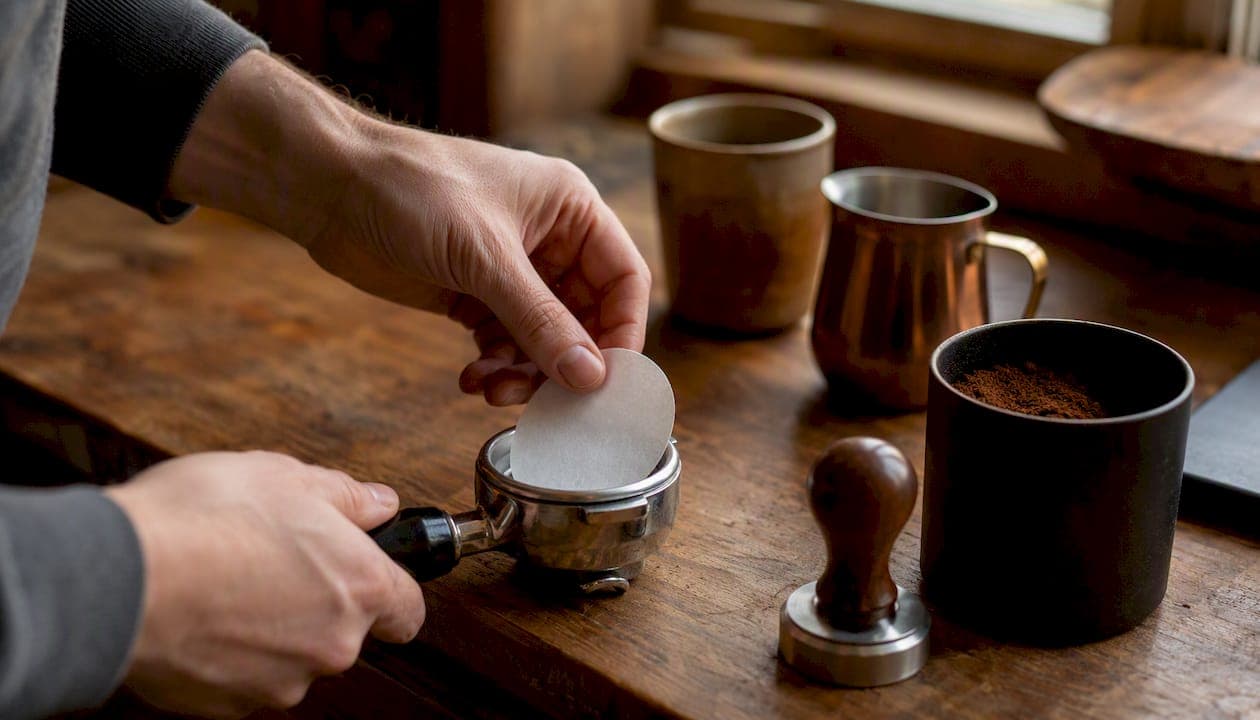
Yes, paper filters improve espresso clarity and can raise extraction yield, particularly with light roasts. They are worth trying if you want a cleaner cup, struggle with channeling, or want to grind finer without choking your basket. The tradeoff is reduced body, less crema, and increased single-use waste.
Three quick use cases:
- AeroPress microfilters stacked in a portafilter adapter are the lowest-cost entry point for experimenting with paper-filtered espresso.
- 58 mm portafilter papers (from makers like Weber Workshops or Good Brothers Coffee) fit most home machines and are precision-cut for consistent results.
- Hydraulic-resistance experiments show that a bottom paper can reduce flow resistance by roughly 43%, allowing a finer grind for the same shot time.
Paper filters are not a fix for poor technique. They are a precision tool that shifts the extraction profile toward clarity and yield — and they reward baristas who already have their fundamentals dialed in.
Key Takeaways
Paper filters are a practical, low-cost tool for home baristas who want higher extraction and cup clarity, particularly with light roasts, but they require a grind adjustment and come with body and crema tradeoffs.
| Point | Details |
|---|---|
| Bottom paper reduces resistance | A bottom paper cuts hydraulic resistance by roughly 43%, enabling a finer grind for the same shot time. |
| Grind finer after adding paper | Shot time will run fast without adjustment; grind finer in small steps to restore your 25–35 second target. |
| Rinse natural papers first | Use 50–100 ml of hot water to remove papery compounds; oxygen-bleached papers are more forgiving. |
| Match paper size to basket floor | Confirm floor diameter (not rim diameter) before buying; 58 mm rim baskets often need a 55–56 mm paper. |
| Use paper selectively | Light-roast and high-extraction sessions benefit most; daily dark-roast espresso gains little and adds waste. |
Table of Contents
- How do paper filters change espresso extraction?
- Where should you place the paper filter?
- Which paper type should you choose?
- How to use paper filters with a portafilter or AeroPress
- What sizes fit which equipment?
- What to look for when buying espresso paper filters in the U.S.
- What do experiments actually show?
- Environmental and cost tradeoffs
- A coffee educator's view on paper-filtered espresso
- Sources
How do paper filters change espresso extraction?
Paper removes nearly all oils and micro-fines from the espresso stream. The result in the cup is brighter acidity, reduced body, and noticeably less crema. For a washed-process light roast, that clarity can be a feature. For a dark, oily espresso blend, it often reads as thin.
The physical mechanism matters here. Basket holes are small and can partially clog with fine coffee particles during a shot, creating uneven flow paths and channeling. A paper placed beneath the puck covers those holes uniformly, so water distributes across the full basket floor rather than rushing through the clearest holes. Research from Coffee ad Astra measured this effect directly: a bottom paper reduced stable hydraulic resistance by approximately 43% (±4%) in small-sample experiments.
A 43% reduction in hydraulic resistance is not a marginal effect. It means the puck is doing less work to resist water flow, which changes the pressure dynamics across the entire shot.
That resistance drop has a practical consequence. With less resistance at the basket floor, you can grind finer and restore your target shot time, extracting more soluble compounds in the process. According to Takumi Brewing Lab, thicker papers slow drainage further and tend to increase extraction compared with thin paper, so filter choice is not neutral.
A paper placed on top of the puck serves a different purpose. It buffers the initial water impact from the shower screen, which can disturb the puck surface and trigger channeling. The top paper acts as a diffuser, spreading water more evenly before it contacts the coffee bed.
Where should you place the paper filter?
Placement determines what problem you are solving. The three configurations each have a distinct effect.
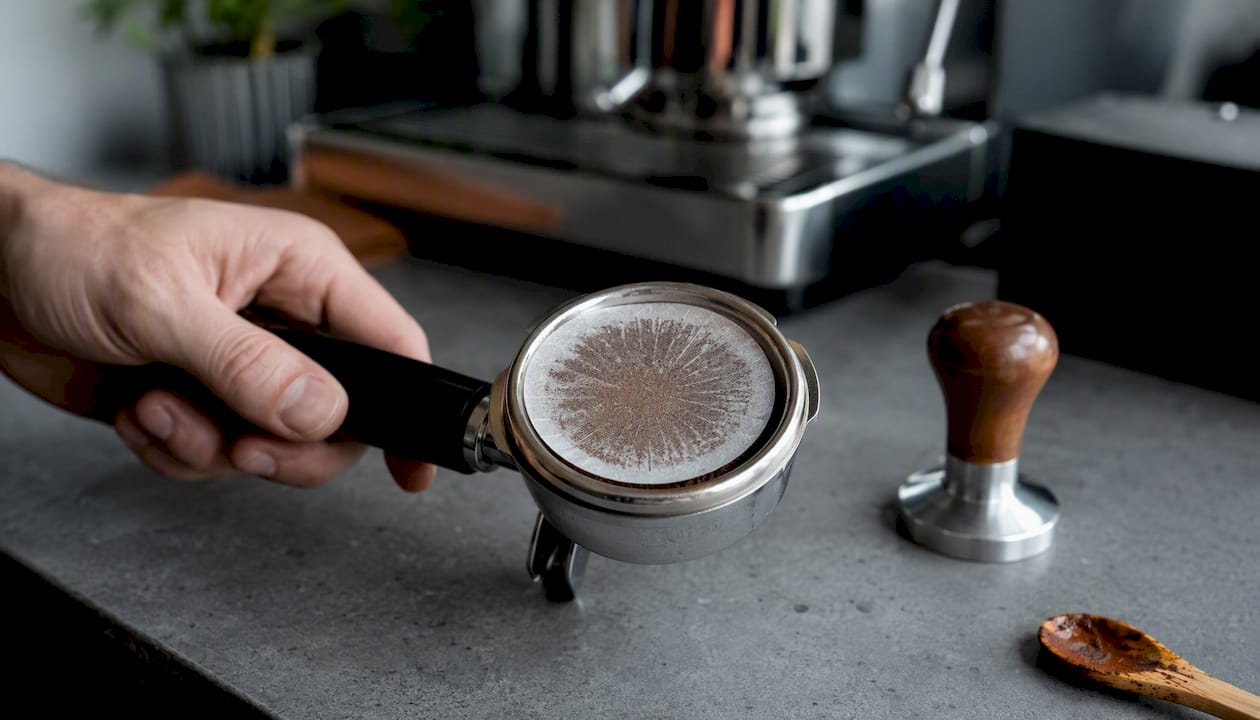
Bottom only is the most common starting point. The paper sits between the puck and the basket floor, preventing fines from clogging the holes and lowering hydraulic resistance. This is the configuration most practitioners reach for when they want higher extraction or a cleaner cup without dramatically altering workflow.
Top only addresses channeling rather than resistance. If your shots show signs of uneven extraction (fast early flow, pale streaks in the cup, or inconsistent TDS), a top paper can even out water distribution. It is less common than bottom placement but useful when your grinder or distribution technique is inconsistent.
Sandwich (top + bottom) combines both effects. Practitioners like Scott Rao have used this configuration for high-extraction light-roast work, and community experiments confirm it produces the clearest cups and highest extraction yields. The cost is a further reduction in body and crema. Use it when cup clarity is the explicit goal, not when you want a traditional espresso texture.
- Bottom paper: place dry or briefly rinsed in the basket before dosing.
- Top paper: lay flat on the tamped puck surface before locking in.
- Sandwich: both papers in place before the shot; rinse both if using natural (unbleached) paper.
Pro Tip: Rinse natural (unbleached) papers with 50–100 ml of hot water before use. Oxygen-bleached papers are more forgiving and can often be placed dry, but a quick rinse also preheats the basket, which helps shot temperature stability.
Which paper type should you choose?
Not all espresso papers are the same, and the differences affect both flavor and workflow.
Bleached vs. natural: Oxygen-bleached papers carry minimal papery flavor even without rinsing, which is why they are preferred in competition and busy service settings. Natural (unbleached) papers are more sustainable in production but carry more cellulose compounds that transfer to the cup if not properly rinsed. For home use, either works well with a proper rinse.
Thickness and crepe texture: Weber Workshops' EPF papers are precision-cut at 0.15 mm single-crepe, with a smooth side facing the coffee and a crepe side facing the basket floor. That texture is not decorative. The crepe side creates micro-channels that regulate exit flow, preventing the paper from sealing flat against the basket and blocking drainage entirely. Thicker papers, like those used in Chemex brewing, slow drainage substantially and would over-extract in a pressurized espresso environment.
Precision cutting: A poorly cut paper that bunches at the basket wall creates uneven resistance and can cause channeling at the edges. Specialty espresso papers are die-cut to exact diameters. Generic filter papers cut by hand are less reliable.
- Oxygen-bleached: preferred for speed and flavor safety; rinse optional but recommended.
- Natural/unbleached: rinse with 50–100 ml hot water before use.
- Single-crepe (0.15 mm): the standard for espresso; manages flow without over-restricting.
- Double-crepe or thick bonded papers: avoid for espresso; designed for gravity-drip methods.
- Food-safety labeling: look for papers explicitly rated for food contact and free of chlorine bleaching agents.
How to use paper filters with a portafilter or AeroPress
Portafilter workflow
- Select a paper cut to your basket diameter (58 mm, 54 mm, or 51 mm as appropriate).
- Rinse the paper with approximately 50–100 ml of hot water directly in the basket, then discard the rinse water.
- Dose your ground coffee onto the paper as you normally would.
- Distribute and tamp at your standard pressure (typically 15–20 kg).
- If using a top paper, lay it flat on the tamped puck surface before locking the portafilter into the group head.
- Pull the shot. Expect the shot time to run faster than usual on your first attempt.
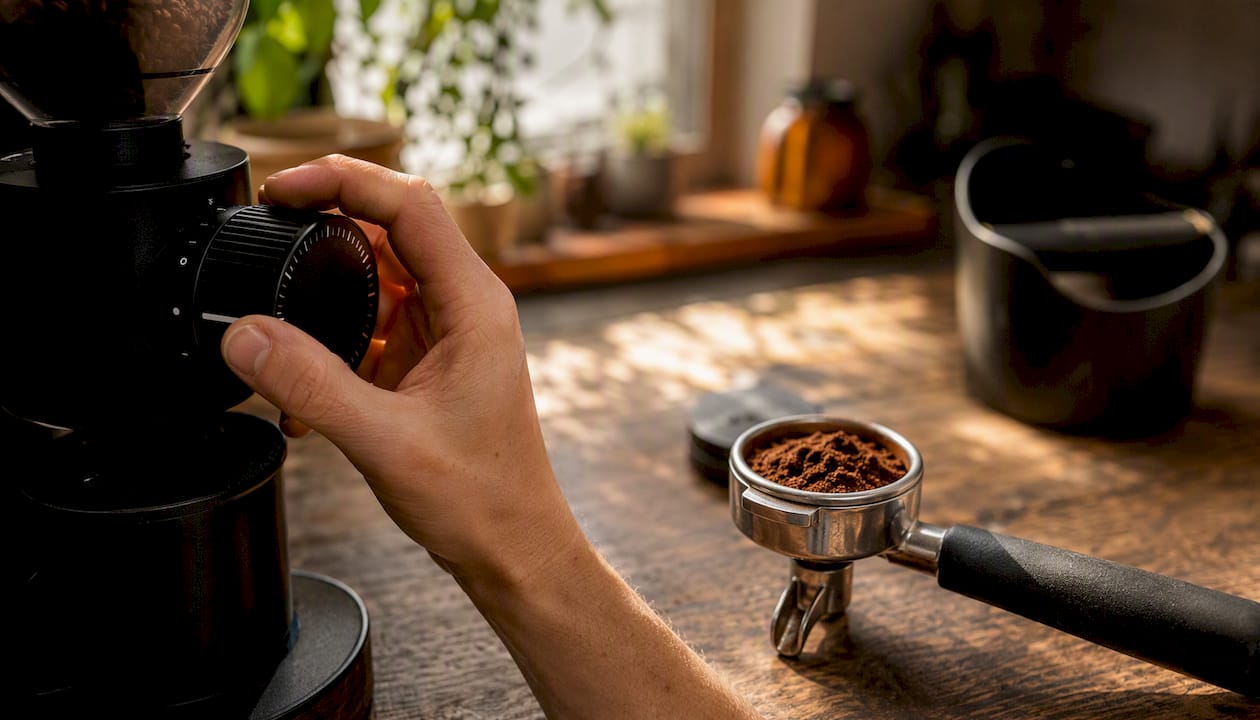
- Grind finer in small increments until you restore your target shot time (typically 25–35 seconds for a 1:2 ratio).
The grind adjustment is the step most home baristas miss. Because the bottom paper reduces hydraulic resistance, the same grind setting that produced a 30-second shot without paper may now run in 20 seconds. Grind finer to compensate.
One community test series observed small increases in TDS when using bottom and top paper filters, illustrating incremental extraction gains from each configuration. These are small-sample results and should be treated as directional, not definitive.
Pro Tip: Keep your first paper-filter shot at your existing grind setting to establish a baseline. Note the shot time, then adjust grind finer on subsequent shots. This isolates the paper's effect from other variables.
AeroPress workflow
AeroPress microfilters (the standard round papers included with the device) are thin and highly porous. For espresso-style brewing with an AeroPress, use one or two stacked microfilters in the cap. Rinse with approximately 50 ml of hot water before brewing. The thin paper allows faster flow than portafilter-specific papers, so grind adjustment is less dramatic.
What sizes fit which equipment?
Portafilter baskets are not standardized across brands, and buying the wrong diameter paper is the most common purchasing mistake.
A few practical notes on fit:
- The basket's floor diameter is smaller than its rim diameter. A 58 mm basket typically has a usable floor of 55–56 mm. Papers cut to 58 mm may need to curl slightly at the edges, which is acceptable if the paper is thin and pliable.
- Weber Workshops specifically engineers multiple sizes for Unibasket and standard 58 mm workflows, acknowledging that basket geometry varies.
- Cutting larger papers (V60, AeroPress) to fit a portafilter is possible but produces inconsistent edges. Purpose-cut espresso papers are worth the modest cost difference.
What to look for when buying espresso paper filters in the U.S.
The U.S. market carries a reasonable range of espresso-specific papers, though availability varies by retailer.
- Diameter match: Confirm your basket's floor diameter before ordering. Most product listings specify compatibility (58 mm, 54 mm, 51 mm, or Unibasket).
- Single-crepe construction: Look for papers described as single-crepe or 0.15 mm. This is the standard for espresso and manages flow without over-restricting.
- Bleached vs. natural: Oxygen-bleached papers (sometimes labeled "ECF" or "oxygen-bleached") are the safer choice for flavor. Natural papers are fine with a proper rinse.
- Food-safety certification: Papers should be explicitly rated for food contact. Avoid papers marketed only for industrial or non-food applications.
- Pack size and cost: Packs of 100–1,000 are standard. Per-shot cost is low, but if you pull multiple shots daily, the cumulative cost and waste add up.
- Good Brothers Coffee produces espresso-specific papers available in the U.S. market, cut for 58 mm baskets and designed for portafilter use.
- Weber Workshops EPF ships to the U.S. and offers the most precisely engineered options, including Unibasket sizing.
- AeroPress microfilters are widely available at U.S. coffee retailers and online; they double as an inexpensive entry point for portafilter experiments when cut to size (with the caveats about edge consistency noted above).
- Generic pour-over papers (Hario V60, Kalita Wave) are not recommended for portafilter use. V60 papers are cone-shaped and do not lie flat; Kalita Wave papers are crimped and designed for a specific basket geometry.
What do experiments actually show?
The experimental record on paper-filtered espresso is consistent in direction but limited in scale. Most published tests involve small sample sizes, single machines, and one or two grinders. Treat the numbers as orientation, not specification.
The most rigorous quantitative work on hydraulic resistance comes from Coffee ad Astra, which measured a 43% (±4%) reduction in stable hydraulic resistance with a bottom paper. The proposed mechanism is that the paper distributes flow across the entire basket floor rather than concentrating it through the basket holes, which are the natural bottleneck in a standard setup.
The resistance reduction is large enough to change shot dynamics meaningfully. A 43% drop in resistance at the basket floor is not a subtle effect — it shifts where the puck does its work.
On extraction, community tests and practitioner reports show modest but consistent TDS increases. The TDS figures cited above (9.49 to 10.03 across configurations) come from a single YouTube test series reported by NewGround Magazine. They illustrate the directional effect but should not be treated as universal benchmarks.
The tradeoffs are equally consistent. Home-barista and practitioner reports document reduced crema, lighter mouthfeel, and occasional astringency, particularly with darker roasts or lower-quality grinders where the paper amplifies extraction unevenness rather than correcting it.
Methodological limits worth keeping in mind: machine pressure, basket geometry, grinder burr profile, and puck preparation all interact with the paper's effect. A result from one setup may not transfer directly to another.
Environmental and cost tradeoffs
Paper filters are inexpensive on a per-shot basis. Packs of 100–1,000 are the norm, and the cost per shot is low enough that it rarely drives purchasing decisions. The more meaningful consideration is cumulative single-use waste.
- A home barista pulling two shots daily uses roughly 730 papers per year with a bottom-only setup, or 1,460 with a sandwich.
- Most espresso papers are uncoated cellulose and can be composted with the spent puck, which reduces landfill impact.
- Reusable alternatives (metal mesh screens, cloth filters) eliminate per-shot waste but do not replicate the oil and fines removal that paper provides. Metal filters, in particular, pass more oils and micro-fines, producing a cup closer to French press in body and texture.
- Puck screens (stainless steel discs placed on top of the puck) address channeling and water distribution without filtering oils. They are a reusable alternative to a top paper but do not affect extraction chemistry the way paper does.
- The most practical approach for limiting waste: use paper selectively. Light-roast, high-extraction sessions or competition-style preparation benefit most. For daily dark-roast espresso where body and crema are priorities, paper adds cost and waste without a clear sensory benefit.
A coffee educator's view on paper-filtered espresso
Paper-filtered espresso occupies an interesting position in the home barista's toolkit. It is genuinely useful, but it is also frequently misapplied.
The clearest case for paper is light-roast, high-extraction work where cup clarity is the goal. A washed Ethiopian or Colombian at a 1:2.5 or longer ratio, pulled through a bottom paper on a well-calibrated grinder, can reveal floral and fruit notes that get muddied in a standard shot. That is a real and reproducible effect, and it is worth the experiment.
Where paper tends to disappoint is when it is applied as a remedy for inconsistent technique. Channeling caused by poor distribution or an uneven tamp is not reliably fixed by a top paper. Extraction problems rooted in grinder calibration are not solved by adding resistance at the basket floor. Paper shifts the extraction profile; it does not correct the underlying variables.
The sandwich configuration deserves more attention from home baristas than it typically receives. The TDS increases are modest, but the reduction in shot-to-shot variation is practically useful, particularly for baristas still dialing in a new coffee. It is a low-cost experiment that costs nothing to reverse.
For teaching purposes, paper filters are valuable precisely because they make the effects of hydraulic resistance and fines migration visible and measurable. Pulling the same coffee with and without a bottom paper, on the same grinder setting, demonstrates in one shot why basket design and puck preparation matter. That kind of direct comparison builds intuition faster than any explanation.
Sources
- How a Paper Filter Below an Espresso Puck Affects Hydraulic Resistance – Coffee ad Astra
- Coffee Filters Guide - Takumi Brewing Lab
- Espresso Paper Filter | Improve Extraction & Flavor - Caffeine & Photos
For a deeper grounding in espresso science and brewing methods, The Complete World of Coffee by Keith Lyons covers extraction mechanics, filter theory, and sensory evaluation in detail. Readers who want the science behind what paper filters are doing at a molecular level will find the coffee science resources at Lyons Den Publishers a useful companion to the experiments cited here.