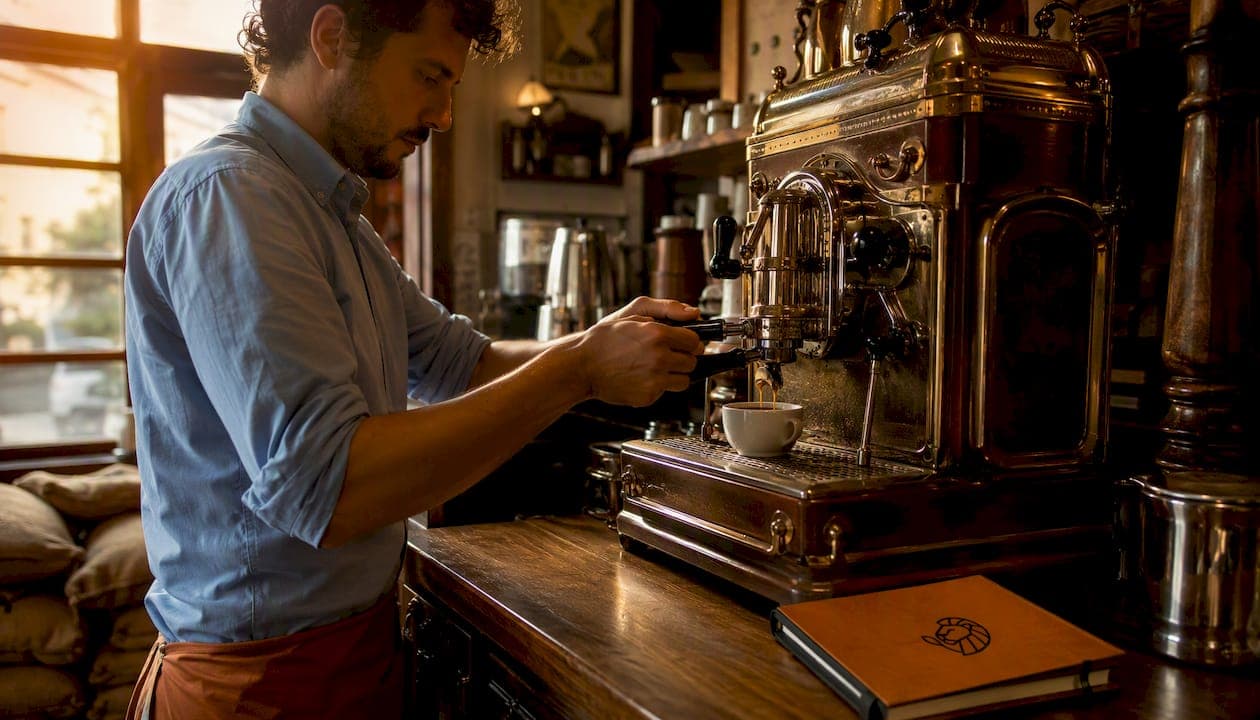
Espresso originated in Italy, tracing its roots to a steam-driven patent filed in Turin in 1884 and reaching its modern form through a sequence of mechanical and commercial innovations that stretched into the 1960s. No single inventor deserves sole credit. The story is layered, built across decades by engineers, entrepreneurs, and café culture.
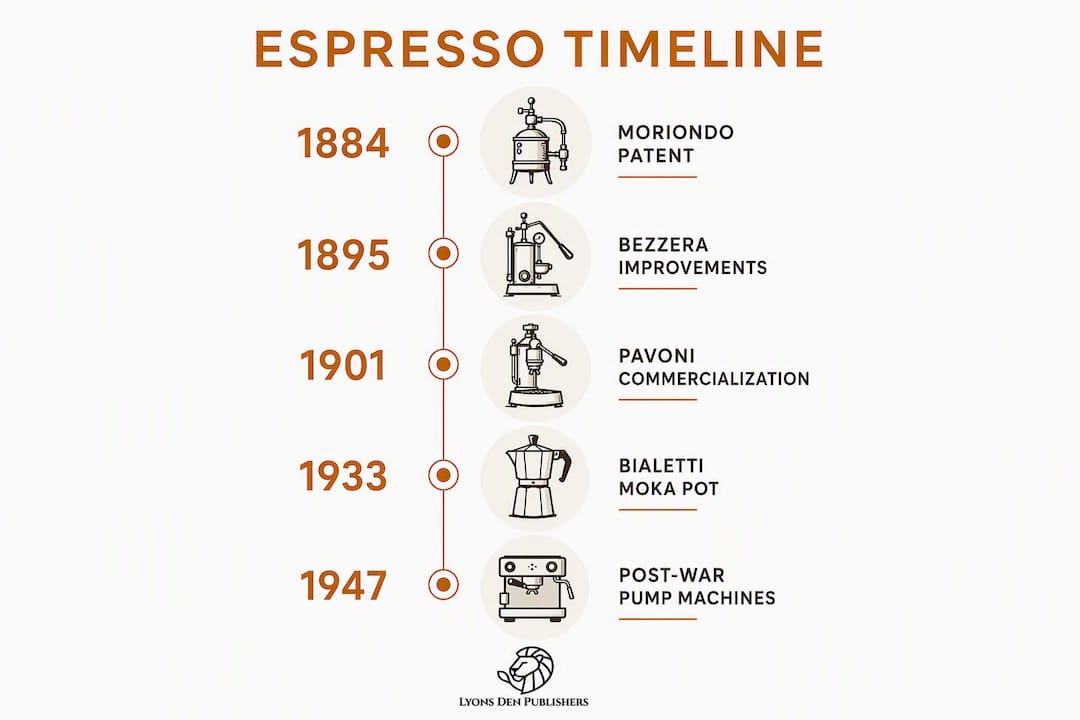
- 1884, Turin: Angelo Moriondo received a patent for a steam-and-water machine that brewed coffee in bulk, the first Italian bar device to control steam and water separately through the grounds.
- 1901–1905, Milan: Luigi Bezzera filed patents for single-cup mechanics and the portafilter; Desiderio Pavoni purchased those patents and began selling commercial machines, adding the pressure-release valve and scaling production.
- 1947–1961: Achille Gaggia's lever-piston machine pushed water through grounds at 8–12 atmospheres, producing crema for the first time.
The Faema E61 (1961) replaced manual levers with a motorized electric pump delivering a steady ~9 bars, setting the technical standard that defines espresso today.
Table of Contents
- What is the origin of espresso? A timeline of key milestones
- What did people drink before espresso existed?
- Angelo Moriondo, Luigi Bezzera, and Desiderio Pavoni: who actually built espresso?
- How machine technology changed what was in the cup
- What does the word "espresso" actually mean?
- How did the sensory profile of espresso change over time?
- How do historians reconstruct the espresso origin story?
- How did espresso spread from Italian cafés to the world?
- Key Takeaways
- Why the origin story still matters to how you taste espresso
- Explore the full history of espresso with Lyons Den Publishers
- Useful sources for further reading
What is the origin of espresso? A timeline of key milestones
| Year | Figure / Machine | Milestone |
|---|---|---|
| 1884 | Angelo Moriondo | Steam-and-water patent filed in Turin; bulk brewer; bronze medal at the General Expo of Turin |
| 1901 | Luigi Bezzera | Patents for single-cup extraction and portafilter attachments filed in Milan |
| 1903–1905 | Desiderio Pavoni | Purchased Bezzera's patents; added pressure-release valve; began commercial sales; exhibited the Ideale at the 1906 Milan Fair |
| 1920s | Arduino and others | Machine exports and marketing expanded espresso beyond Italy |
| 1947–1961 | Achille Gaggia | Lever-piston machine reached 8–12 atmospheres; crema appeared as a defining quality marker |
| 1961 | Faema E61 | Motorized electric pump; steady ~9 bars; plumbing-fed water; modern café scalability |
Each row in that table represents a genuine technical or commercial leap, not a cosmetic refinement. The gap between Moriondo's bulk brewer and Gaggia's lever machine is the difference between a factory urn and a precision instrument.
What did people drink before espresso existed?
Before pressure-driven extraction arrived, Italian and European café-goers relied on methods that were slow, batch-oriented, and ill-suited to a busy counter.
- Ibrik / Turkish coffee: Finely ground coffee simmered directly in water, producing a thick, sediment-heavy cup. Common in the Ottoman world and parts of southern Europe, but not adapted to high-volume café service.
- Filter and infusion brewing: Ground coffee steeped or dripped through cloth or paper, producing a cleaner but slow cup. Batch-brewed and held warm, which degraded flavor over time.
- Percolator-style batch brewers: Large vessels that cycled hot water repeatedly through grounds. Efficient for volume but prone to over-extraction and bitterness.
The economic pressures of Italian café culture pushed proprietors toward faster counter-service models. Regulated coffee pricing meant margins were thin; speed of service was the competitive lever. A method that could produce a single cup in seconds, on demand, had obvious commercial value. That pressure, more than any single inventor's curiosity, drove the search for a faster machine.
The Bialetti moka pot, introduced in 1933, belongs to this same heritage. It uses steam pressure to push water upward through grounds, producing a concentrated brew at home. The moka pot shares the steam-pressure lineage with early espresso machines, but it operates at roughly 1–2 bars and produces a different sensory result. It is a domestic parallel, not a direct ancestor of the café espresso machine.
Angelo Moriondo, Luigi Bezzera, and Desiderio Pavoni: who actually built espresso?
The honest answer is that all three did, in sequence, and none of them alone would have been sufficient.
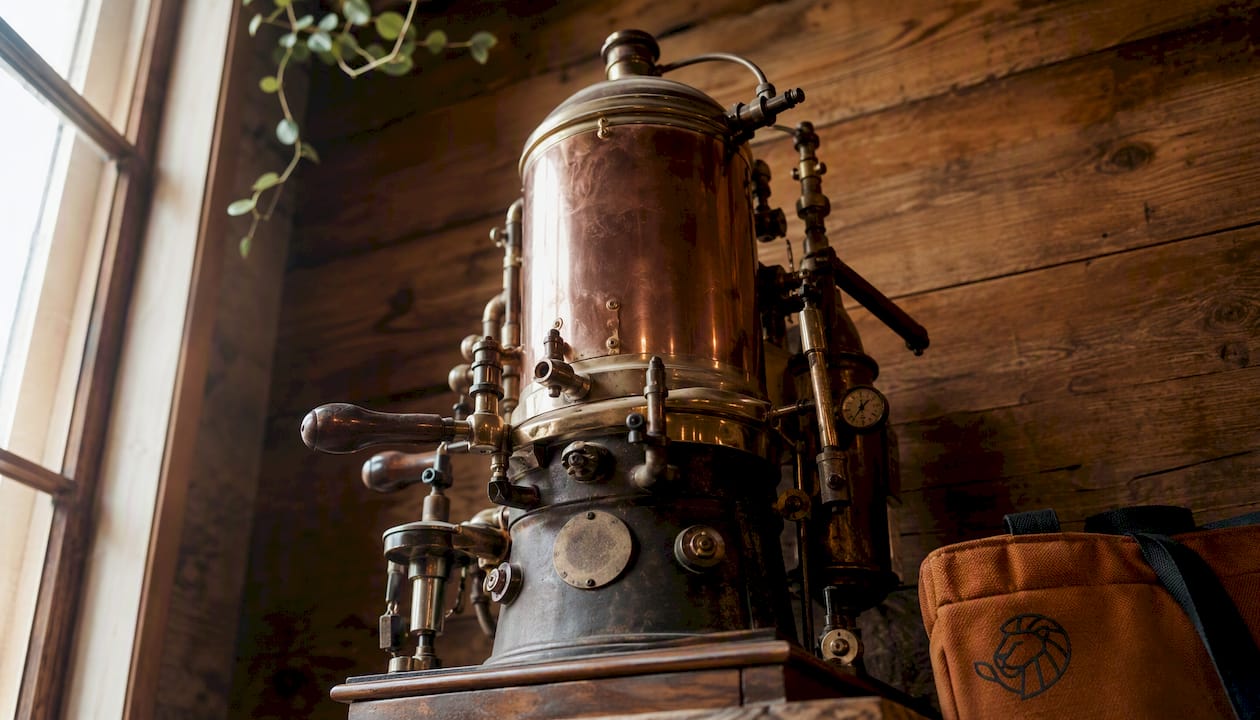
Angelo Moriondo (June 6, 1851 – May 31, 1914) was a Turin entrepreneur with interests in hospitality. His 1884 patent described a device that pushed water through a bed of grounds using a combination of steam and boiling water, controlling both supplies separately. The machine brewed in bulk rather than single servings, but it demonstrated a workable principle. Moriondo exhibited it at the General Expo of Turin in 1884 and received a bronze medal. Archival research has since confirmed multiple Moriondo models and international filings, correcting earlier accounts that dismissed him as a footnote.
Luigi Bezzera was a Milanese engineer who filed patents around 1901 for improvements that changed the category. His key contribution was the portafilter: a handle-mounted filter basket that attached to the machine and allowed a single serving to be prepared and removed quickly. That mechanical detail is still present on every commercial espresso machine made today. Bezzera also introduced the group head, the interface between boiler and portafilter. His commercial instincts, however, were limited, and he sold his patents rather than building a manufacturing business.
Desiderio Pavoni bought those patents around 1903 and understood something Bezzera did not: that a machine is only as valuable as its distribution. Pavoni began selling commercial machines from 1905, added a pressure-release valve that made the machines safer and more practical, and exhibited the Ideale model at the 1906 Milan Fair, where it reached a national audience of café owners. He is, in the clearest sense, the person who turned espresso into a product.
"The term 'espresso' signals not just speed but also a cup brewed expressly for a single customer; this shift from bulk to made-to-order extraction is the conceptual pivot in espresso history." — Smithsonian Magazine
The layered nature of this story is not a diplomatic compromise. Historians consistently describe the origin as multi-stage: Moriondo's steam patent provided the technical proof of concept, while Bezzera, Pavoni, Gaggia, and later manufacturers each contributed innovations that were necessary to reach the modern result.
How machine technology changed what was in the cup
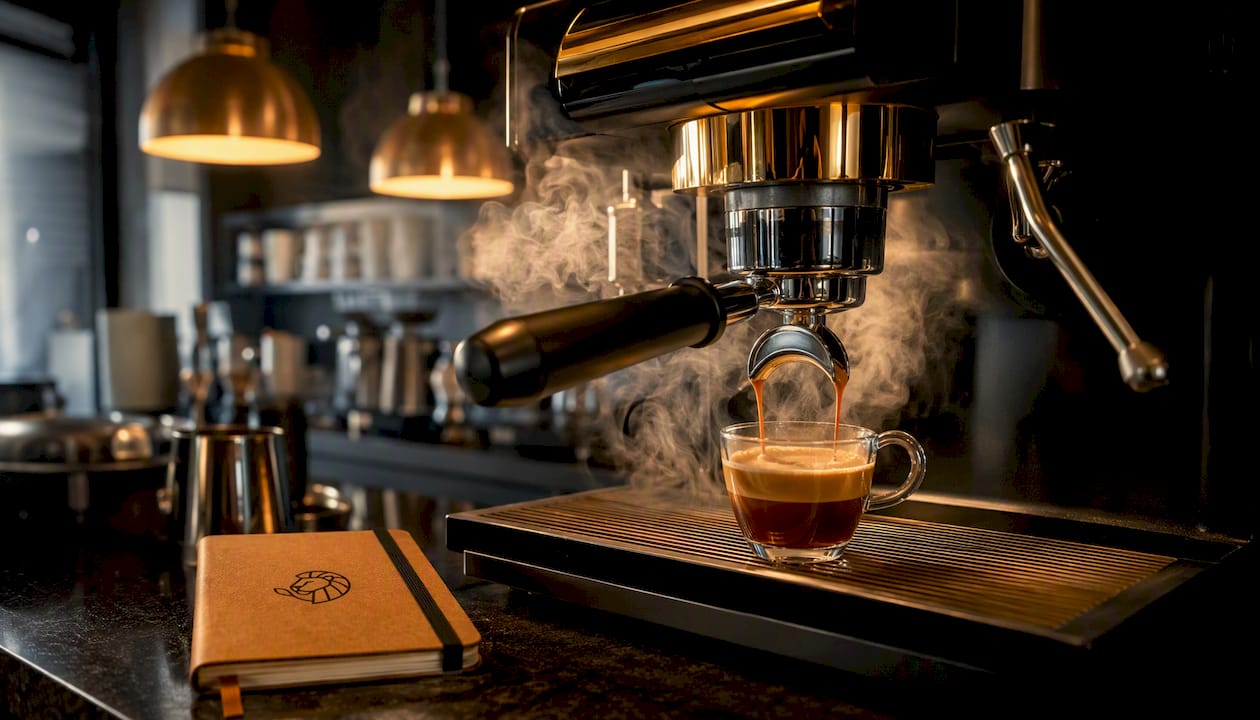
The sensory profile of espresso, the crema, the body, the 25-second extraction, is not a natural property of coffee. It is the product of specific mechanical conditions, and those conditions changed dramatically across three machine generations.
Steam-era machines (pre-1947)
- Operating pressure: approximately 1.5 bars
- Extraction: longer, higher-volume shots
- Flavor: often bitter, lacking sweetness or complexity
- Crema: absent
- Volume capacity: early machines could produce very high hourly volumes, but the drink was closer to strong filter coffee than modern espresso
Lever/piston machines (1947 onward)
- Operating pressure: 8–12 atmospheres (Gaggia's spring-piston mechanism)
- Extraction: shorter, more concentrated
- Flavor: noticeably sweeter, more complex
- Crema: present; Gaggia marketed it as caffè crema to distinguish his product
- Mechanism: a spring-loaded piston compressed by the barista's pull on a lever, then released to push water through the puck at high pressure
Motorized pump machines (1961 onward)
- Operating pressure: steady ~9 bars (Faema E61)
- Extraction: consistent shot to shot; plumbing-fed water removed the need for manual boiler refilling
- Flavor: balanced; the consistency of pressure and temperature enabled repeatable results
- Scalability: a café could now run multiple groups from one machine without variation between shots
Gaggia's lever machines used a smaller cylinder and spring-piston to reach higher extraction pressures. That mechanical change, not marketing alone, created crema by emulsifying oils and colloids at pressure. The Faema E61's adoption of an electric pump and heat-exchange path for water allowed cafés to run consistent shots from plumbing-fed water, moving espresso from a specialty novelty to a scalable café beverage.
Pro Tip: If you want to taste the mechanical difference, compare a shot pulled on a manual lever machine against one from a modern pump machine using the same coffee and grind. The lever shot will often show more textural variation and a thicker, coarser crema; the pump shot will be more uniform. Neither is objectively better, but the contrast makes the engineering history tangible.
What does the word "espresso" actually mean?
The word comes from the Italian espresso, past participle of esprimere, meaning "to press out" or "to express." In its earliest commercial use, it carried a second meaning: a cup prepared expressly for the customer standing at the counter. That made-to-order quality was the marketing proposition Pavoni built around the Ideale, and it distinguished espresso from the batch-brewed alternatives that café owners had relied on for decades.
The common misconception that "espresso" means "fast" is understandable but incomplete. Speed was a consequence of the method, not its defining characteristic. A cup brewed expressly for one person, on demand, from freshly ground coffee, was the concept. Speed followed from the pressure-driven extraction.
Modern definitions used by specialty coffee institutions describe espresso as produced by forcing very hot water under high pressure through finely ground, compacted coffee, with a typical serving of 25–30 ml, crema as a sensory marker, and published parameters covering coffee dose, water temperature, pressure, and extraction rate. No single universal standard exists, but the Specialty Coffee Association and the Istituto Nazionale Espresso Italiano each publish specific parameters that professional baristas use as reference points.
How did the sensory profile of espresso change over time?
The cup changed as dramatically as the machine. Early steam-era espresso and modern pump espresso share a name and a general method, but the sensory experience is substantially different.
Modern espresso parameters (pump era):
- Typical shot volume: 25–30 ml
- Target pressure: ~9 bar
- Extraction time: approximately 20–30 seconds
- Grind: fine, uniform
- Dose: typically 7–9 g (single) or 14–18 g (double)
- Crema: present, reddish-brown, persistent
| Characteristic | Steam era (pre-1947) | Pump era (1961 onward) |
|---|---|---|
| Pressure | ~1.5 bar | ~9 bar |
| Crema | Absent | Present, persistent |
| Shot volume | Longer, higher volume | 25–30 ml |
| Extraction time | Extended | 20–30 seconds |
| Dominant flavor | Bitter, flat | Balanced; sweet and bitter |
| Consistency | Variable | Repeatable shot to shot |
Crema became a hallmark only after higher-pressure innovations because it requires the emulsification of coffee oils and the suspension of CO₂ bubbles, processes that do not occur at 1.5 bars. Early espresso was also longer in volume because the steam pressure could not stop extraction cleanly; the result was a drink closer in character to a strong, slightly bitter filter coffee. The shift to higher, stable pressures and better temperature control after the war established the sensory standards that coffee drinkers now associate with the category.
How do historians reconstruct the espresso origin story?
The documentary record for espresso history is richer than most food histories, largely because the key innovations were patented and exhibited publicly. Patents filed with national registries carry dates, technical drawings, and inventor names, making them primary sources in the strict sense. Moriondo's 1884 patent, Bezzera's 1901 filings, and Pavoni's subsequent modifications are all traceable through Italian patent archives.
Trade-fair catalogs and contemporary advertisements add commercial context. The 1906 Milan Fair, where Pavoni exhibited the Ideale, left catalog records that historians have used to establish both the machine's design and its public reception. Surviving machines in museum collections provide physical evidence that cross-checks patent drawings against actual construction.
Archival research by scholars including Franco Capponi and Ian Bersten unearthed Moriondo patent records and images documenting multiple models and international filings, correcting earlier accounts that focused solely on Bezzera and Pavoni. Moriondo had been largely written out of the story because his machines were never widely commercialized; without a product on the market, his name did not circulate in trade literature. Archival recovery changed that.
The contested areas in the record are mostly commercial rather than technical. Who first used the word "espresso" in advertising? Which machine first reached a specific pressure threshold? These questions are harder to answer from patents alone and depend on surviving trade catalogs, newspaper advertisements, and oral histories that are incomplete. Historians are candid about those gaps, which is why the layered-origin framing is both more accurate and more honest than any single-inventor claim.
How did espresso spread from Italian cafés to the world?
Espresso left Italy through several overlapping channels, none of which was planned as a cultural export.
- Machine manufacturers: Companies like Pavoni, La Pavoni, and later Faema sold machines to café owners across Europe, particularly in France, Switzerland, and the United Kingdom, from the 1920s onward.
- Italian migration: Italian communities in the United States, Australia, and South America brought café culture with them. Espresso bars in cities like Melbourne, New York, and Buenos Aires were often established by Italian immigrants who imported both machines and the counter-service model.
- Trade fairs and marketing: Posters, postcards, and exhibition catalogs circulated the image of espresso as a modern, efficient, and distinctly Italian beverage. The visual language of espresso, the small cup, the standing customer, the gleaming machine, became a recognizable shorthand for Italian modernity.
- Mid-century automation: The Faema E61's pump technology made it practical for cafés outside Italy to run consistent espresso service without specialized technical knowledge. Scalability was the key to global adoption.
The specialty coffee movement, which gained momentum from the 1980s onward, reframed the origin story in a different direction. Where mid-century marketing emphasized speed and modernity, specialty coffee emphasized craft, sensory standards, and the provenance of the bean. The historical figures, Moriondo, Bezzera, Pavoni, Gaggia, became reference points for a community interested in understanding why the machine works the way it does, not just that it does.
Key Takeaways
The origin of espresso is a multi-stage technical and cultural story, not a single invention, spanning from Moriondo's 1884 Turin patent through the Faema E61's 1961 pump innovation that set the modern 9-bar standard.
| Point | Details |
|---|---|
| Moriondo's foundational patent | Angelo Moriondo filed the first Italian bar machine patent in Turin in 1884, controlling steam and water separately. |
| Bezzera and Pavoni commercialized the single cup | Bezzera's 1901 portafilter patents and Pavoni's 1903–1905 commercial machines turned a prototype into a product. |
| Gaggia's lever created crema | Achille Gaggia's post-war piston machine reached 8–12 atmospheres, producing crema for the first time. |
| Faema E61 set the modern standard | The 1961 E61's electric pump delivered steady high pressure, enabling consistent, scalable café espresso. |
| Lyons Den Publishers covers the full history | The Complete World of Coffee by Keith Lyons traces espresso history, science, and culture in one comprehensive reference. |
Why the origin story still matters to how you taste espresso
The conventional wisdom treats espresso history as trivia: interesting, perhaps, but irrelevant to what happens in the cup. That view misses something. Knowing that crema is a product of pressure, not a natural property of coffee, changes how you evaluate it. Knowing that early espresso was longer, more bitter, and produced at a fraction of modern pressure explains why the word "espresso" once described something quite different from what a barista pulls today.
The history also clarifies what "authentic" means in espresso. Purists sometimes invoke tradition to defend a single preparation style, but the tradition itself changed repeatedly and deliberately across eight decades of engineering. The lever machine was a radical departure from steam-era practice. The pump machine was a radical departure from the lever. Each generation of practitioners believed they were making espresso better, and by the measurable standards of consistency and sensory balance, they were right.
For home baristas, the practical takeaway is this: the parameters that define modern espresso, 9 bars, 25–30 ml, 20–30 seconds, are not arbitrary. They emerged from a specific mechanical history, and understanding that history helps you diagnose what goes wrong when a shot falls outside those parameters. A sour espresso, for instance, is often a pressure or extraction-time problem, the same variables that occupied Gaggia and Valente decades ago.
Pro Tip: Seek out a café that operates a manual lever machine alongside a modern pump machine and order the same coffee on both. The lever shot will vary slightly with the barista's pull; the pump shot will be more uniform. Tasting them side by side is the most direct way to experience what the engineering history actually produced.
Explore the full history of espresso with Lyons Den Publishers
The Complete World of Coffee by Keith Lyons covers the history, science, and culture of espresso in the depth this article can only introduce. From Moriondo's Turin patent to the chemistry of crema formation, the book traces every significant development with the same documentary rigor that specialty coffee professionals expect.
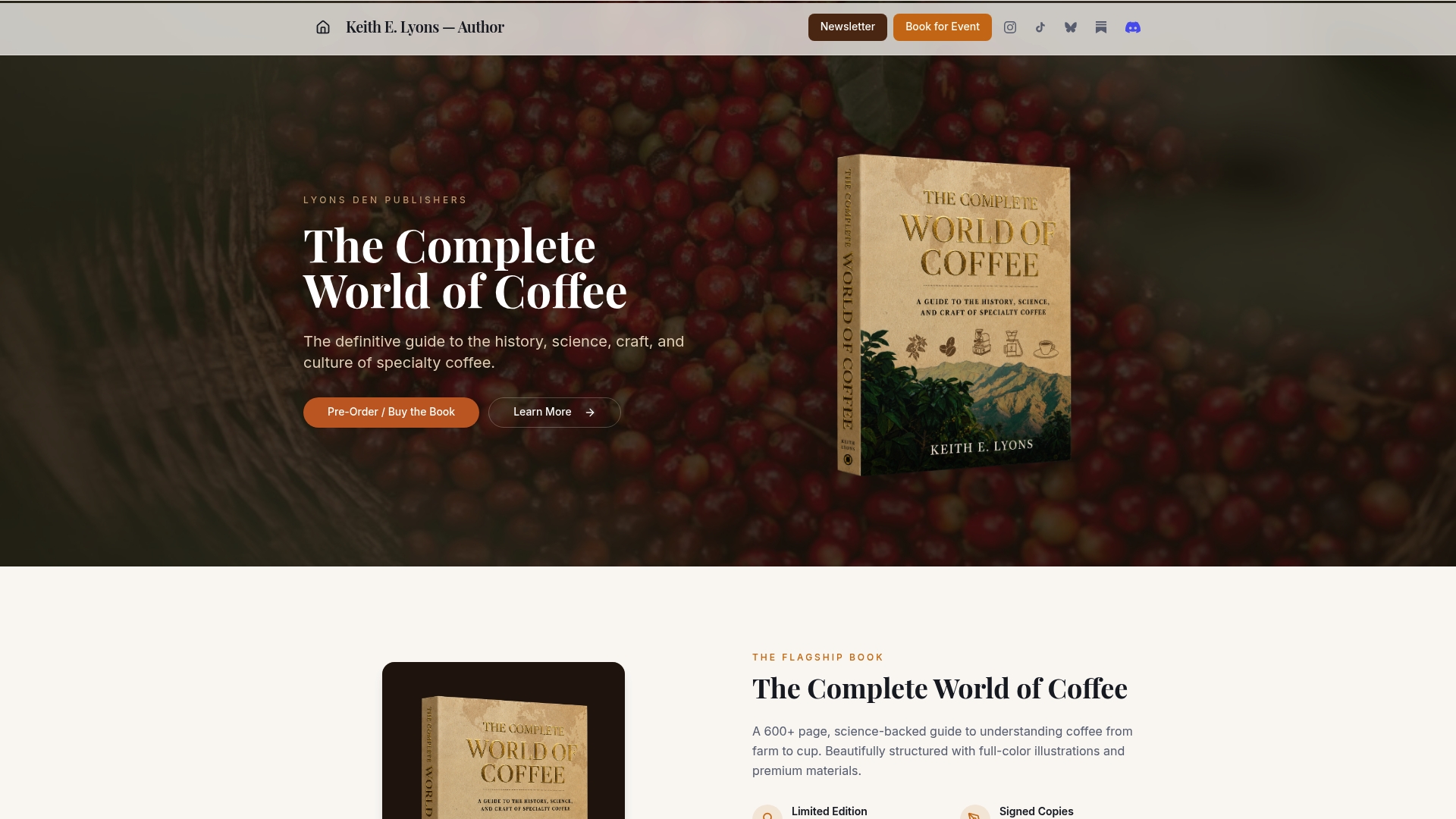
Readers who want to go further into coffee history will find dedicated chapters on Italian café culture, machine evolution, and the global diffusion of espresso alongside the broader story of how coffee moved from its origins to the modern specialty cup. The coffee science section covers extraction chemistry, pressure dynamics, and sensory evaluation in detail that complements the historical narrative here. Whether you are a home barista refining your technique or a coffee professional building your reference library, The Complete World of Coffee is the resource built for that level of inquiry.
Useful sources for further reading
The claims in this article rest on primary sources and peer-reviewed secondary histories. The following are the most useful starting points for readers who want to verify facts or read deeper.
- Angelo Moriondo — Wikipedia: Biographical entry with patent dates (May 16, 1884) and the General Expo of Turin citation; a reliable starting point for the foundational patent.
- Espresso — Wikipedia: Technical overview covering Bezzera, Pavoni, Gaggia, and Faema with citations to secondary histories; useful for cross-checking dates and machine specifications.
- Espresso Machine — Wikipedia: Parallel entry focused on machine development; includes patent numbers and model histories.
- The Long History of the Espresso Machine — Smithsonian Magazine: Accessible secondary history drawing on museum records and trade-fair documentation; covers Pavoni's commercialization and the Faema E61 in detail.
- Angelo Moriondo: The Myth of the Selfish Barista — Barista Hustle: Research paper drawing on Franco Capponi and Ian Bersten's archival work; the most thorough English-language treatment of Moriondo's multiple models and international filings.
- Understanding the History and Evolution of the Espresso Machine — Perfect Daily Grind: Recent synthesis covering the layered-origin interpretation; useful for understanding how contemporary specialty coffee frames the historical narrative.
- Jonathan Morris on Coffee History — Johns Hopkins Hub: Interview with a leading coffee historian covering the economic and cultural drivers of espresso's development.
- The Complete World of Coffee by Keith Lyons (Lyons Den Publishers): Comprehensive reference covering espresso history, machine science, and sensory evaluation; the most thorough single-volume treatment available for enthusiasts and professionals.
Verifying patent records: Italian patents from the 1880s onward are held by the Ufficio Italiano Brevetti e Marchi (Italian Patent and Trademark Office). Moriondo's original filing is referenced as patent No. 33/256, dated 1884. For international cross-checks, the European Patent Office's Espacenet database and the World Intellectual Property Organization's PATENTSCOPE both index historical filings with searchable inventor names and dates.