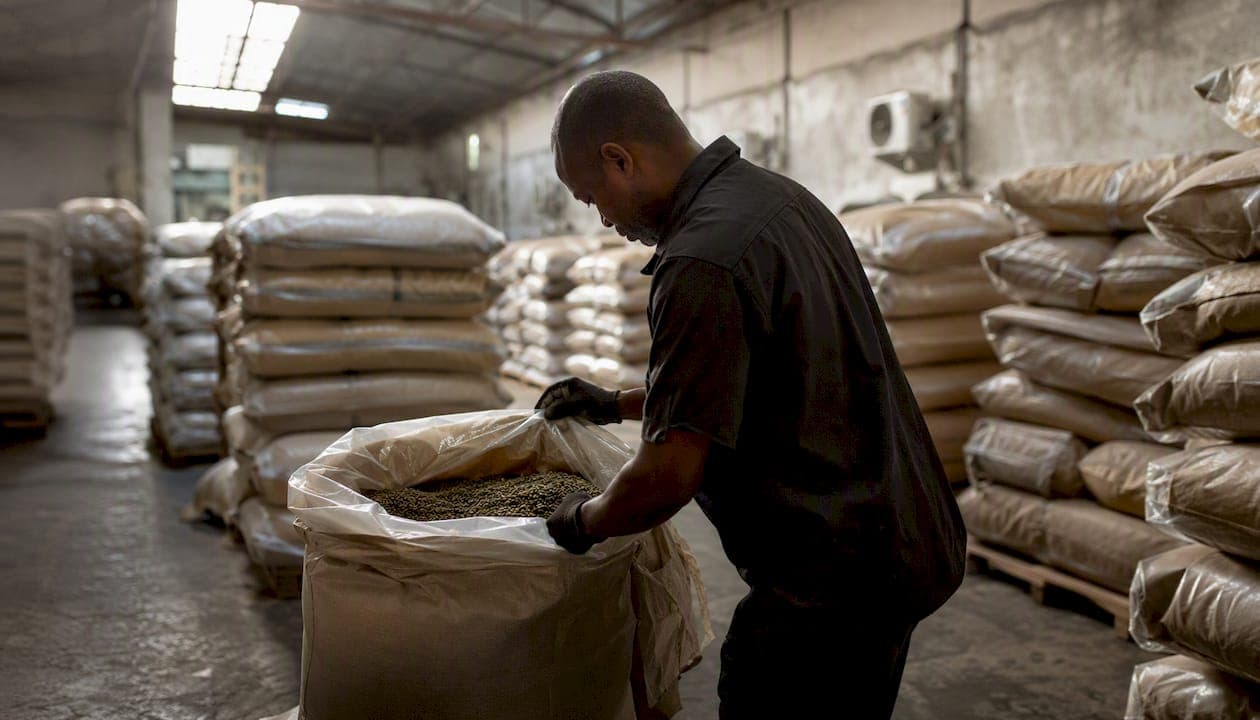
The single most effective approach to storing green (unroasted) coffee is maintaining a stable cool temperature, controlled relative humidity, and airtight or hermetic packaging. Get those three variables right and most lots will hold their quality for twelve months or more.
Three actions to take the moment a shipment arrives:
- Receive and tag. Record the lot number, origin, processing method, and arrival date on every bag or container before it touches a shelf.
- Isolate and inspect. Move new arrivals to a quarantine area, check for off-odors, visible moisture, or pest activity, and measure moisture content before integrating with existing stock.
- Monitor immediately. Log the ambient temperature and relative humidity of the storage area on day one and every day for the first week.
Pro Tip: Take a 300 g sample from each new lot on arrival, cup it as a baseline, and seal the remainder in a labeled sample jar. That reference cup becomes your benchmark for detecting sensory drift during later monthly checks.
Key Takeaways
Stable temperature (60–70°F), controlled relative humidity (50–60%), and hermetic packaging are the three non-negotiable foundations of effective green coffee bean preservation.
| Point | Details |
|---|---|
| Temperature and RH targets | Store at moderate temperatures and relative humidity levels within a recommended range; stability matters more than precise daily values. |
| Hermetic packaging | Use multi-layer hermetic liners for any lot held beyond four to six weeks; jute and paper offer no meaningful moisture barrier. |
| Moisture content on arrival | Measure every incoming lot; flag anything outside 9–13% for immediate review before placing it in storage. |
| Rotation and sampling | Apply FIFO rotation and cup each lot monthly for the first six months, then quarterly, to catch sensory drift early. |
| Quarantine protocol | Isolate any lot showing off-odors, pest activity, or unexpected cupping results until a full assessment is complete. |
Table of Contents
- Why proper green coffee storage matters for quality and value
- Does packaging make a difference for green bean preservation?
- How long can green coffee be stored realistically?
- What temperature and humidity targets should U.S. roasters aim for?
- How do light, pests, and contamination affect stored green coffee?
- What container options work best at different scales?
- A step-by-step storage checklist from receiving to roast
- What do ISO standards and industry guidelines say about storage science?
- Final recommendations for protecting your green coffee
- A coffee educator's perspective on why this guidance matters
- Sources
Why proper green coffee storage matters for quality and value
Green coffee is a living, hygroscopic material. It absorbs and releases moisture in response to its surroundings, and that exchange drives nearly every form of quality loss a roaster will encounter. Understanding the mechanism behind degradation is what separates a disciplined storage program from a guessing game.
The main degradation pathways are moisture exchange, oxygen exposure, temperature fluctuation, light, and pest activity. Moisture is the fastest-acting threat: beans that absorb ambient humidity above safe thresholds become susceptible to mold, off-flavors, and accelerated staling. Oxygen drives lipid oxidation, which produces the papery, cardboard notes that signal an aged lot. Temperature swings cause condensation inside bags, compounding both problems at once.
Green coffee exported at a moisture content of approximately 10.5–11% (as noted by DRWakefield) represents a narrow, carefully managed window. Letting that figure drift upward in storage is the primary commercial risk for roasters.
The economic stakes are real. A lot that arrives as a specialty-grade offering can slip below specialty thresholds within months if stored carelessly, affecting both cup quality and the price a roaster paid for it. Coffee processing methods at origin also influence how resilient a lot will be in storage: washed coffees tend to be more stable than naturals, which carry more residual sugars and are more sensitive to humidity swings.
Does packaging make a difference for green bean preservation?
Packaging is not a secondary consideration. Hermetic multi-layer liners create a micro-environment that reduces the impact of external humidity and temperature fluctuations far more effectively than jute or single-layer plastic. For roasters operating in humid U.S. climates, the right liner can compensate for an imperfect warehouse.
The main packaging types, compared:
| Packaging type | Oxygen/moisture barrier | Pest resistance | Reusability | Relative cost |
|---|---|---|---|---|
| Jute/burlap bag | Very low | Low | No | Low |
| Paper bag (single-layer) | Very low | Low | No | Low |
| Single-layer polyethylene | Low | Moderate | Limited | Low–moderate |
| Multi-layer hermetic liner (e.g., GrainPro) | High | High | Yes (with care) | Moderate |
| Bulk silo or big-bag with liner | High | High | Yes | High |
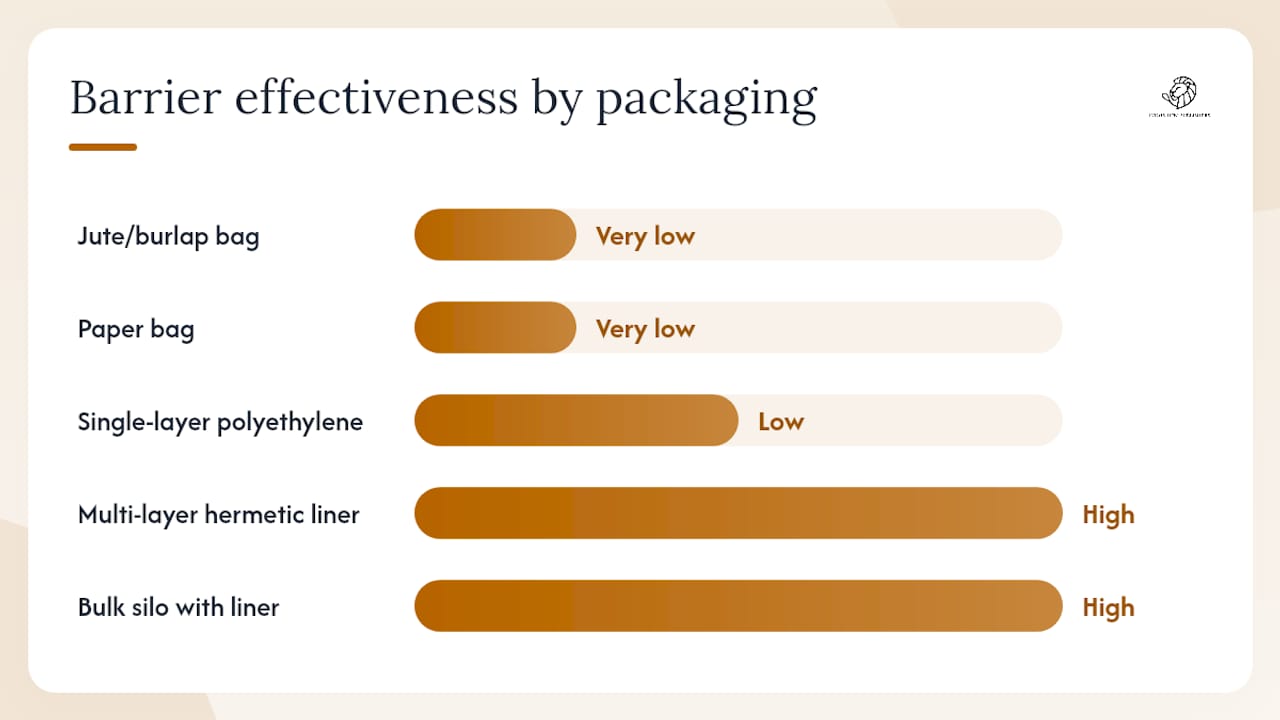
Jute and paper remain common at origin and in transit because they allow some gas exchange during the drying and resting phases. Once a lot reaches a U.S. roastery, however, those same properties become liabilities. Jute offers no meaningful barrier against ambient humidity and provides easy access for insects.
When to rebag: if a lot arrives in jute or single-layer plastic and will be stored for more than four to six weeks, transfer it to a hermetic liner or a sealed food-grade container. If the original hermetic liner is intact and undamaged, keep it sealed until you are ready to roast.
- Inspect every liner for punctures before sealing.
- Expel as much air as possible before closing a hermetic bag.
- Label the outside of any repackaged lot with the original lot tag.
Pro Tip: For small roasteries receiving 60 kg bags, a single GrainPro liner inserted inside the original jute bag before resealing adds a meaningful barrier without requiring a full rebagging operation.
How long can green coffee be stored realistically?
Shelf life depends on the starting moisture content, packaging quality, and storage environment. Under good conditions, most specialty lots hold acceptable quality for twelve months; well-managed lots in hermetic packaging in a climate-controlled space can extend to eighteen to twenty-four months without significant sensory loss. Beyond that, degradation accelerates.
- Short term (0–6 months): Minimal sensory change in properly stored lots. This is the window where most roasters should aim to use their stock.
- Medium term (6–12 months): Subtle shifts in aroma and brightness are possible. Washed coffees may show slight loss of floral or citrus notes. Monthly cupping becomes important.
- Long term (12–24 months): Papery, woody, or flat notes can develop. Naturals and honey-processed lots are more vulnerable. Hermetic packaging and stable temperature slow but do not stop the process.
- Beyond 24 months: Significant flavor loss is likely. Lots stored this long should be cupped carefully before purchase decisions are made.
FAO/SCAA classification guidance uses moisture-content bands of roughly 9–13% as part of quality grading, and lots that drift outside that range during storage are at risk of grade reclassification. That is a direct commercial consequence, not just a sensory one.
A practical cupping cadence: cup a baseline sample on arrival, then cup monthly for the first six months, then quarterly. Any lot showing unexpected sensory change should move to a more frequent schedule or be flagged for early use.
What temperature and humidity targets should U.S. roasters aim for?
Cafe Imports recommends a "cave temperature" approximately between 60 and 70°F with relative humidity around 50 to 60% as a practical target for warehouse storage. DRWakefield's guidance aligns by recommending moderate temperatures with RH control. Stability within a range matters more than hitting a precise number every day.
| Parameter | Target range | Warning sign | Corrective action |
|---|---|---|---|
| Temperature | 60 to 70°F | Sustained temperatures above 70°F | Improve ventilation; move stock away from heat sources |
| Relative humidity | 50–60% | Above 65% or below 40% | Run a dehumidifier or humidifier; check for leaks |
| Bean moisture content | 10–12% | Below 9% or above 13% | Adjust environment; consider hermetic repackaging |
Temperature fluctuation is often more damaging than a slightly elevated steady-state temperature. A room that swings between 55°F at night and 80°F during the day will cause condensation inside bags, driving moisture into the beans regardless of the ambient RH reading.
Monitoring tools worth using:
- Hygrometers placed at bean level (not ceiling height) give the most accurate ambient RH reading.
- Data loggers such as those from Govee or Inkbird record temperature and RH over time, allowing you to spot overnight swings you would otherwise miss.
- Moisture meters calibrated for green coffee give a direct bean-level reading; probe multiple points in a bag to account for uneven distribution.
Pro Tip: Place your data logger at the same height as the top of your coffee stacks, not at eye level. Heat and humidity stratify, and the reading at 6 feet may differ meaningfully from the reading at 3 feet where your bags actually sit.
How do light, pests, and contamination affect stored green coffee?
UV and bright visible light accelerate lipid oxidation in green coffee, producing off-flavors similar to those caused by oxygen exposure. Dark storage is not a luxury; it is a baseline requirement. Opaque bags, closed rooms, or covered storage areas all serve this purpose.
Pest risks are more varied than most roasters expect:
- Coffee berry borer (Hypothenemus hampei) and other stored-product insects can survive inside bags that arrived from origin already infested. Inspect every bag on arrival.
- Rodents are attracted to the oils in green coffee. Keep storage areas sealed, use pallets to elevate bags off the floor, and maintain clear aisles for inspection.
- Grain moths and weevils can establish in a storage room if spilled coffee or organic debris accumulates. Sweep regularly and dispose of damaged or split bags promptly.
GCA warehouse guidelines require a written pest-control program and documented weekly inspections. Even a small roastery benefits from a simple inspection log.
Chemical contamination is a less visible but serious risk. ICO Good Hygiene Practices guidance specifically warns against storing coffee near odorous materials: petroleum products, cleaning solvents, spices, and even strongly scented wood can transfer volatile compounds to green beans through permeable packaging. Keep coffee in a dedicated area, away from any chemical storage.
Pro Tip: Before placing a new lot in storage, walk the room and identify every non-coffee item stored there. If you can smell it from three feet away, it is close enough to affect your coffee.
What container options work best at different scales?
The right container depends on volume, budget, and how long the coffee will sit. Here is a practical breakdown:
- Pallets with original bags: The default for most roasteries. Effective when combined with hermetic liners and a climate-controlled room. Keep bags at least 4 inches off the floor, 24 inches from walls, and 20 inches between stacks to allow airflow and inspection access, per GCA warehouse guidance.
- GrainPro or Ecotact liners: Multi-layer hermetic bags designed for 60–70 kg lots. Reusable with care, moderate cost, and the most practical upgrade for small roasteries handling specialty lots.
- Food-grade plastic drums (5–7 gallon): Suitable for samples, small retail quantities, or broken lots. Gasket lids provide a reasonable seal. Easy to stack and label.
- 5-gallon pails with gamma-seal lids: A cost-effective option for home roasters or retailers holding small quantities (under 10 kg). Gamma-seal lids create a reliable airtight closure without tools.
- Big-bags (bulk supersacks) with hermetic liners: Used by larger operations handling 500–1,000 kg lots. High upfront cost, but efficient for high-volume storage with forklift access.
- Silos: Fixed infrastructure for commercial-scale operations. Require temperature and humidity monitoring at multiple points. Not practical for most small roasteries.
Operational notes: desiccant packets can help in high-humidity environments but are not a substitute for a proper vapor barrier. Oxygen-absorbing sachets are useful inside sealed hermetic bags for very long-term storage. Condition any container that has held other products by airing it out for at least 48 hours before use.
Pro Tip: Before reusing a GrainPro liner, check the inner surface for residual oils or off-odors from the previous lot. A liner that held a natural-processed coffee may transfer aromatic compounds to a washed lot stored next.
A step-by-step storage checklist from receiving to roast
On arrival
- Record lot number, origin, process, weight, and arrival date on a physical tag attached to every bag.
- Measure moisture content with a calibrated meter; flag any lot outside 9–13% for immediate review.
- Inspect visually for pest activity, mold, unusual odors, or physical damage to bags.
- Quarantine any suspect lot in a separate, labeled area until a cupping assessment is complete.
- Take a 300 g baseline sample, cup it within 48 hours, and store the remainder in a sealed, labeled jar.
Placement and stacking
- Place all bags on clean pallets, minimum 4 inches off the floor.
- Maintain at least 24 inches of clearance from walls and 20 inches between stacks.
- Keep new arrivals separated from existing stock until the quarantine period ends.
- Apply FIFO (first in, first out) rotation: oldest lots roast first.
Ongoing monitoring
- Log temperature and RH daily for the first week, then weekly thereafter.
- Conduct a visual inspection of every stack weekly; note any bag damage, condensation, or pest signs.
- Cup each lot monthly for the first six months, then quarterly.
- Quarantine and cup any lot that shows unexpected sensory change before continuing to use it.
Pre-roast conditioning
- Move bags from cold storage to the roasting area at least 24 hours before roasting to allow the beans to equilibrate to room temperature.
- Re-check moisture content if the lot has been in storage for more than six months.
- Inspect the beans visually one final time for any signs of mold or insect activity before loading the hopper.
What do ISO standards and industry guidelines say about storage science?
The practical recommendations in this article are grounded in formal standards and industry guidance. Three ISO documents are directly relevant.
ISO 8455:2011 provides guidelines specifically aimed at minimizing infestation, contamination, and quality deterioration of green coffee in bags, big-bags, bulk, and silos during storage and transport. It is the primary reference for warehouse operators and the basis for most professional storage protocols.
ISO 10470:2004 establishes defect categories and grading methods, including moisture-content bands used in quality classification. Roasters who understand this standard can use it to set acceptance criteria when receiving lots and to document quality changes over time.
ISO 4149 addresses sensory analysis of green coffee, providing a framework for the cupping assessments recommended throughout this article.
The science behind hermetic packaging rests on moisture equilibrium and water activity. A sealed hermetic bag limits the exchange of water vapor between the beans and the ambient air, keeping the bean's water activity stable. Lower water activity slows both microbial growth and the oxidative chemical reactions that degrade flavor compounds. This is why hermetic packaging can partially compensate for a less-than-ideal storage room.
For roasters who want to use these standards in procurement, ISO 8455 and ISO 10470 can be referenced directly in warehouse contracts and green coffee purchase agreements to set minimum storage and quality requirements. Professional Q-Graders and CQI-certified evaluators are trained to apply these classifications in practice.
Final recommendations for protecting your green coffee
The core rule does not change regardless of scale: stable temperature, controlled humidity, and a proper moisture barrier are the three variables that determine how long your green coffee holds its quality.
Three recommendations to implement now:
- Monitor continuously. A data logger costs less than a single spoiled bag of specialty coffee. Install one at stack height and review the logs weekly.
- Use hermetic packaging for any lot held beyond four to six weeks. Jute and paper are transit materials, not storage solutions.
- Rotate and sample on a schedule. FIFO rotation and monthly cupping are the two practices most likely to catch a problem before it becomes a financial loss.
For roasters who want to go deeper on the science behind these practices, including the chemistry of aging, the role of water activity, and how processing methods affect storage resilience, The Complete World of Coffee by Keith Lyons covers these topics in full. Explore the coffee science resources at Lyons Den Publishers for further technical reading.
A coffee educator's perspective on why this guidance matters
The gap between knowing the storage rules and actually following them is where most quality loss happens in small roasteries. The standards exist. The research is clear. Yet a surprising number of roasters still store green coffee on concrete floors, in rooms that share space with cleaning chemicals, without a single temperature log.
The guidance in this article is not theoretical. ISO 8455, GCA warehouse protocols, and the moisture-content targets from FAO and SCAA classification materials represent decades of accumulated industry knowledge. Applying even the most basic elements, pallets, hermetic liners for vulnerable lots, a weekly inspection log, and a monthly cupping cadence, will protect the commercial and sensory value of a roastery's inventory more reliably than any single equipment upgrade.
As a roastery grows, these practices scale naturally. A small operation monitoring one room with a single data logger uses exactly the same principles as a large warehouse running a full HVAC system and documented pest-control program. The discipline is the same; only the infrastructure changes.
Sources
The following references underpin the guidance in this article. Standards are primary sources; the others are practitioner commentary and industry guidance.
- ISO 8455:2011 - Green coffee — Guidelines for storage and transport
- Green Bean Storage: What Factors Do You Need to Control? - Perfect Daily Grind
- Storing Your Green Coffee: Best Practices | Cafe Imports
- How to Store Green Coffee: A Guide for Coffee Roasters - DRWakefield
- Annex 7: Green Coffee Classification and Grading (FAO/SCAA/Brazilian guidance)