Freezing coffee beans works — but only when you do it correctly. The single rule that separates success from a ruined bag: portion your beans into single-use doses, seal them airtight, and never return them to the freezer once thawed. Experts including James Hoffmann and guidance from the Specialty Coffee Association (SCA) treat freezing as a legitimate preservation method, not a kitchen myth. Research from Dr. Christopher Hendon at the University of Oregon adds a compelling bonus: frozen beans can actually improve grind consistency, particularly for light roasts.
The core conditions for success:
- Freeze only properly sealed, portioned doses
- Never open and re-seal the same bag repeatedly
- Use freezing for long-term storage, not as a substitute for fresh daily rotation
- Expect slowed staling, not suspended animation
Pro Tip: If you remember only one thing, make it this: moisture is the enemy. Every time a warm, humid hand reaches into a cold bag, condensation forms on the beans. Portion before you freeze, and that problem disappears.
Key Takeaways
Freezing coffee beans preserves flavor for 3–4 months when beans are portioned into single-use doses, sealed airtight, and never refrozen after thawing.
| Point | Details |
|---|---|
| Who benefits from freezing | Home roasters, bulk buyers, and collectors of rare or limited-run coffees gain the most from freezing. |
| Portion before freezing | Divide beans into single-use doses before sealing to eliminate repeated opening and moisture exposure. |
| Realistic shelf life | Vacuum-sealed portions in a home freezer retain acceptable quality for roughly 3–4 months. |
| Grind from frozen | Grinding directly from frozen can improve grind uniformity for light roasts due to the glass-transition effect. |
| No-refreeze rule | Once a portion is thawed or opened, use it within a day or two and never return it to the freezer. |
Table of Contents
- When does freezing coffee beans actually make sense?
- How to prepare beans for freezing
- Where and how to store frozen beans in your freezer
- How to use frozen beans without losing what you preserved
- How long do frozen coffee beans actually stay fresh?
- What can go wrong, and how to fix it
- Which containers and tools work best for home freezing?
- Why freezing works: the science behind it
- The verdict: three rules to follow
- A note on freezing in real practice
- Primary sources and further reading
- Sources
When does freezing coffee beans actually make sense?
Freezing is not the right move for every coffee or every household. For a bag you will finish within two to three weeks, room-temperature storage in an airtight canister away from light and heat is perfectly adequate. Freezing adds complexity without meaningful benefit at that timescale.
The situations where freezing genuinely pays off:
- Bulk purchases: Buying a large quantity at a favorable price or from a roaster with limited shipping windows
- Rare and limited-run coffees: A competition-grade lot or a single-origin you want to preserve for a special occasion
- Home roasters: Batch-roasting more than you can consume in two to three weeks
- Experiment and comparison stashes: Keeping a reference sample of a coffee to taste against a fresh bag later
Timing relative to the roast matters. Many roasters recommend waiting roughly 10 days after roast before freezing — long enough for the most vigorous CO₂ degassing to subside, but before the peak flavor window closes. Freezing too soon traps active degassing gases inside a sealed package, which can compromise both the seal and the aroma profile.
Storage window at a glance: Roasted whole beans kept at room temperature in an airtight container stay at their best for roughly 1–3 weeks. The same beans, properly sealed and frozen, can retain acceptable quality for 3–4 months in typical home conditions.
Once opened, quality declines faster regardless of storage method. An unopened sealed bag holds up far longer than one that has been opened and resealed, even in otherwise careful storage.
How to prepare beans for freezing
Preparation is where most home enthusiasts go wrong. The steps below apply whether you are using a vacuum sealer or a simple zip-top bag.
-
Portion into single-use doses. Decide how many grams you brew in a typical session — 15 g for a single espresso, 30 g for a pour-over — and divide the full batch into individual pouches before freezing. This eliminates the need to open the bag repeatedly.
-
Allow adequate degassing time. Do not vacuum-seal beans immediately after roast. Wait at least 7–10 days so the bulk of CO₂ has off-gassed. Sealing too early can cause packages to balloon or burst, and the trapped gas interferes with aroma development.
-
Tape over one-way valves. If you are freezing beans in their original roaster bag, experts advise taping over the one-way degassing valve before placing the bag in the freezer. Valves allow air to enter at freezer temperatures, which accelerates staling.
-
Choose your sealing method. Options in order of effectiveness:
- Vacuum sealer: Removes most oxygen and compresses the package. Note that household sealers leave residual oxygen and lack the nitrogen-flush capability of commercial packaging, but they still outperform zip-top bags for long-term storage.
- Double zip-top (Russian-doll method): Place a portioned zip-top bag inside a second freezer-grade zip-top bag, pressing out as much air as possible from each layer.
- Silicone reusable bags (Stasher-style): A practical middle ground — airtight, reusable, and easier to label than foil pouches.
-
Label every package. Write the roast date, freeze date, coffee name, and dose weight directly on the bag or on a piece of freezer tape. A bag with no label is a bag you will eventually throw away without knowing what it was.
Pro Tip: Weigh your doses on a scale before sealing. Consistent dose weights mean you can grind and brew directly from frozen without adjusting your recipe each time.
Where and how to store frozen beans in your freezer
Placement inside the freezer matters more than most guides acknowledge. Home freezers cycle through small temperature fluctuations every time the compressor runs or the door opens. The back of the freezer, away from the door, stays coldest and most stable.
Practical storage habits that protect your beans:
- Store at the back, not the door. Door shelves experience the widest temperature swings. A dedicated spot at the back of a drawer or shelf keeps conditions more consistent.
- Surround packages with other frozen goods. Thermal mass from neighboring frozen items buffers against temperature spikes when the door opens.
- Keep each portion sealed until use. The industry best practice for long-term preservation uses stable sub-zero temperatures (around -25°C in professional settings). Home freezers typically run at 0°F (-18°C), which is workable with careful portioning and minimal door exposure.
- Avoid storing beans near strong-smelling foods. Coffee absorbs odors readily. A sealed bag next to fish or onions is a liability even with good packaging.
A quick checklist before placing packages in the freezer:
- Portioned into single-use doses
- Valve taped (if applicable)
- Sealed airtight (vacuum or double-bagged)
- Labeled with roast date, freeze date, and dose weight
- Placed at the back of the freezer, away from the door
How to use frozen beans without losing what you preserved
Two approaches exist for using frozen beans, and the right one depends on your brewing method and tolerance for grind adjustment.
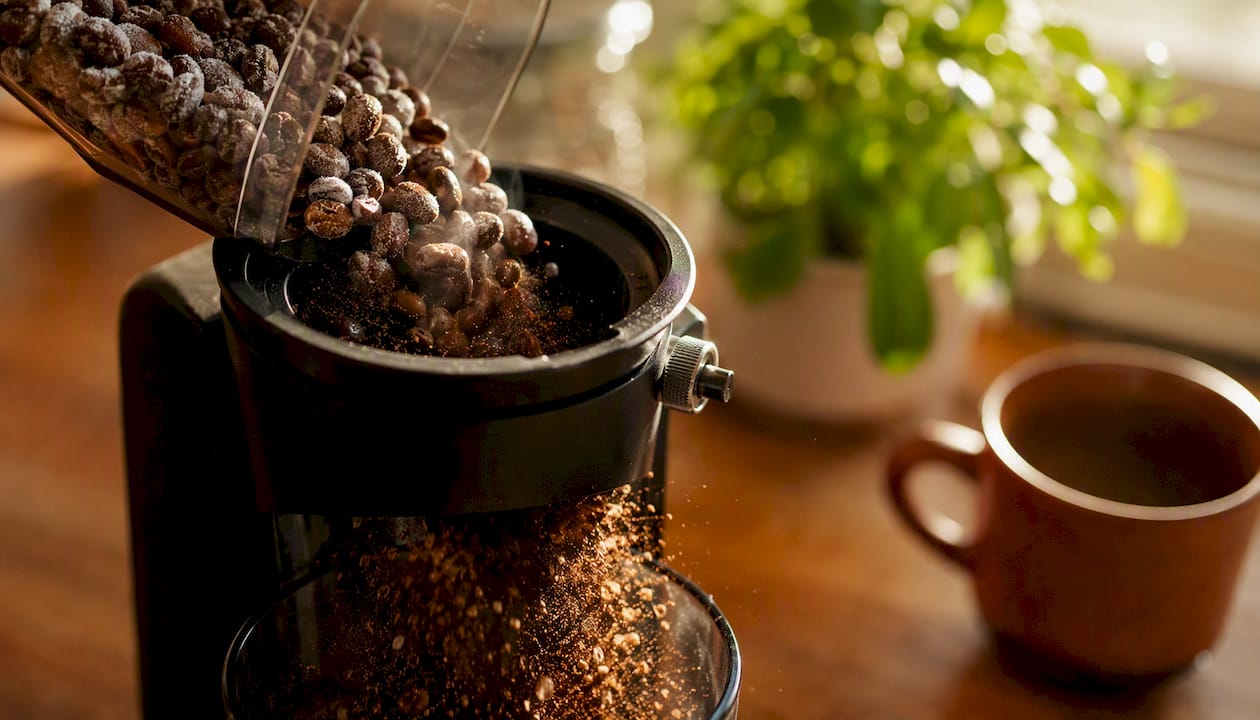
Grinding directly from frozen is the approach most specialty coffee professionals prefer. Freezing makes beans more brittle, which can tighten particle-size distribution and reduce the fine particles (super-fines) that muddy extraction. For light roasts especially, grinding from frozen often produces a cleaner, more uniform grind. Take the portioned bag from the freezer, open it immediately, and grind without waiting.
Bringing beans to room temperature first is the safer option for those concerned about condensation. If you choose this route, keep the bag sealed until it reaches room temperature — typically 30–45 minutes. Opening a cold bag in a warm kitchen pulls humid air onto the beans, which is exactly the moisture problem freezing was meant to avoid.
Key do's and don'ts:
- Do grind immediately after opening a frozen portion
- Do keep the bag sealed during any thawing period
- Do not refreeze beans once thawed — a single freeze-thaw cycle is the limit
- Do not leave thawed beans sitting open for hours before brewing
For espresso, expect to fine-tune your grind setting slightly after switching to frozen beans. The increased brittleness can shift your particle distribution enough to affect extraction time. A guide to dialing in espresso at home covers the adjustment process in detail.
Pro Tip: Label each frozen portion with the grind setting that worked last time. When you pull the next identical portion from the freezer, you have a starting point rather than starting from scratch.
How long do frozen coffee beans actually stay fresh?
Freezing slows staling chemistry but does not stop it. Volatile aromatic compounds continue to diffuse slowly even at freezer temperatures, which is why frozen beans are not indefinitely preserved — they are meaningfully extended.
Practical time windows for home storage:
| Storage method | Approximate freshness window |
|---|---|
| Room temperature, airtight canister | 1–3 weeks |
| Freezer, zip-top double-bagged | Up to 2 months |
| Freezer, vacuum-sealed portions | 3–4 months |
| Professional vacuum-sealed, -25°C storage | Several months to longer |
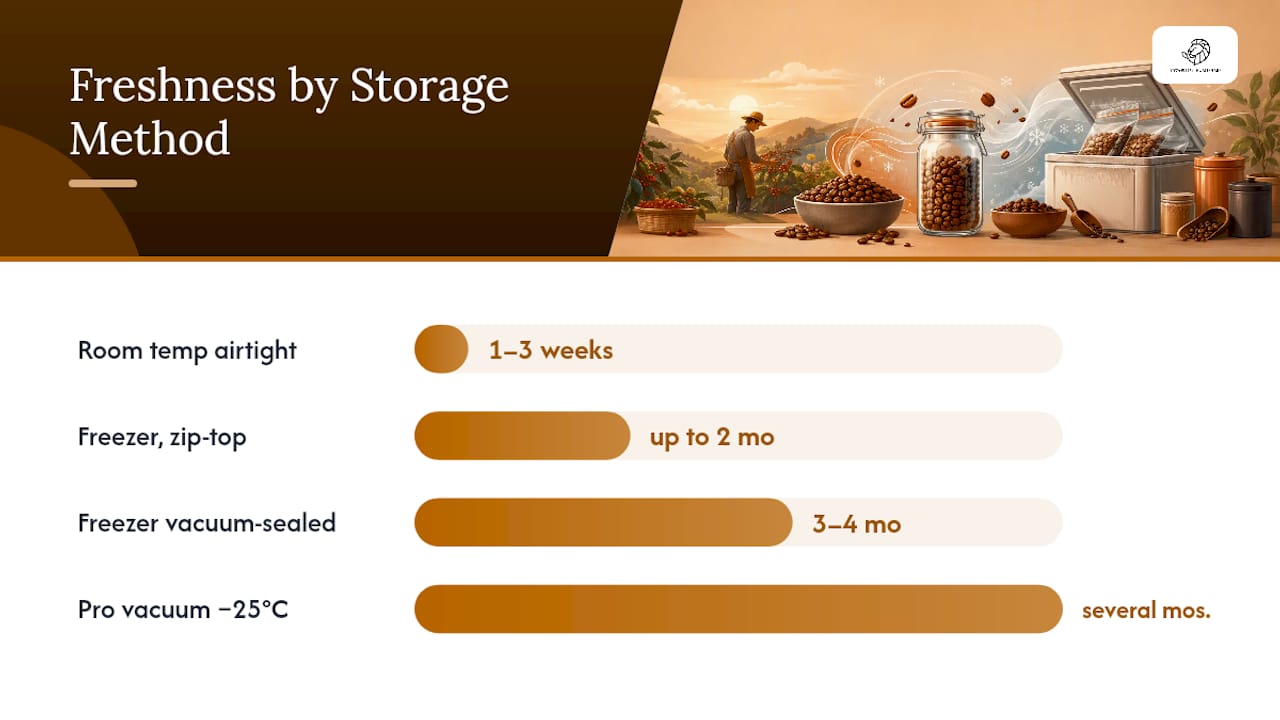
The 3–4 month window for vacuum-sealed home storage reflects typical conditions: a standard 0°F home freezer, reasonable portioning, and minimal freeze-thaw cycling. Beyond that window, beans are unlikely to be unsafe, but noticeable flavor loss becomes more probable.
A few practical planning notes:
- Freeze only what you cannot realistically consume within three weeks at room temperature
- Rotate stock: use older frozen portions before newer ones
- If a bag has been in the freezer longer than four months, brew a test cup before committing to a full batch
What can go wrong, and how to fix it
Most freezing failures trace back to one of three causes: moisture, odor contamination, or freezer burn. Each is preventable.
Moisture and condensation are the primary hazard. Penn State research confirms that condensation during handling is the main risk when freezing preserves aroma better than warm, humid storage. Every freeze-thaw cycle that involves opening a bag in a warm room deposits moisture on the beans, accelerating oxidation and staling.
How to prevent it:
- Portion before freezing so each bag is opened only once
- Keep bags sealed during thawing
- Grind directly from frozen when possible
Odor contamination happens when packaging is not fully airtight. Coffee absorbs surrounding smells through even small gaps.
Fixes:
- Double-check seals before placing bags in the freezer
- Store coffee away from strong-smelling foods in a dedicated freezer bin or container
- If beans smell of anything other than coffee after thawing, discard them
Freezer burn appears as a dry, papery texture and a flat, woody taste. It results from moisture loss through inadequate packaging over time.
Corrective steps:
- Repackage any beans showing early signs of freezer burn into a vacuum-sealed bag and use them promptly
- Discard beans with pronounced off-odors or a noticeably desiccated appearance
- Move remaining portions to a more stable part of the freezer
Which containers and tools work best for home freezing?
The right container depends on how long you plan to store beans and how much you want to invest in the process.
-
Vacuum sealer (domestic models): The most effective home option for storage beyond six weeks. Brands like FoodSaver remove most oxygen and compress the package. Understand the limitation: household sealers leave residual oxygen and cannot replicate the nitrogen-flush protocols used by commercial roasters, but they outperform zip-top bags for extended storage.
-
Silicone reusable bags (Stasher-style): Airtight, freezer-safe, and easy to label. A practical choice for single-dose portions when you prefer a reusable option over disposable plastic. Pair with a hand pump or straw-seal method to remove excess air.
-
Double zip-top freezer bags (Russian-doll method): The most accessible budget approach. Use heavy-duty freezer-grade bags, press out air from the inner bag, then seal it inside a second bag. Effective for storage up to roughly two months.
-
Small glass jars inside a sealed outer bag: Glass is odor-neutral and easy to clean. A 4 oz mason jar filled with a single dose, then placed inside a zip-top bag, works well for home roasters who want to preserve individual samples. The outer bag provides an additional moisture barrier.
Pro Tip: Whatever container you choose, keep a permanent marker near the freezer. A bag with no label is a mystery you will not want to solve six weeks later.
Specialized tools — a dedicated chest freezer set to a stable temperature, a commercial vacuum sealer — make a measurable difference for storage beyond three months or for competition-level preservation. For most home enthusiasts storing beans for four to eight weeks, a quality domestic vacuum sealer or the double-bag method is sufficient.
Why freezing works: the science behind it
The chemistry of coffee staling involves two parallel processes: the loss of volatile aromatic compounds through diffusion and evaporation, and oxidative reactions that degrade flavor-active molecules. Temperature governs the rate of both. Laboratory research confirms that freezing slows the loss of volatile aromatics, though it does not stop it entirely — chemical kinetics continue at reduced rates even at 0°F.
The SCA and related industry research show that degassing rates drop markedly at very low temperatures. At the -25°C used in professional storage, CO₂ loss slows to a fraction of its room-temperature rate, which is why specialist freezing can preserve flavor for many months when executed correctly. Home freezers at -18°C achieve a meaningful but less dramatic reduction.
The grind-quality benefit has a specific physical explanation. Dr. Christopher Hendon's research at the University of Oregon identified a glass-transition effect: when roasted beans cool to freezer temperatures, they become more mechanically brittle. Grinding in that brittle state produces a tighter particle-size distribution with fewer super-fines. For light roasts in particular, this can translate to more uniform extraction and greater cup clarity. Understanding the chemical compounds in coffee that are most affected by temperature helps explain why this matters at the sensory level.
The practical implication: freezing is not simply a storage hack. When done correctly, it can improve both preservation and brewing performance simultaneously.
The verdict: three rules to follow
Freezing coffee beans is a sound preservation technique when applied deliberately. It is not a fix for poor buying habits or a substitute for fresh rotation.
The three rules that cover most home scenarios:
- Portion before you freeze. Single-use doses eliminate the moisture and repeated-opening problems that cause most freezing failures.
- Seal airtight. Vacuum-seal when possible; double-bag when not. Tape over one-way valves on roaster bags.
- Never refreeze. Once a portion is thawed or opened, use it within a day or two and do not return it to the freezer.
Plan your packaging before the beans arrive. Label everything. Use older portions first. Those habits, more than any specific container brand, determine whether your frozen beans taste as good coming out as they did going in.
A note on freezing in real practice
Freezing coffee beans became genuinely useful in my practice when I started treating it as a deliberate archiving decision rather than a casual storage habit. The coffees that benefited most were limited-run naturals and washed Ethiopians from small roasters who ship infrequently — coffees where a second bag was not available and the first bag deserved more than two weeks of shelf life.
The workflow that holds up best for home roasters and collectors: rest the batch for 10 days, weigh and portion into individual doses, vacuum-seal or double-bag each one, label clearly, and place at the back of the freezer. Pull one portion at a time, grind directly from frozen for filter brewing, and adjust the grind setting by one or two clicks finer if the shot or pour-over runs fast. The evidence from Hendon's glass-transition research and the SCA's storage guidance supports this approach, and the results in the cup confirm it.
The caveat worth stating plainly: freezing rewards planning. A bag tossed into the freezer unsealed and pulled out repeatedly will taste worse than one stored at room temperature in a proper canister. The technique is only as good as the discipline behind it.
Primary sources and further reading
Key research and expert resources used to build this guide:
- I Asked Coffee Experts How to Keep Beans Fresh — Serious Eats — Expert guidance on sealing, valve-taping, and avoiding freeze-thaw cycles
- Should You Freeze Coffee Beans? — WIRED — Covers the glass-transition effect and grind-from-frozen benefits, citing Dr. Christopher Hendon's research
- Freezing Your Coffee Beans Keeps Them Fresher for Longer — Food & Wine — Roaster guidance on timing (10 days post-roast) and packaging methods
- PMC food-science research on volatile retention during cold storage — Laboratory evidence on how freezing slows aromatic compound loss
- Freezing Roasted Coffee: Best Practices — Perfect Daily Grind — Industry-level storage protocols and SCA-related degassing rate data
- Aboutcoffee — Practical shelf-life windows for home storage conditions
- Cool Beans — Penn State Agricultural Sciences — Experimental findings on condensation as the primary freezing hazard
Sources
- I Asked Coffee Experts How to Keep Beans Fresh—They ...
- Freezing Your Coffee Beans Keeps Them Fresher for Longer
- PMC article (relevant lab/food-science research)
- Aboutcoffee