
A coffee scientist is a research expert who applies genetics, chemistry, agronomy, and sensory science to understand and improve every stage of coffee production, from seed to cup. The field draws on disciplines as varied as plant genomics, analytical chemistry, and food engineering. Institutions like the UC Davis Coffee Center have formalized this work, establishing research programs that connect laboratory findings directly to farm and roastery practice. Understanding what coffee scientists do reveals why specialty coffee has advanced so rapidly in quality and consistency over the past two decades.
What does a coffee scientist study and research?
A coffee scientist, more formally called a coffee research expert or coffee quality analyst depending on specialization, works across the full production chain. Some focus on plant genetics and cultivation. Others specialize in roast chemistry or sensory evaluation. The most influential work today integrates all three, recognizing that a single variable rarely determines cup quality in isolation.
The interdisciplinary nature of the role is its defining feature. A researcher studying Coffea arabica must understand plant biology, soil science, fermentation microbiology, and analytical chemistry simultaneously. That breadth separates coffee science from narrower food science disciplines and explains why dedicated research centers, rather than individual laboratories, have become the standard model for advancing the field.

How do coffee genetics and environment shape bean quality?
Coffee bean quality is the product of genetic potential expressed through specific environmental conditions. The Coffea arabica allotetraploid genome encodes the biochemical pathways that produce caffeine, chlorogenic acids, and the sugars responsible for sweetness and body. That genetic blueprint sets the ceiling for quality. Environment determines how close a given crop comes to reaching it.
Altitude is the most studied environmental variable. Farms at 1,600–2,000 meters above sea level produce beans with higher concentrations of flavor-active metabolites. Cooler temperatures slow cherry maturation, allowing more time for sugar accumulation and acid development. Shade management and nutrient availability further modulate these pathways. MYB transcription proteins regulate caffeine and chlorogenic acid biosynthesis, meaning that even genetically identical plants will express different chemical profiles depending on growing conditions.
Postharvest processing adds another layer of complexity. Altitude, shade, fermentation, and packaging all interact to determine the final chemical composition of green coffee. A coffee research expert must account for all of these variables when designing cultivation studies or interpreting quality data. Isolating a single factor, such as fermentation time, without controlling for the others produces results that rarely translate to real-world farm practice.
| Factor | Primary influence | Key metabolites affected |
|---|---|---|
| Genetic variety | Biochemical pathway capacity | Caffeine, chlorogenic acids, sugars |
| Altitude (1,600–2,000m) | Maturation rate and sugar accumulation | Sucrose, organic acids |
| Shade management | Photosynthesis and stress response | Chlorogenic acids, lipids |
| Fermentation protocol | Microbial activity and acid development | Lactic acid, acetic acid, esters |
| Packaging and storage | Oxidation and moisture control | Lipid stability, volatile retention |
Pro Tip: When evaluating green coffee from a new origin, ask the producer for altitude and fermentation records alongside the variety. Those two data points explain more about the cup than any single sensory descriptor.
How do coffee scientists measure roast and brew quality?
Sensory panels have long been the primary tool for evaluating coffee quality. Trained tasters score attributes like acidity, body, and aroma using standardized protocols. The limitation is reproducibility. Human perception varies with fatigue, palate calibration, and context, making it difficult to compare results across labs or time periods.
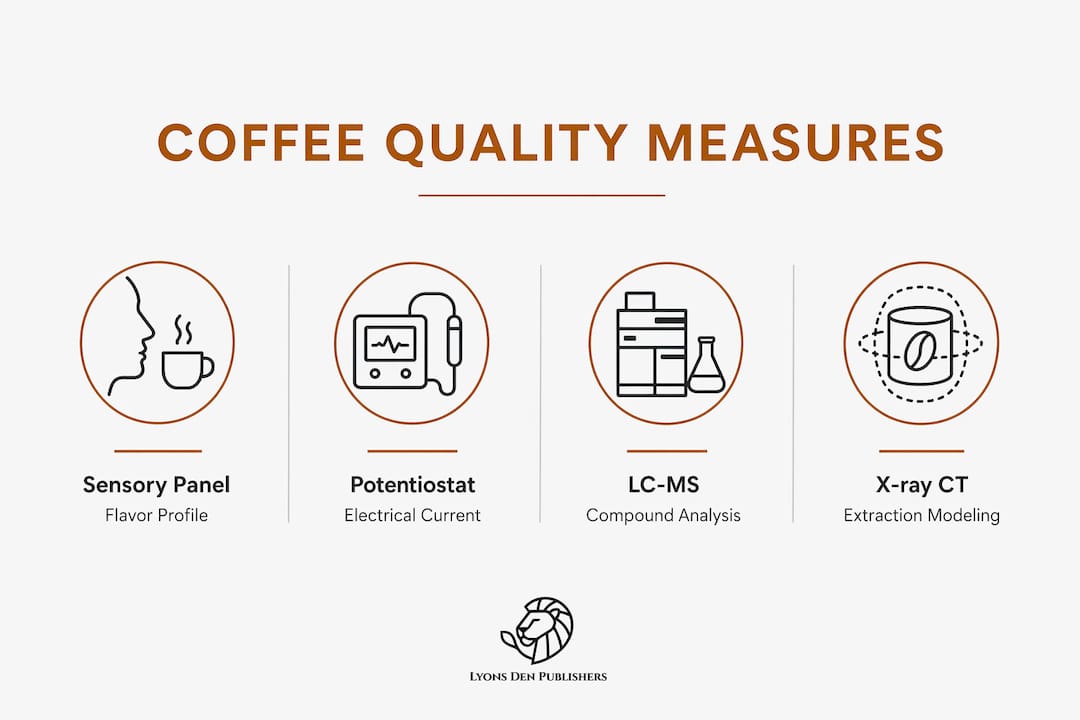
Quantitative chemical methods address this gap directly. A potentiostat measuring electrical current through brewed coffee can detect molecular reactions associated with acidity and roast intensity at different voltage levels. This approach provides an objective, repeatable metric that performs comparably to expert sensory panels in identifying roast quality. The measurement captures electrochemical signals from compounds like chlorogenic acids and their degradation products, which shift predictably with roast level.
Analytical chemistry techniques extend this capability further. Liquid chromatography with mass spectrometry (LC-MS) separates and identifies individual compounds in a coffee extract with high precision. Nuclear magnetic resonance (NMR) spectroscopy provides a structural fingerprint of the entire sample without requiring compound separation. Both methods generate quantitative data that links directly to sensory outcomes, giving coffee quality analysts a chemical basis for decisions that were previously made by taste alone.
| Method | What it measures | Primary application |
|---|---|---|
| Sensory panel | Perceived flavor attributes | Quality grading, consumer research |
| Potentiostat (electrical current) | Electrochemical activity, acidity, roast level | Objective roast and brew consistency |
| LC-MS | Individual compound identification and quantity | Metabolite profiling, adulteration detection |
| NMR spectroscopy | Full chemical fingerprint of extract | Origin authentication, roast characterization |
| X-ray tomography | Coffee puck structure and permeability | Espresso extraction modeling |
Pro Tip: Home brewers can apply the logic of quantitative measurement by tracking water temperature, dose, and yield with a scale and thermometer. Consistent variables produce consistent results, which is the same principle driving laboratory measurement methods.
Espresso extraction offers a clear example of how physical measurement informs brewing practice. X-ray tomography modeling shows that shot quality depends heavily on coffee puck permeability, which is controlled by grind particle size distribution. Uniform particle sizes produce uniform flow rates and extraction. This finding, generated in a laboratory, translates directly to the grinder settings used by baristas every day. You can read more about applying these principles in practice through best brewing techniques for home baristas.
What chemical compounds define coffee flavor?
Coffee flavor is defined by several distinct chemical families, each contributing differently to the sensory experience. Chlorogenic acids, caffeine, trigonelline, diterpenes, and Maillard-derived volatiles are the primary compound groups that coffee flavor scientists track. Chlorogenic acids contribute bitterness and astringency in green coffee and break down during roasting to form phenolic flavor compounds. Trigonelline degrades to produce nicotinic acid and pyridines, adding roast, nutty notes. Diterpenes like cafestol and kahweol affect body and mouthfeel.
Metabolomics connects these chemical profiles to sensory outcomes. By mapping the full metabolite composition of a coffee sample and correlating it with trained panel scores, researchers can identify which compounds drive specific flavor attributes. This approach has confirmed, for example, that certain volatile esters produced during fermentation correlate strongly with fruity cup notes in naturally processed coffees.
Validated metabolomic methods using LC-MS or NMR are the standard for this work. Studies that rely on unvalidated bioassays produce results that are difficult to reproduce and often fail to translate across different coffee matrices. The field has recognized this limitation, and leading journals now require explicit validation metrics before publishing flavor-chemistry correlations.
The practical application of this chemistry knowledge is direct:
-
Roasting decisions: Understanding how chlorogenic acid degradation accelerates above 200°C allows roasters to target specific flavor outcomes by controlling time and temperature at critical development stages.
-
Brewing extraction: Knowing that caffeine extracts faster than many flavor-active acids helps baristas calibrate grind size and contact time to balance bitterness against complexity.
-
Green coffee selection: Screening raw beans for chlorogenic acid and sucrose content gives buyers a predictive indicator of cup quality before roasting.
-
Fermentation control: Monitoring organic acid development during wet processing lets producers steer flavor profiles toward specific market preferences.
Understanding the factors influencing coffee flavor at the chemical level gives producers and roasters a shared language for quality decisions that previously relied entirely on subjective description.
What are the emerging trends in coffee science research?
The next phase of coffee science centers on integration. Individual studies of genetics, agronomy, or chemistry have generated substantial knowledge. The challenge now is connecting those findings into a unified model of coffee quality. Mechanistic studies, long-term system analyses, and integrated genomic and agronomic data are the priorities identified by leading researchers for sustainable, high-quality production.
Multi-omics approaches combine genomic, transcriptomic, and metabolomic data from the same plant or sample. This gives researchers a complete picture of how genetic variation translates into chemical composition under specific growing conditions. Genomic selection, borrowed from plant breeding programs in other crops, is being applied to Coffea arabica to identify varieties with superior flavor potential before they are ever grown at scale.
Quantitative sensory science is also advancing rapidly. Data-driven brewing protocols, informed by electrical measurement and chemical analysis, are replacing purely intuitive approaches in specialty roasteries and research labs alike. The UC Davis Coffee Center exemplifies this model, bridging academic research with practical applications to produce findings that growers, roasters, and baristas can act on immediately.
Sustainability research represents a third growth area. Climate change is altering the altitude bands where premium arabica thrives, compressing the zones that produce the flavor profiles the specialty market demands. Coffee scientists are mapping these shifts and working with agronomists to identify cultivation strategies and genetic varieties that maintain quality under changing conditions.
Pro Tip: Follow peer-reviewed journals like the Journal of Agricultural and Food Chemistry and Food Chemistry for primary research on coffee science. These publications carry the validated studies that eventually shape industry practice, often years before the findings reach trade publications.
Key Takeaways
A coffee scientist integrates genetics, chemistry, agronomy, and sensory science to advance coffee quality at every stage of production, from farm to cup.
| Point | Details |
|---|---|
| Genetics set the quality ceiling | The C. arabica allotetraploid genome encodes flavor pathways; environment determines how fully they express. |
| Altitude drives metabolite development | Growing at 1,600–2,000m slows maturation and increases sugar and acid accumulation in the bean. |
| Electrical measurement improves consistency | Potentiostat readings provide objective, reproducible roast and acidity metrics beyond what sensory panels alone can deliver. |
| Validated chemistry methods matter | LC-MS and NMR are the reliable standards for linking coffee’s chemical profile to flavor and health outcomes. |
| Integration is the future | Combining genomics, agronomy, and sensory data into unified models is the defining challenge of the next decade in coffee research. |
The science behind the cup: my perspective
The most significant shift I have observed in coffee science over the past decade is not a single discovery. It is the move from subjective description to empirical measurement. For most of coffee’s history, quality was assessed by taste alone. That is not a flaw. Sensory evaluation is a legitimate and sophisticated discipline. But it has limits when you need to communicate quality across languages, cultures, and supply chains.
What electrical measurement and metabolomics have done is give the industry a shared numerical language. A roast level expressed as an electrochemical reading means the same thing in a laboratory in California and a roastery in Tokyo. That consistency is what allows quality standards to travel. It is also what makes the science of roast profiles teachable rather than purely intuitive.
My advice to coffee enthusiasts who want genuine scientific literacy is to start with chemistry, not equipment. Understanding what chlorogenic acids do during roasting, or why grind consistency matters for espresso permeability, gives you a framework for interpreting every brewing variable you encounter. Equipment is a tool. Chemistry is the explanation for why the tool works or fails.
The gap between academic coffee research and daily practice is narrowing. Institutions like the UC Davis Coffee Center are producing findings that reach farms and roasteries within years rather than decades. That acceleration benefits everyone who cares about what ends up in the cup.
— Keith E Lyons
Deepen your coffee knowledge with Lyons Den Publishers

Coffee science is a field where depth of knowledge translates directly into better decisions at every stage of production and brewing. The Complete World of Coffee by Keith Lyons covers the science, cultivation, processing, roasting, brewing, and sensory evaluation of specialty coffee in one authoritative reference. For readers who want curated collections of coffee educational materials organized by topic and depth, the coffee education bundles at Lyons Den Publishers bring together the most relevant resources for enthusiasts, baristas, and coffee professionals seeking scientifically grounded knowledge. Each collection is built around the same evidence-based approach that informs every article on this site.
FAQ
What does a coffee scientist do professionally?
A coffee scientist applies chemistry, genetics, agronomy, and sensory science to study and improve coffee quality across cultivation, processing, roasting, and brewing. The role spans academic research, industry quality labs, and applied development work at specialty roasteries and farms.
How does altitude affect coffee bean quality scientifically?
Farms at 1,600–2,000 meters above sea level produce slower cherry maturation, which increases sugar accumulation and the concentration of flavor-active acids in the bean. These biochemical changes are regulated by MYB proteins that control caffeine and chlorogenic acid pathways.
What chemical compounds are most important in coffee flavor?
Chlorogenic acids, caffeine, trigonelline, diterpenes, and Maillard-derived volatiles are the primary compound families that define coffee’s aroma and taste. Metabolomic studies using LC-MS and NMR map these compounds and link them to specific sensory attributes.
How do scientists measure coffee roast quality objectively?
A potentiostat measures electrical current through brewed coffee at different voltages to detect molecular reactions tied to acidity and roast intensity. This method provides a consistent, quantitative metric that performs comparably to trained sensory panels.
Why does grind consistency matter for espresso extraction?
X-ray tomography modeling shows that espresso puck permeability, which controls water flow rate and extraction uniformity, depends directly on grind particle size distribution. Inconsistent grind produces uneven flow channels and variable extraction, regardless of other brewing parameters.