
Full body in coffee is defined as the physical weight, viscosity, and texture of the liquid as it sits on your palate. It is a tactile sensation, not a flavor. Professional cuppers describe it as the difference between skim milk and whole milk in your mouth: one feels thin and watery, the other feels dense and coating. Understanding what full body coffee means separates casual tasters from informed coffee enthusiasts who can select and brew with real intention.
What does full body coffee mean in sensory terms?
Full-bodied coffee is felt as a dense, coating sensation that lingers on the palate and can be creamy or syrupy. The industry term for this quality is "body," and it sits alongside flavor, aroma, acidity, and finish as one of the five core sensory attributes evaluated in professional cupping. Body describes how the coffee physically feels, not how it tastes or smells.
Professional cuppers assess body by pressing the liquid against the roof of the mouth. They distinguish between a light, tea-like sensation and a heavy, syrupy one. Descriptors range from thin and watery at one end to creamy, velvety, and viscous at the other. A full-bodied cup leaves a coating sensation that persists after swallowing.
Body is not the same as strength. A double espresso can feel intensely flavored but relatively thin in body. A naturally processed Ethiopian coffee can feel dense and coating at a moderate brew strength. Recognizing this distinction is the first step toward using body as a deliberate variable in your brewing decisions.
What physical factors produce a full-bodied coffee experience?
Full body in coffee is driven by dissolved solids, coffee oils (lipids), proteins, and suspended fine particles. Each of these components contributes to the viscosity and weight you perceive on the palate. Remove them through filtration or dilution, and the body drops noticeably.
Several variables set the ceiling for how much body a coffee can achieve:
- Roast level: Darker roasts break down cell walls more completely, releasing more oils and increasing the potential for a heavier mouthfeel.
- Bean origin: Coffees from Sumatra and Yemen are known for naturally fuller-bodied profiles due to their bean composition and traditional processing methods. Ethiopian washed coffees, by contrast, tend toward lighter, cleaner body.
- Processing method: Natural (dry) processing leaves more fruit sugars and mucilage on the bean, which translates to more body in the cup. Washed processing removes these layers, producing a cleaner, lighter body. Coffee processing methods directly shape this outcome.
- Extraction efficiency: Higher extraction pulls more dissolved solids into the cup, increasing body. Under-extracted coffee often tastes thin regardless of roast or origin.
Espresso carries a total dissolved solids (TDS) concentration of around 12%, compared to brewed coffee at roughly 1.2%–1.5%. That difference in concentration explains why espresso feels so much heavier and more coating on the palate than a standard pour-over.
Pro Tip: If your coffee tastes strong but feels thin, the issue is likely filtration or dilution, not extraction. Switch to a metal filter or reduce your brew ratio before adjusting grind or temperature.
How do different brewing methods affect coffee body?
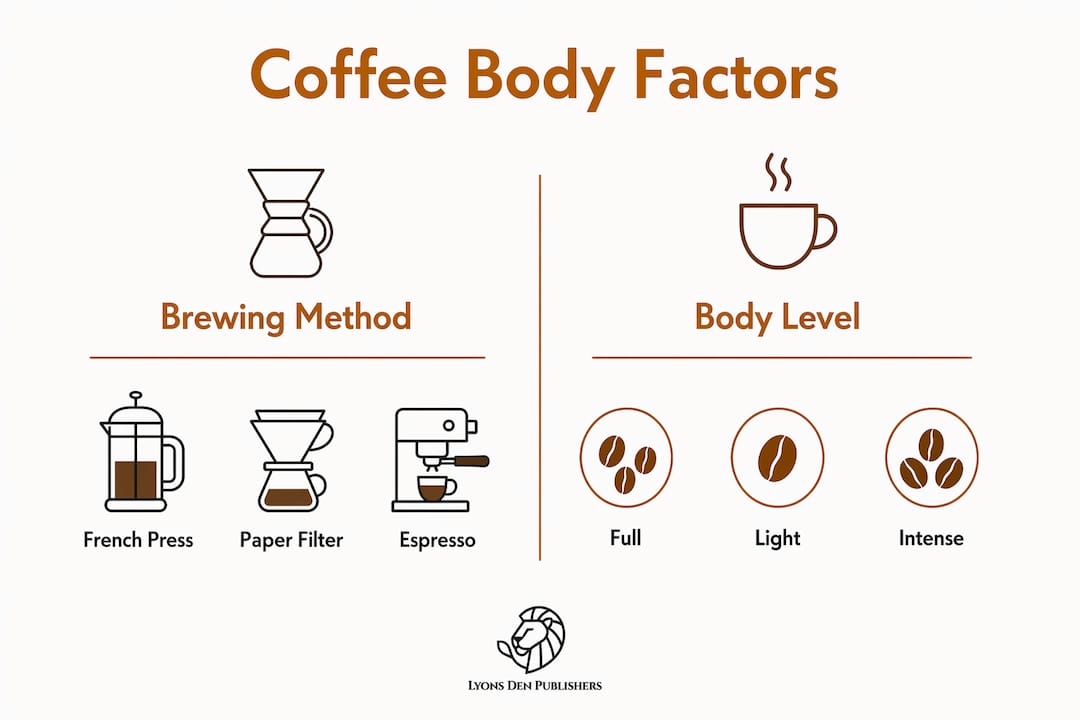
Brewing method is the most controllable variable in determining the body of your final cup. The key mechanism is filtration: what the filter allows to pass through determines what lands on your palate.
| Brewing method | Filter type | Body level | Key reason |
|---|---|---|---|
| French press | Metal mesh | Full | Oils and fines pass freely |
| Espresso | Metal portafilter | Full to very full | High pressure, high TDS |
| AeroPress (metal filter) | Metal disk | Full to medium-full | Oils pass; pressure aids extraction |
| AeroPress (paper filter) | Paper | Medium to light | Oils trapped by paper |
| Pour-over (V60, Chemex) | Paper | Light to medium | Paper strips oils and fines |
| Cold brew | No filter or cloth | Medium-full | Long steep, high dissolved solids |
Paper filters trap most oils and microfines, producing a lighter, cleaner cup. Metal mesh filters allow oils and fines to pass through, contributing to a heavier, fuller mouthfeel. This is why a French press and a V60 using the same beans and the same grind can taste dramatically different in texture.
Grind size also plays a direct role. Finer grinds produce more fines, which increase viscosity and perceived body even through paper filters. Blade grinders produce inconsistent fines that can muddy the body unpredictably. A quality burr grinder gives you control over fines content and, by extension, body.
One common pitfall is bypass brewing, where water is added to the finished brew to reduce strength. Bypass brewing dilutes dissolved solids responsible for full body, so even a well-extracted coffee can taste thin if water is added after brewing. If you want a milder cup without sacrificing body, adjust the brew ratio before extraction rather than diluting afterward.
Pro Tip: To compare body across methods, brew the same coffee as a French press and a paper pour-over on the same day. The difference in mouthfeel will be immediate and educational.
How does full body relate to flavor, acidity, and strength?
Body is independent of flavor intensity and acidity. A coffee can be strong in flavor but light-bodied, or weak in flavor but heavy-bodied, depending on origin, roast, and brewing method. Conflating these attributes leads to poor purchasing decisions and frustrating brew sessions.
Consider these distinctions:
- Body vs. strength: Strength refers to the concentration of dissolved coffee in water (TDS). Body refers to the tactile weight of those dissolved compounds. High TDS generally produces more body, but filtration can strip body even from a concentrated brew.
- Body vs. acidity: A bright, high-acid Kenyan coffee can feel medium-bodied. A low-acid Sumatran coffee can feel very full-bodied. Acidity is a flavor attribute; body is a textural one.
- Body vs. bitterness: Dark roasts often feel full-bodied and bitter simultaneously, which leads many drinkers to associate the two. They are separate. A naturally processed light roast can be full-bodied with no bitterness at all.
Origin, roast, and processing each shape body and flavor along different axes. A washed Yirgacheffe from Ethiopia delivers floral, citrus flavors with a light, clean body. A natural Sumatra delivers earthy, savory flavors with a heavy, syrupy body. Neither is superior. Neither light nor full-bodied coffee is inherently better; the ideal body matches the coffee's origin character and the drinker's preference.
Tasting methodology that separates body from other attributes requires deliberate focus. After taking a sip, close your mouth and press the liquid against your palate before swallowing. Notice the weight and coating quality before you assess flavor or finish. This sequence trains your palate to treat body as its own sensory category.
What is "body coffee" as internet slang, and how does it differ?
The term "body coffee" circulating online in 2026 has no connection to the sensory concept of coffee body. The internet slang "body coffee" emerged as a rhetorical comparison to "body tea," a Gen Z slang term originating in 2023. In that context, "body tea" means something stronger or more intense than the original. "Body coffee" extends that logic one step further.
The distinction matters for several reasons:
- Slang "body coffee" is a cultural expression of intensity or escalation, used in social media commentary and casual conversation.
- Sensory "body" in coffee is a measurable, teachable attribute evaluated by the Specialty Coffee Association (SCA) in its cupping protocols.
- Confusion between the two can lead enthusiasts to misread product descriptions, tasting notes, or barista recommendations.
When a roaster labels a coffee as "full-bodied," they are describing its tactile weight on the palate. When a social media post calls something "body coffee," they are using slang to mean "even more intense." These two uses share a word and nothing else. Recognizing the difference protects your ability to read coffee descriptions accurately and communicate clearly with baristas and roasters.
How to use body knowledge to select beans and improve your brewing
Perceiving body as a distinct sensory axis gives you a practical tool for curating your brewing routine. Once you can identify body independently of flavor, you can make targeted adjustments rather than guessing.
- Choose beans by origin and processing for your body preference. If you want a full-bodied cup, start with naturally processed coffees from Sumatra, Yemen, or Brazil. If you prefer a lighter, cleaner body, choose washed coffees from Ethiopia or Colombia.
- Match your brewing method to your body goal. French press and espresso deliver the most body. Paper pour-over and Chemex deliver the least. AeroPress sits in the middle and can be adjusted by swapping between paper and metal filters.
- Adjust grind size to fine-tune body. A slightly finer grind increases fines content and raises perceived body, even through a paper filter. Make small adjustments and taste after each change.
- Avoid bypass dilution if body matters to you. Add water before brewing by adjusting your brew ratio, not after. A 1:15 coffee-to-water ratio produces more body than a 1:17 ratio using the same beans and method.
- Practice the palate-press technique during tasting. Press the coffee against the roof of your mouth before swallowing. Ask yourself: does this feel like water, skim milk, whole milk, or cream? That mental scale builds body awareness quickly.
Understanding and calibrating your palate to body differences produces a more nuanced and rewarding tasting practice. Pair this skill with knowledge of coffee flavor pairings and you gain a complete sensory framework for enjoying coffee at a higher level. For a deeper look at how each method shapes the cup, the guide on coffee brewing techniques covers the full range of variables in practical detail.
Pro Tip: Keep a simple tasting journal with three columns: origin, brewing method, and body rating (thin, medium, full). After ten entries, patterns emerge that will guide your purchasing decisions more reliably than any product description.
Key Takeaways
Full body in coffee is a tactile attribute defined by the weight, viscosity, and coating quality of the liquid on the palate, shaped by dissolved solids, oils, and particles that vary with origin, roast, processing, and brewing method.
| Point | Details |
|---|---|
| Body is a tactile attribute | Full body describes physical weight and coating on the palate, not flavor or aroma. |
| Dissolved solids and oils drive body | Lipids, proteins, and fines from roast, origin, and processing determine body potential. |
| Filter type controls body delivery | Metal filters pass oils and fines; paper filters trap them, producing lighter body. |
| Body is independent of strength | A strong-flavored coffee can be light-bodied; a mild coffee can feel full and syrupy. |
| Slang "body coffee" is unrelated | Internet slang uses "body coffee" to mean intensity, not the sensory attribute of body. |
Why body is the most underrated dimension of coffee appreciation
I have spent years tasting coffees across origins, roasts, and brewing methods, and body remains the attribute that most enthusiasts overlook. Flavor gets all the attention. Acidity sparks debate. But body is the dimension that determines whether a coffee feels satisfying or hollow, regardless of how good it tastes.
The moment that shifted my thinking was tasting a naturally processed Yemeni Mocha alongside a washed Ethiopian Yirgacheffe. The flavor profiles were both exceptional. But the Yemeni sat on the palate like warm broth, dense and lingering. The Ethiopian was bright and clean, almost weightless. Neither was better. They were simply different sensory experiences, and body was the axis that defined the difference.
What I find most valuable is that body is learnable faster than flavor or aroma. The palate-press technique produces results within a single tasting session. Once you can feel the difference between a French press and a V60 using the same beans, you have a reference point that stays with you permanently. That reference point changes how you read tasting notes, how you talk to roasters, and how you set up your brewing equipment.
My honest recommendation: spend one month deliberately tasting for body before anything else. Set aside flavor analysis. Just ask, "How does this feel?" The answers will reorganize your entire understanding of what makes a great cup of coffee.
— Keith E Lyons
Explore full body coffee profiles with Lyons Den Publishers
Lyons Den Publishers offers curated coffee bundles designed to give coffee enthusiasts a hands-on way to experience the full range of coffee body. Each bundle brings together coffees selected across origins, roast levels, and processing methods, so you can taste the difference between a syrupy natural Sumatra and a clean washed Ethiopian side by side. This is the fastest way to build genuine body awareness, because no description replaces direct sensory experience. The Complete World of Coffee by Keith Lyons provides the reference framework; the bundles provide the tasting laboratory. Both together give you a complete education in specialty coffee that goes well beyond any single cup.
FAQ
What does full body mean in coffee?
Full body in coffee describes the physical weight, viscosity, and coating texture of the liquid on the palate. It is a tactile attribute, separate from flavor or aroma, ranging from thin and tea-like to dense and syrupy.
What causes a coffee to be full-bodied?
Full body results from high concentrations of dissolved solids, coffee oils (lipids), proteins, and suspended fine particles. Roast level, natural processing, and brewing methods that use metal filters all increase body.
Does dark roast always mean full body?
Dark roast increases body potential by releasing more oils, but brewing method determines the final result. A dark roast brewed through a paper filter will have less body than the same roast brewed in a French press.
Is "body coffee" the same as full-bodied coffee?
No. "Body coffee" is internet slang meaning something more intense than "body tea," a Gen Z expression. It has no connection to the sensory attribute of body evaluated in specialty coffee cupping.
How do I taste for body in my cup?
Take a sip and press the liquid against the roof of your mouth before swallowing. Notice whether it feels thin like water, light like skim milk, or dense like whole milk or cream. That tactile weight is the body of the coffee.