
Coffee originated in the Ethiopian highlands and became a global commodity through cultivation and trade in Yemen, the rise of coffeehouses across the Ottoman and European worlds, and colonial-era plantation expansion into the Americas. According to the National Coffee Association, Yemen served as the world's first major production and export hub before Dutch traders broke that monopoly in the late 17th century.
Key milestones at a glance:
- 9th–15th century: Coffee plants grow wild in Ethiopia; early use of the cherry and husk documented
- 15th–16th century: Yemen establishes the first sustained cultivation; Sufi orders use coffee in devotional practice; Mocha becomes the dominant export port
- Mid-16th century: The first coffeehouses open in Constantinople (Istanbul); the coffeehouse model spreads to Cairo, Aleppo, and Mecca
- Late 17th century: The Dutch East India Company plants coffee on Java, ending Yemen's effective monopoly
- 1720s: French naval officer Gabriel de Clieu carries a seedling to Martinique, seeding Caribbean and eventually South American cultivation
- 19th century: Brazil rises to global dominance; industrial processing and commodity trading reshape the market
- 20th–21st century: Espresso, instant coffee, and the U.S. specialty "waves" framework define modern consumption
Key Takeaways
Coffee's trajectory from Ethiopian highland forests to a globally traded specialty product spans roughly six centuries of documented history, shaped at every stage by trade, religion, politics, and technology.
| Point | Details |
|---|---|
| Ethiopian origins are the starting point | Wild Coffea arabica grew in Ethiopia's highlands; early consumption predates any formal cultivation |
| Yemen built the first coffee economy | Sufi use, highland cultivation, and the Mocha port established the world's first sustained coffee trade in the 15th–17th centuries |
| Coffeehouses changed social life | From Constantinople to London, coffeehouses created new spaces for news, commerce, and political organizing |
| Colonial expansion broke Yemen's monopoly | Dutch Java plantations in the late 17th century and Gabriel de Clieu's 1720s Martinique transfer redistributed global supply |
| The NCA waves framework maps U.S. coffee culture | Three waves trace American consumption from mass-market convenience through chain café experience to specialty origin-awareness |
| Lyons Den Publishers covers the full timeline | The Coffee History Topics hub and The Complete World of Coffee provide in-depth, sourced coverage of every era discussed here |
Table of Contents
- How does the coffee history timeline unfold from origins to today?
- Why did coffeehouses become centers of social and political life?
- How did coffee shape American culture and the NCA waves framework?
- Key dates in the coffee history timeline
- Why the coffee history timeline still matters today
- Deepen your understanding of coffee history
- Sources
How does the coffee history timeline unfold from origins to today?
Ethiopia and the earliest evidence
The coffee plant, Coffea arabica, is native to the highland forests of southwestern Ethiopia, particularly the Kaffa region. Wild coffee trees grew there long before anyone cultivated them deliberately, and local communities consumed the cherry in various forms — sometimes chewed whole, sometimes brewed as a husk tea. That husk-based drink, known in Arabic as qešr, is an important distinction: as the Encyclopaedia Iranica explains, early accounts often describe qešr rather than the roasted-bean beverage (qahwa) that later became the global standard. Conflating the two has caused persistent confusion in popular histories.
The Kaldi legend — a goatherd who noticed his animals dancing after eating red berries — is the most widely repeated origin story. It is instructive folklore, not documented history. The NCA's own account flags it as apocryphal, and no contemporary written record corroborates it. Treat it as a cultural narrative, not a date on a timeline.
Yemen: the first cultivation and the Mocha trade
Documented coffee history begins firmly in Yemen during the 15th century. Sufi monks in the Yemeni highlands used a brewed coffee drink to sustain nighttime prayers and devotional sessions, and this religious adoption gave the beverage its first institutional foothold. Cultivation spread across the terraced hillsides of Haraz and Bani Matar, where the altitude and volcanic soil produced a distinctive flavor profile that traders would eventually carry across the Red Sea and beyond.
The port of Mocha became the world's primary coffee export gateway. Caravans moved beans from the highlands to the coast, where merchants loaded them onto dhows bound for Egypt, Persia, and the Ottoman heartland. Yemen maintained a near-total monopoly on global coffee exports through the end of the 17th century, partly by enforcing a policy of roasting or boiling exported beans to prevent germination — a deliberate strategy to protect the trade.
Pro Tip: When reading early historical accounts of coffee preparation, check whether the source describes qešr (a husk-based infusion) or qahwa (roasted-bean coffee). The two drinks have different preparation methods and different historical timelines, and mixing them up distorts the chronology.
Ottoman coffeehouses and the spread into Europe
The first coffeehouses, known as qahveh khaneh, appeared in Constantinople (modern Istanbul) around the mid-16th century, roughly 1554–1555. They spread quickly to Cairo, Damascus, and Aleppo, establishing a new kind of urban institution: a place where men gathered to drink, converse, play chess, and exchange news. The social model was genuinely novel. Nothing quite like it had existed before in the Islamic world.

European contact with coffee came primarily through Mediterranean trade routes. Venetian merchants were among the first to bring coffee into Western Europe, and Venice had functioning coffeehouses by the early 17th century. From there the model traveled north and west. By the 1650s, coffeehouses had opened in Oxford and London; by the 1680s, Paris had its own thriving café culture.
The Dutch East India Company and the end of Yemen's monopoly
Yemen's grip on the global supply broke in the late 17th century. Dutch traders, operating through the Dutch East India Company (VOC), obtained live coffee plants and established the first plantation cultivation outside Arabia on the island of Java (in present-day Indonesia) around 1699. The VOC's plantation model was efficient and scalable in ways that Yemeni highland farming was not. Within decades, Java was supplying a significant share of European demand, and the word "java" entered the English language as a synonym for coffee.
The Dutch also transplanted seedlings to Suriname and other colonial territories, further fragmenting Yemen's market position. The NCA notes that this shift from a single-origin monopoly to a distributed plantation system fundamentally changed how coffee was priced, traded, and consumed.
Gabriel de Clieu and the Caribbean expansion
The most celebrated seedling transfer in coffee history occurred in the 1720s, when French naval officer Gabriel de Clieu transported a coffee plant from Paris to Martinique. Wikipedia's history of coffee records this transfer as a pivotal moment: the Martinique plant became the progenitor of much of the arabica cultivation that spread through the Caribbean and into Central and South America over the following century.
By the late 18th century, Saint-Domingue (present-day Haiti) had become a major coffee producer. The plantation economy that drove this output relied on enslaved labor, and the brutal conditions of that system contributed directly to the Haitian Revolution of 1791–1804. Coffee's global expansion and the violence of colonial labor are inseparable parts of the same history.
Brazil's rise and the commodity era
Brazil entered coffee cultivation in the early 18th century and by the mid-19th century had become the world's dominant producer, a position it has held ever since. The country's vast interior, combined with a plantation model that initially also depended on enslaved labor, allowed production at a scale that drove down global prices and made coffee an everyday commodity rather than a luxury.
The 19th century also brought the first major technological changes to coffee processing and roasting. Commercial roasters replaced home-roasting pans; mechanized hulling and sorting equipment accelerated throughput. These shifts moved coffee from an artisanal product to an industrial one, setting the stage for the mass-market era of the 20th century.
Espresso, instant coffee, and industrial-era transformation
The espresso machine arrived in Italy in the early 20th century. Angelo Moriondo patented an early steam-based machine in 1884; Luigi Bezzera and Desiderio Pavoni refined the design in the early 1900s, and the lever-operated machine that produced true espresso under high pressure appeared in 1948 with Achille Gaggia's commercial model. Espresso compressed the entire coffee experience into a small, intense cup and created the café bar culture that still defines Italian coffee service.
Instant coffee had a parallel trajectory. Satori Kato developed an early soluble coffee process around 1903, and Nestlé's Nescafé, launched in 1938, brought instant coffee to mass-market scale. During World War II, instant coffee was included in U.S. military rations, which accelerated its adoption among American consumers and normalized the idea of coffee as a quick, functional beverage rather than a ritual preparation.
Modern specialty coffee and the three waves
The third-wave specialty movement represents the most recent major shift in coffee culture, one defined by origin transparency, precise roasting, and intentional brewing. Understanding how it emerged requires the context of what came before it.
Why did coffeehouses become centers of social and political life?
The coffeehouse's social power came from what it replaced and what it enabled. In the Ottoman world, the qahveh khaneh offered a sober alternative to the tavern: a space where literacy was not required, where men of different occupations could sit together, and where conversation was the primary activity. Historical prints and engravings held in the Library of Congress document the interior arrangements of 17th and 18th-century coffeehouses, showing the communal seating, the central hearth, and the social mixing that contemporaries found both appealing and threatening.
The social functions coffeehouses served were genuinely new:
- News exchange: Before newspapers were common, coffeehouses were where merchants, travelers, and officials shared information about markets, politics, and distant events
- Commercial dealing: Brokers and traders used coffeehouses as informal exchanges; Lloyd's of London grew directly from Edward Lloyd's coffeehouse, where marine insurers gathered in the 1680s
- Intellectual and literary life: In London and Paris, specific coffeehouses became associated with particular professions or political factions; writers, scientists, and philosophers held informal salons
- Political organizing: The density of conversation and the absence of alcohol made coffeehouses effective spaces for political discussion, which is precisely why authorities found them alarming
Religious and political controversies
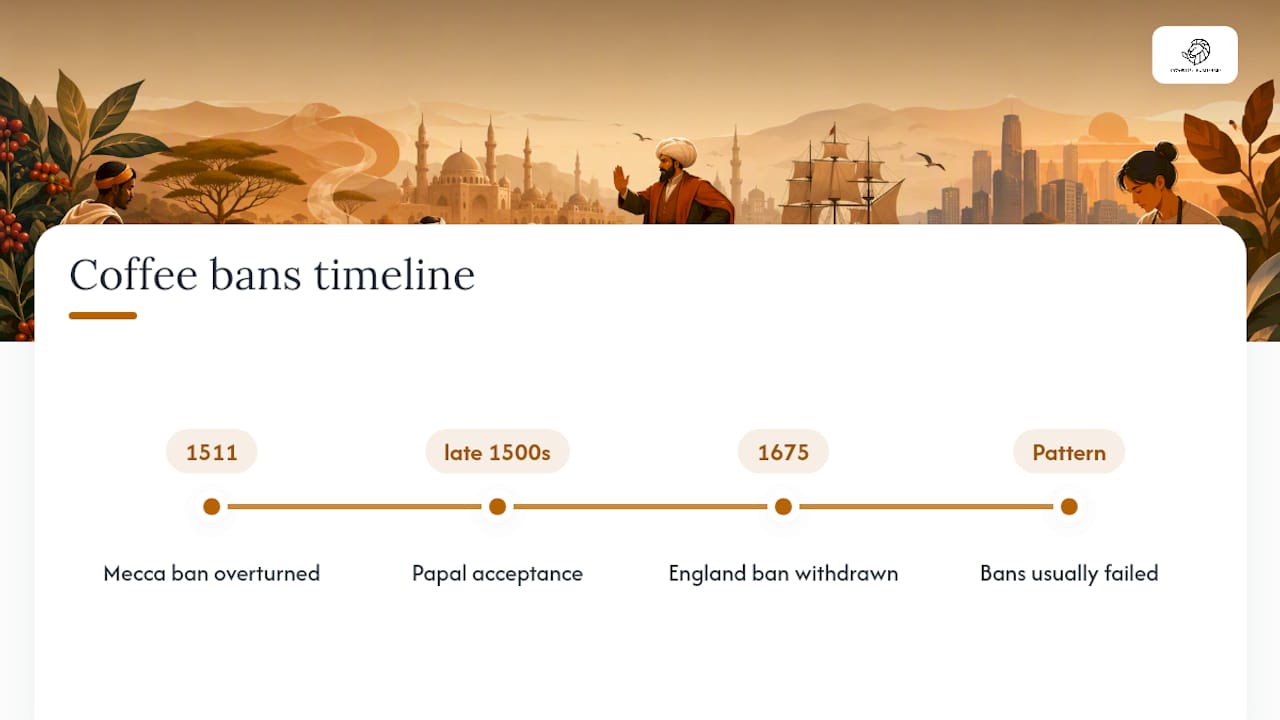
Opposition to coffee appeared almost as soon as the drink did. In 1511, the governor of Mecca, Khair Beg, ordered coffeehouses closed on the grounds that coffee was an intoxicant and that the gatherings it enabled were seditious. The ban was overturned within months by the Ottoman sultan, but it established a pattern: coffee and the spaces it created would face periodic suppression wherever authorities felt threatened by uncontrolled public assembly.
European clergy raised similar objections. When coffee reached Rome in the late 16th century, some Catholic priests petitioned Pope Clement VIII to ban it as "Satan's drink," a beverage of the infidel. According to Britannica's account, Clement reportedly tasted it before deciding, found it too pleasurable to condemn, and gave it his blessing. Whether the anecdote is precisely accurate or somewhat embellished, the papal acceptance it describes was real in its effect: coffee spread through Catholic Europe without serious ecclesiastical opposition.
In England, Charles II attempted to suppress coffeehouses in 1675, issuing a proclamation against them on the grounds that they spread seditious rumors. The proclamation was withdrawn within days, overwhelmed by public resistance. The pattern held across cultures: coffee bans tended to fail because the social demand for coffeehouses was stronger than the political will to enforce closure.
How did coffee shape American culture and the NCA waves framework?
Arrival in the Americas and the colonial period
Coffee reached North America in the mid-17th century, carried by Dutch traders to New Amsterdam (present-day New York). Coffeehouses appeared in Boston and New York by the 1690s, modeled on their London counterparts. For most of the colonial period, however, tea remained the dominant hot beverage among British colonists.
The Boston Tea Party of 1773 changed that calculus. When colonists dumped East India Company tea into Boston Harbor to protest British taxation, drinking tea became a political statement of loyalty to the Crown. Coffee stepped into the gap. The Continental Congress informally designated coffee the patriotic drink, and American consumption shifted decisively. That cultural pivot, driven by politics rather than taste, shaped U.S. coffee habits for generations.
The 19th century and Brazil's influence on American supply
Brazil's rise as the world's dominant producer had direct consequences for American consumers. Falling commodity prices through the 19th century made coffee affordable to working-class households, and by the Civil War era it was a staple of American daily life. Union soldiers received coffee as a ration; accounts from the period describe soldiers grinding beans in the butts of their rifles. The volume of coffee consumed by the Union Army alone was extraordinary by any prior standard.
The late 19th century brought the first major American coffee brands. Folgers was founded in San Francisco in 1850; Maxwell House launched in Nashville in 1892. Both companies built their businesses on consistent, affordable blends sourced from Brazil and other commodity producers, and both used national advertising to turn coffee into a household expectation rather than an occasional treat.
The NCA waves framework explained
The NCA's framework divides modern American coffee culture into three distinct waves, each representing a shift in consumer priorities and industry structure:
-
First wave (roughly 1800s–1960s): Coffee as a functional commodity. The goal was convenience and consistency. Vacuum-sealed cans, instant coffee, and supermarket distribution defined this era. Quality was secondary to availability and price.
-
Second wave (roughly 1960s–2000s): Coffee as an experience. Chain café culture, flavored drinks, and branded environments transformed coffee from a home staple into a social ritual. Consumers began paying attention to roast level and café atmosphere, though origin transparency remained limited.
-
Third wave (roughly 2000s–present): Coffee as a craft product. Roasters and baristas began treating coffee with the same attention given to wine: specific farms, named varietals, documented processing methods, and precise brewing parameters. The third-wave movement placed origin transparency and sensory quality at the center of the consumer relationship. It also connected American coffee culture back to the producing countries in ways the commodity era had obscured.
The waves framework is interpretive rather than strictly chronological; elements of all three coexist in the current market. A diner still serving drip coffee from a commercial urn and a specialty roaster offering single-origin pour-overs are both part of the same national coffee culture, separated by about 150 years of accumulated history.
Key dates in the coffee history timeline
| Approximate Date | Event | Significance |
|---|---|---|
| 9th–15th century | Ethiopian origins | Wild Coffea arabica grows in highland Ethiopia; early consumption of cherry and husk documented |
| 15th century | Yemeni cultivation begins | Sufi orders adopt coffee for devotional use; terraced highland farming established in Haraz and Bani Matar |
| 15th–16th century | Mocha emerges as trade hub | Red Sea port becomes the world's primary coffee export gateway |
| 1511 | Mecca ban | Governor Khair Beg orders coffeehouses closed; Ottoman sultan overturns the ban within months |
| 1554–1555 | First coffeehouses in Constantinople | Qahveh khaneh open in Istanbul; the model spreads to Cairo, Damascus, and Aleppo |
| Late 16th century | Coffee reaches Europe | Venetian merchants introduce coffee to Western Europe; early coffeehouses open in Venice |
| Early 17th century | Pope Clement VIII blesses coffee | Papal acceptance removes ecclesiastical opposition and accelerates European adoption |
| Late 17th century | Dutch plant coffee on Java | VOC establishes plantation cultivation in Indonesia, ending Yemen's effective export monopoly |
| 1720s | Gabriel de Clieu carries seedling to Martinique | Caribbean arabica cultivation begins; the plant becomes the progenitor of much of Latin American coffee |
| 1773 | Boston Tea Party | American colonists shift from tea to coffee as a patriotic statement |
| 19th century | Brazil rises to dominance | Plantation-scale production drives down global prices; coffee becomes a mass-market commodity |
| 1884–1948 | Espresso machine developed | Moriondo, Bezzera, Pavoni, and Gaggia progressively refine the espresso machine |
| 1938 | Nescafé launched | Nestlé's instant coffee reaches mass-market scale; WWII military rations accelerate U.S. adoption |
| 2000s–present | Third-wave specialty coffee | Origin transparency, precision roasting, and craft brewing define the modern specialty movement |
About the author
Keith Lyons is the author of The Complete World of Coffee, a reference work covering the history, science, cultivation, processing, roasting, brewing, espresso, sensory evaluation, and culture of specialty coffee. The research behind this timeline draws on the same scholarly and archival sources that informed the book.
Source selection and the problem of contested dates
Coffee history presents a genuine sourcing challenge. The earliest records are fragmentary, and many widely repeated dates come from secondary compilations rather than primary archives. This timeline prioritizes the following source types:
- Scholarly encyclopedias: The Encyclopaedia Iranica provides the most rigorous treatment of early Arabic-language sources and the qešr/qahwa distinction
- Established reference works: Britannica's history of coffee offers reliable secondary synthesis for European spread and religious controversies
- Industry organizations: The NCA's About Coffee resource documents the waves framework and U.S. consumption history
- Archival visual records: The Library of Congress digital collection holds prints and engravings that corroborate written descriptions of coffeehouse interiors and social scenes
- Cross-check compilations: Sources such as CoffeeVibe's timeline are useful for identifying commonly cited milestones but should be verified against scholarly sources for contested details
How to read contested origin stories
The Kaldi legend is the clearest example of a story that has been repeated so often it has acquired the texture of fact. No contemporary source documents it; the earliest written version appears centuries after the events it supposedly describes. Presenting it as lore, clearly labeled, is the honest approach.
Similar caution applies to precise dates for early Ethiopian use. The highland forests of Kaffa almost certainly supplied coffee long before any written record, but "9th century" is an approximation based on inference, not a date from an archive. Readers who want to verify specific claims can consult the primary sources listed in the Useful Sources section below, as well as the digital collections of the British Library and the Bodleian Library at Oxford, both of which hold relevant manuscript materials.
Why the coffee history timeline still matters today
The timeline of coffee is not merely a sequence of dates. It is a record of how a single plant shaped trade routes, built cities, funded revolutions, and created entirely new forms of social life. The coffeehouse model that emerged in 15th-century Yemen is recognizable in every specialty café operating today. The colonial plantation structures that drove 18th and 19th-century expansion still shape the economic relationships between producing and consuming countries.
For baristas, roasters, and serious coffee drinkers, this history carries practical weight. Understanding that Yemen's Mocha port gave its name to a flavor profile, that Java's Dutch plantations introduced the commodity model, and that the Boston Tea Party helped make coffee an American cultural default — these are not trivia points. They explain why coffee tastes, costs, and means what it does. The specialty coffee revolution of the third wave is, in many respects, a conscious response to the commodity era's flattening of those histories: an attempt to restore origin, labor, and craft to the center of the cup.
The gastronomy world has noticed the same pattern. As current hospitality trends show, coffee's role in food culture has expanded well beyond the beverage itself, influencing menu design, sourcing philosophy, and the broader conversation about where ingredients come from and who grows them.
Deepen your understanding of coffee history
The Complete World of Coffee by Keith Lyons covers the full arc of this timeline in far greater depth, from the earliest Ethiopian records through the science of modern specialty roasting and brewing. For readers who want to go further, the Coffee History Topics hub at Lyons Den Publishers brings together detailed articles on every major era: the Islamic world's role in early coffee culture, the European coffeehouse tradition, colonial-era trade, and the specialty revolution. Each article is written to the same standard of accuracy and depth as this timeline.
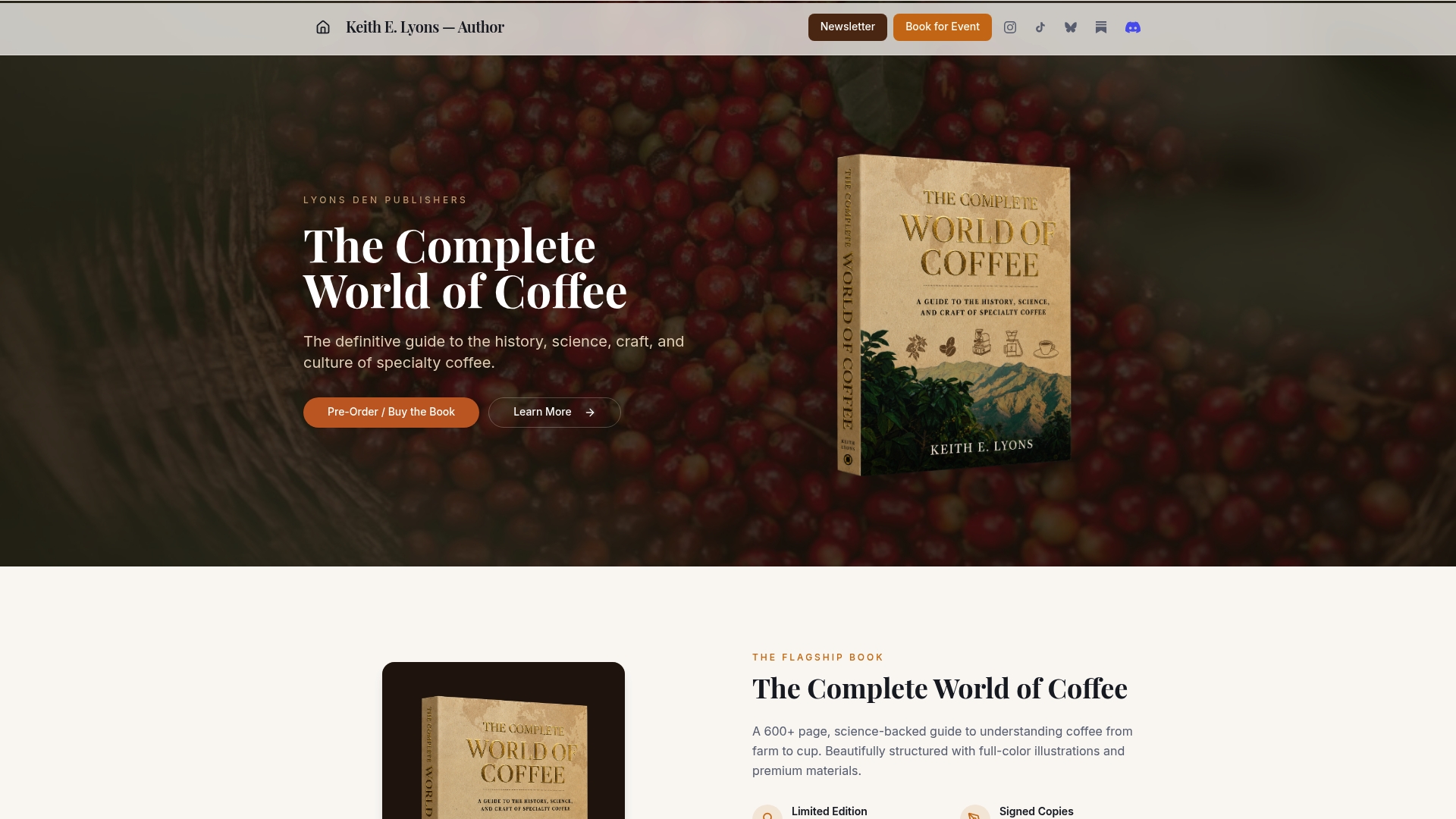
Whether you are a home brewer curious about the origins of your morning cup, a barista building professional knowledge, or a researcher tracing the economic history of a global commodity, the Lyons Den Publishers resource library offers a reliable starting point. Visit the Coffee History Topics hub to read further or explore The Complete World of Coffee for the most comprehensive single-volume treatment available.
Sources
- History of coffee - NCA - About Coffee
- History of coffee - Britannica
- History of coffee - Wikipedia
- COFFEE - Encyclopaedia Iranica
- Library of Congress - digital collection
- The History of Coffee: Timeline - CoffeeVibe